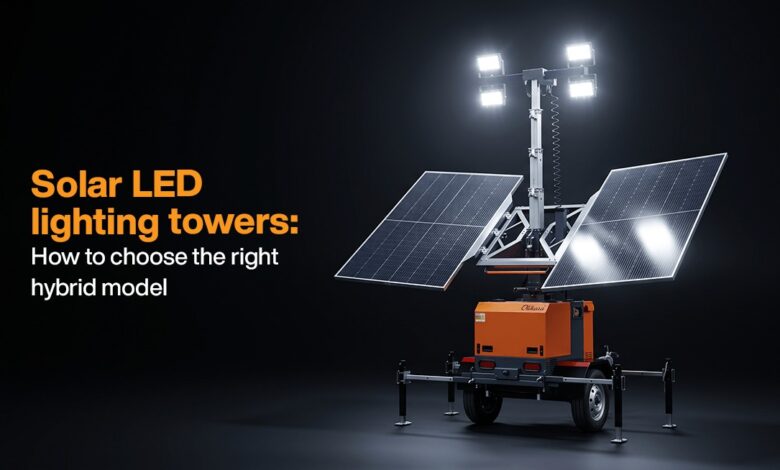

The decision between a solar LED lighting tower and a hybrid model is less about which is “more sustainable” and more about the site’s power architecture.
Solar light towers operate quietly with low emissions. Hybrid systems add conventional power backup for situations where uninterrupted light matters more than full reliance on solar.
The final selection depends on runtime requirements, illumination area, weather, mobility, charging conditions, and downtime repercussions.
Why Hybrid Solar Lighting is Becoming More Relevant
Beyond brightness, temporary lighting is increasingly being assessed for energy efficiency. This is especially useful in remote operations, city works, and railway yards, where the continuous use of conventional power is either not available or too costly.
The broader energy landscape supports this shift. According to the International Energy Agency, solar PV accounted for almost 80% of the expected global renewable-power capacity expansion between 2025 and 2030. The IEA also reported that India’s solar PV generation increased by 25% year-on-year in the first half of 2025.
Solar generation, however, does not ensure constant nighttime lighting for mobile sets. This is where battery storage and hybrid backup become valuable.
Solar vs Hybrid: Understand the Difference First
The solar lighting tower usually consists of photovoltaic modules, a battery bank, and LED fixtures. The battery is charged by the solar energy in the daytime, and the stored energy illuminates the LEDs at night.
A hybrid lighting tower goes one step further by integrating another power source such as an engine-generator alongside battery storage. This helps ensure a more resilient system when there is not enough solar power available or the system needs to run for a longer period.
For example, Olikara’s Qube Solar lighting tower has a 1,100 W solar capacity, using two 550 W bifacial panels, along with a 10.8 kWh battery pack. Its four 100 W LEDs are specified for approximately 10–15 hours of runtime and coverage of around 2,000 sq. m. Its Qube Power Max Hybrid is powered by a diesel engine with a 60-liter diesel fuel tank, backed by a 7.2 kWh battery configuration.
What Should You Evaluate Before Choosing?
1. Start With Required Runtime
Runtime is usually a more critical factor than panel wattage. The amount of solar energy available to power the tower can vary significantly between sunny and cloudy conditions.
For instance, an 8-12 hour nighttime security application could be powered by a solar-battery system. A hybrid arrangement may be suitable for long-duration mining or infrastructure projects where solar charging may not always be sufficient. The secondary power source can support the tower when solar energy is limited, reducing dependence on daily solar charging.
The crucial point is not “How many hours does it run?” but:
- How many hours are required every night?
- How much reserve is needed for poor weather?
- Can the battery recharge adequately during daylight?
- Is backup power available if the battery reaches its operating limit?
2. Match Lighting Coverage to the Work Zone
Practical performance depends on factors such as mast height, beam distribution, fixture arrangement, and the size of the illuminated area.
For example, Olikara’s Qube Solar features a 7 m mast and 4 × 100 W LEDs, with a specified coverage area of approximately 2,000 sq. m. The Qube Power Max Hybrid uses the same 7 m mast but has 6 × 200 W LEDs and a specified coverage area of approximately 4,000 sq. m.
On large worksites, several appropriately sized towers may provide more even coverage and help minimise dark zones and shadows.
3. Examine the Battery, Not Just the Solar Panels
The amount of energy that can be stored for future use depends on the type and size of the battery, whereas the speed at which energy can be produced depends on the size and number of solar panels.
For example, Olikara’s Qube Solar’s 10.8 kWh battery is a good example of a solar-first design. Bifacial panels can capture light from both sides, but the actual performance depends on installation and surroundings. Dimmable LEDs can help adjust light output according to the lighting requirements and available stored energy.
A hybrid configuration changes the calculation. The Qube Power Max Hybrid has a battery system with diesel generation to offer a greater margin of safety where interruption of lights may have a negative impact on productivity and safety for applications.
A Practical Comparison:
| Factor | Solar LED Tower | Hybrid Solar/Battery + Backup |
| Primary energy source | Solar | Solar/battery with conventional backup, depending on configuration |
| Noise during battery operation | Very low | Low when operating on battery; higher during engine operation |
| Emissions during solar operation | None at point of use | Reduced compared with continuous engine operation |
| Weather dependency | Higher | Lower |
| Long-duration operation | Depends on battery and solar recovery | Better suited to extended operation |
| Remote locations | Highly suitable | Highly suitable |
| Fuel requirement | None for solar-only operation | Required when conventional backup is used |
| More Appropriate for | Security, remote lighting, railway yards, smaller work areas | Mining, infrastructure and sites where continuity is critical |
The comparison is better understood in terms of energy independence and operational resilience, rather than as a simple choice between solar and diesel power.
4. Consider Weather and Site Conditions
Solar performance depends on the amount of sunlight. Energy generation can be reduced by dust accumulation, cloud cover, seasonal weather conditions, and incorrect panel orientation.
This is especially true in areas where there is monsoonal weather or longer periods of cloudiness. A solar tower can continue to work even after the energy from the sun has been stored in batteries, but if solar generation is weak for an extended period of time, the amount of energy stored in the battery may be reduced.
When the cost of lighting failure increases, hybrid technology becomes more valuable because disruptions impact activities conducted during the night shift. Thus, procurement teams should examine past weather patterns and not take annual average sunlight as a proxy for nighttime reliability.
5. Consider Mobility and Stability
Power technology is part of the decision-making, but it’s not the only factor when selecting a lighting tower. Towing, lifting, mast deployment, and stability all matter just as much
For instance, Olikara’s Qube Solar has a single wide axle, pneumatic tires, foldable drawbar, center lifting hook and stabilizing jacks, with a 7 m operating height. The Qube Power Max Hybrid similarly incorporates a single axle, pneumatic tires, forklift pockets, a lifting hook and stabilizer system. Both units are rated for stability in wind speeds up to 100 kph.
Conclusion
Solar LED lighting towers are getting more capable, but the right choice depends on which power architecture matches the site’s actual risk tolerance for downtime.
The range of configurations includes solar-focused towers to engine-powered and grid-powered alternatives, demonstrating the versatility of different energy architectures to meet different operational circumstances.
For projects evaluating these options, hybrid light tower manufacturers such as Olikara Lighting Towers provides a useful real-world reference point for comparing solar, hybrid, engine-powered, and grid-powered tower configurations according to actual site requirements.
| Choose the right lighting solution for your project with Olikara.
Contact now! |
FAQs
- Are solar lighting towers suitable for long nighttime operation?
Yes, if the battery capacity, LED load, and solar charging are perfectly matched. Always determine the runtime under the conditions of the worst-case scenario.
- When should I choose a hybrid lighting tower?
A hybrid model is appropriate when uninterrupted power is essential, and the weather or lack of sun may affect the availability of the batteries.
- Are solar LED towers suitable for remote construction sites?
Yes. They are capable of running without needing a permanent grid connection, which makes them well suited for remote worksites, railway yards, security, and infrastructure applications.
- What is more important: solar-panel capacity or battery capacity?
Both matter, but they serve different purposes. The panels replenish the energy, and the battery stores it; the size of the two depends on the required operating cycle.