
Adolescence has always been turbulent, but for some teenagers the emotional swings feel less like waves and more like tsunamis. One moment everything is fine; the next, a small frustration spirals into a crisis. If you have watched a teen you care about struggle to manage big feelings, you have probably wondered whether there is a structured, evidence-based way to actually help. There is, and it has decades of research behind it. This article breaks down how Dialectical Behavior Therapy works, why it was adapted specifically for adolescents, what skills it teaches, and what realistic outcomes look like.
What Dialectical Behavior Therapy Actually Is
Dialectical Behavior Therapy, commonly shortened to DBT, was developed in the late 1980s by psychologist Marsha Linehan at the University of Washington. She originally designed it for adults with borderline personality disorder, a condition marked by extreme emotional instability and impulsive behavior. What Linehan discovered was that standard cognitive-behavioral therapy alone was not enough for people who felt emotions so intensely. The treatment needed to balance two things that seem contradictory: accepting yourself as you are right now, and committing to change. That balance is where the word “dialectical” comes from.
Over time, researchers and clinicians noticed that many of the core challenges DBT addressed, including emotional dysregulation, impulsivity, interpersonal conflict, and self-harm, were also showing up in adolescent populations. A modified version of the treatment was developed in the 1990s specifically for teenagers, and it has since been tested in dozens of clinical trials with strong results across a range of diagnoses.
Why Teenagers Specifically Benefit from This Approach
The teenage brain is a work in progress. The prefrontal cortex, the region responsible for impulse control, long-term planning, and emotional regulation, does not fully mature until the mid-twenties. Meanwhile, the limbic system, which drives emotional responses, is already running at full capacity. That neurological mismatch means adolescents are literally wired to feel emotions more intensely and to act on them before thinking things through.
DBT meets teenagers where their brains actually are. Rather than asking a teen to simply “calm down” or “think before you act,” it gives them concrete, learnable skills that substitute for the regulatory capacity their brains have not yet fully built. That practical orientation is a big part of why the approach resonates with young people who have often been told what not to do without being taught what to do instead.
Research backs this up. A 2015 randomized controlled trial published in the Journal of the American Academy of Child and Adolescent Psychiatry found that adolescents who received DBT showed significantly greater reductions in suicidal ideation, self-harm, and depression compared to those who received standard supportive therapy. The sample included teens with histories of self-harm and multiple psychiatric diagnoses, a population that is notoriously difficult to treat.
The Four Core Skill Modules
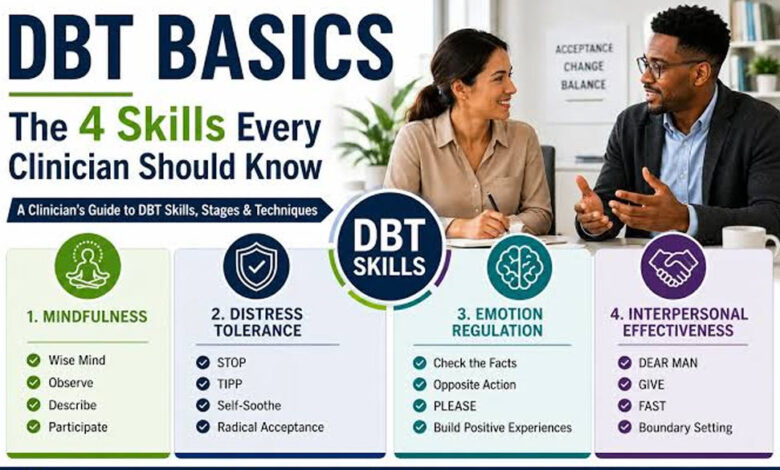
DBT is organized around four interconnected skill sets. Each module targets a different dimension of the emotional and behavioral challenges teens often face. Understanding what each module covers helps explain why the treatment works across such a wide range of presenting problems.
| Skill Module | Core Goal | Example Skills |
| Mindfulness | Build awareness of thoughts and feelings without judgment | Observe, describe, participate; one-mindfully focusing |
| Distress Tolerance | Survive crisis moments without making things worse | TIPP (Temperature, Intense exercise, Paced breathing, Progressive relaxation), distraction techniques |
| Emotion Regulation | Understand and reduce the intensity of painful emotions | Identifying emotions, opposite action, checking the facts |
| Interpersonal Effectiveness | Maintain relationships while respecting your own needs | DEAR MAN, GIVE, FAST skill sequences |
Mindfulness is the foundation that all the other modules rest on. A teenager who cannot observe their own emotional state has almost no chance of regulating it. The mindfulness component in DBT is practical rather than spiritual; it focuses on noticing what is happening internally without immediately reacting. Distress tolerance skills are designed for moments when the emotional pain is so acute that any intervention aimed at long-term change feels impossible. The goal is survival without making the situation worse. Emotion regulation goes deeper, teaching teens to identify what they are feeling, understand its source, and shift it over time. Interpersonal effectiveness rounds out the package by addressing the relational friction that so often triggers emotional crises in the first place.
What Treatment Actually Looks Like
Standard DBT for adolescents typically combines individual therapy sessions with a multi-family skills training group. The group component is a distinctive feature that sets DBT apart from most other therapeutic models. Parents or caregivers attend alongside their teens and learn the same skill sets, which dramatically reduces the chance that a teenager goes home from a session and has no support system that speaks the same language.
When a clinician specializes in DBT for teens, they also provide phone coaching between sessions, which gives adolescents a way to get real-time support during crises rather than waiting until the next appointment. This is a critical piece of the model. Emotional crises do not schedule themselves for Tuesday afternoons at 3 p.m. Having access to a coach who can walk a teen through a skill in the moment significantly reduces the gap between learning something in a session and actually using it when it counts.
A full course of DBT for adolescents typically runs between 16 and 24 weeks, though this can vary depending on the teen’s needs and the treatment setting. Some programs offer a condensed format; others extend the duration for more complex presentations. The structure is intentionally more time-limited than open-ended therapy, which tends to appeal to both teenagers and their families.
Conditions Where DBT Shows Strong Results
DBT was not built for a single diagnosis; it was built for a pattern of emotional dysregulation that cuts across many diagnoses. That breadth is one of its most useful features. The following conditions have a solid evidence base supporting DBT as an effective treatment option for adolescents.
- Non-suicidal self-injury (such as cutting or burning)
- Suicidal ideation and repeated suicide attempts
- Borderline personality disorder features or diagnosis
- Major depressive disorder with emotional dysregulation
- Eating disorders, particularly binge-eating and bulimia
- Substance use disorders co-occurring with emotional dysregulation
- Post-traumatic stress disorder with impulsive behavior patterns
- Anxiety disorders when avoidance and emotional flooding are central features
It is worth noting that a teen does not need to meet full diagnostic criteria for any of these conditions to benefit from DBT skills. Many adolescents who struggle with emotional volatility, peer conflict, or impulsive decision-making find the skill modules genuinely useful even outside a formal clinical context. School-based DBT programs have been piloted in several states and shown promising results for general student populations, not just those with clinical diagnoses.
How to Tell If DBT Might Be the Right Fit
Every teenager is different, and no single treatment works for everyone. That said, certain patterns suggest DBT is worth exploring seriously. A teen who repeatedly ends up in crisis despite previous therapy, who struggles to apply coping strategies under pressure, who has a history of self-harm or suicidal behavior, or whose emotional reactions consistently feel disproportionate to the situation is likely dealing with the kind of emotional dysregulation that DBT was specifically designed to address.
Family dynamics matter too. Because the adolescent DBT model is built around family participation, families that are willing to engage with the process tend to see better outcomes. That does not mean the family has to be functioning perfectly before treatment starts. In fact, DBT skills training often helps parents and caregivers manage their own emotional reactions to their teen’s behavior, which can itself reduce household tension and break cycles of conflict.
If you are unsure whether DBT is the right approach, a thorough intake assessment with a clinician trained in the model is the clearest path to an answer. A good evaluator will look at the full picture: the teen’s history, current symptoms, family environment, and treatment goals. They will also be honest if a different modality might be a better starting point. DBT is powerful, but it works best when it is the right tool for the actual problem at hand.
Teenagers are capable of remarkable change when they are given the right skills and the right support. DBT does not promise an easy road, but it does offer a concrete, structured path toward a life that feels more manageable. For many adolescents, that is exactly what they need to get started.