How Does Long Range Ultrasonic Testing (LRUT) Inspect Miles of Pipe From a Single Access Point?

A pipe that sits under a road, inside a sleeve, or under thick insulation is hard to check by normal means. Crews would have to dig it up or strip it bare, and on a long line that gets expensive fast. So when plant managers compare pipeline inspection services, Long Range Ultrasonic Testing (LRUT) usually comes up early in the conversation.
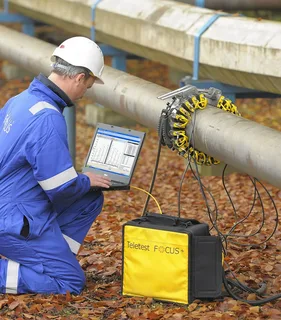
In practice, it works a little differently than the name suggests. LRUT can’t look at miles of pipe from one spot. Technicians clamp a ring of sensors around the pipe at one exposed location, and the ring sends low frequency sound waves down the pipe wall, both ways at once. Anything that changes the wall, like a corroded patch, a weld or a pipe support, sends some of that sound back. On a good day, one setup might cover a couple hundred feet in each direction. On a bad one, maybe 20 or 30 feet. The “miles” figure in brochures comes from moving the ring to new spots again and again until the whole line is covered.
What Happens During an LRUT Test
Plenty of sites that already book tank integrity inspection services add LRUT for the transfer lines running into and out of their tanks, since those lines often corrode in the same places. Out in the field, the job itself isn’t complicated. A small strip of coating or insulation gets removed, usually not more than a foot or two wide. The ring goes on, the signals go out, and a computer records every echo along with how far away it came from.
The more difficult thing to do is read the data. Welded joints and flanges produce very clear and well-defined echoes that one anticipates seeing from a professional analysis point of view. Corrosion will be depicted in terms of something smaller and less defined. The indications will then be classified either as minor, moderate, or severe, so the owner knows which spots to look at first.
Why Owners Like It
The appeal is easy to understand. LRUT lets a team screen pipe that’s otherwise very hard to reach, such as:
- road and rail crossings
- lines passing through walls or dikes
- insulated runs on pipe racks
- buried sections where digging is costly
Some sites also leave sensor rings permanently installed, then retest every year or two and compare the readings. That makes slow changes easier to spot.
Where LRUT Runs Into Trouble
Most of the marketing around LRUT stops at the range. What gets talked about less is everything that cuts that range down.
Bends. The wave can get through an elbow, but it comes out the other side scrambled. One bend is usually manageable. After two, the readings are hard to trust, so a twisty line needs more test points.
Welds and fittings. Every weld bounces back a bit of the signal and soaks up a bit more. On pipe welded every 20 or 40 feet, that adds up quickly. Flanges, tees and valves are worse, and most of the time the test simply ends at them. There’s also a quieter problem. Corrosion sitting right beside a weld can get buried inside the weld’s echo and never show up.
Coatings. Paint and thin epoxy barely matter. Thick bitumen, wax tape or heavy wrap is another story, since it eats wave energy. A line that would give 200 feet bare might only give 30 or 40 with that kind of coating.
Soil. Buried pipe loses signal into the ground around it. Wet, packed clay is about as bad as it gets, while dry sand is much kinder. Pipe set in concrete can be worse still.
The spot right under the ring. Close to the sensors, the outgoing pulse drowns out any echo. That short dead zone has to be checked some other way.
What the Report Won’t Tell You
LRUT Report: This type of report consists of suspect areas rather than a dimension of pipe. There will not be an inch wall thickness reading in an LRUT report. It is not very effective in detecting individual deep pits, as a deep pit alone cannot create enough metal removal to produce reflection of sound waves. Slow and gradual thinning over a great distance cannot also be detected due to no sharp discontinuity.
A few other gaps worth knowing:
- It usually can’t say whether corrosion is on the inside or outside of the pipe.
- Thin cracks running along the length of the pipe are hard for it to pick up.
- It can’t decide whether the pipe is fit for service. That takes real thickness data and an engineer’s review.
In decent conditions, most systems pick up metal loss of roughly 5 to 10 percent of the pipe’s cross section. Anything smaller may not register. So a clean result means nothing big turned up in the range that was tested. It isn’t proof the pipe is in perfect shape.
Getting Real Value From the Test
LRUT does its best work as a first pass. It takes a long line and shrinks the problem down to a few places worth digging or stripping. Inspectors then go to those exact spots with thickness gauging, phased array UT, or a plain visual check to see what’s really there.
Before signing off on pipeline inspection services that include LRUT, it helps to ask the provider:
- how much range they expect on this particular line, given its coating and soil
- how many test locations the full length will need
- which bends, valves or flanges will cut a test short
- what follow up testing is included once something gets flagged
A provider who answers these plainly, limits and all, usually knows the method well. And at sites where tanks and their piping share the same corrosion risks, it makes sense to plan LRUT alongside tank integrity inspection services, so the whole system gets checked together instead of in pieces.
Final Thoughts
LRUT is genuinely useful, but it’s a screening method with real limits. Bends, welds, coatings and soil all shrink how far it can see, and the results still need checking up close. Interspec LLC works with facility owners on tank and piping inspections and can help set up screening and follow up testing that fits the actual condition of the site.
Frequently Asked Questions
- What is the range of visibility for LRUT at one point?
In case of a straight pipe without coating, the range can be about two hundred feet in each direction. Coating, burial, bendings and other factors may reduce the range to 30 feet and even less.
- Does LRUT measure wall thickness?
No. It shows where the pipe wall changes and gives a rough idea of how serious that change looks. Actual thickness has to be measured afterward with ultrasonic gauging or phased array testing at those spots. - Is LRUT applicable to buried pipes?
Yes, but the range will be greatly reduced due to absorption of the signal by soil and thick coatings. Moist clay and concrete coating cause the greatest loss of signal.
- How does the weld and the bend restrict the test?
Every weld reflects some part of the wave while absorbing some, hence causing the range to keep reducing along the line. The bend distorts the wave such that after one or two bends, the reading becomes unreliable.
- When nothing shows up on the LRUT, does it mean that the pipe is free from corrosion?
No, because it simply means that nothing has been found in the range tested. There may be small pitting, gradual thinning and damage near welds or beneath the sensing ring.