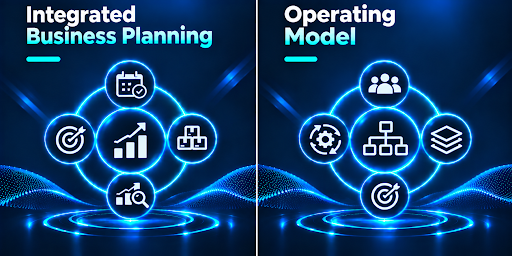
Integrated Business Planning and Operating Model Design: Bridging the Gap Between Strategy and Execution

A business may have an ambitious growth strategy, a detailed financial plan and sophisticated demand forecasting capabilities, yet struggle to achieve its performance objectives. The problem often lies in how departments coordinate decisions, allocate resources and respond to changing business conditions.
Integrated business planning helps organizations address this disconnect by aligning financial, commercial and operational priorities. However, its effectiveness depends on an operating model that establishes clear responsibilities, decision rights and mechanisms for cross-functional collaboration.
Together, these disciplines help organizations move from fragmented planning toward coordinated execution, where strategic objectives influence everyday business decisions.
Why disconnected planning creates business problems
Different departments frequently develop plans based on their individual performance objectives. Sales teams focus on revenue growth, procurement seeks favorable purchasing conditions, and supply chain teams manage inventory and production capacity. Finance must reconcile these priorities with profitability and cash flow expectations.
When these plans are developed independently, conflicting assumptions can lead to resource shortages, excess inventory or unrealistic financial projections.
Integrated business planning establishes a common framework for evaluating these competing priorities. A well-designed operating model supports this framework by clarifying how departments collaborate, resolve conflicts and take responsibility for collective outcomes.
What is integrated business planning?
Integrated business planning (IBP) is a management discipline that aligns strategic, financial and operational planning across an organization. It connects demand forecasts, supply capabilities, financial projections and resource requirements to support coordinated business decisions.
Unlike traditional planning approaches that concentrate on individual functions, IBP evaluates how decisions in one area affect performance elsewhere.
For example, a proposed sales promotion may increase revenue but also require additional inventory, production capacity and working capital. Evaluating these implications together enables leadership teams to make better-informed decisions about expected profitability.
What is an operating model?
An operating model defines how an organization structures its people, processes, technology, governance and resources to deliver its business strategy.
It establishes how work is performed, how decisions are made and how responsibilities are distributed across departments.
Within a planning environment, the model determines who owns forecasts, how competing priorities are resolved and which leaders authorize changes to resource allocation.
Without these arrangements, even sophisticated planning capabilities may produce recommendations that are difficult to execute.
How integrated business planning connects strategy with execution
The relationship between strategic planning and operational execution becomes particularly important when business conditions change.
Consider a consumer goods manufacturer experiencing stronger-than-expected demand for a product. Sales may recommend increasing availability, while manufacturing identifies capacity constraints and finance raises concerns about additional production costs.
Integrated business planning brings these perspectives together so leadership can evaluate the commercial opportunity against operational feasibility and financial implications.
The operating model determines how this evaluation takes place, who makes the final decision and how approved changes are communicated to the teams responsible for execution.
This connection helps prevent strategic decisions from becoming disconnected from operational realities.
Four organizational capabilities that make planning effective
Shared business assumptions
Departments need consistent assumptions about demand, pricing, costs and available resources. Differences in underlying assumptions can undermine the reliability of enterprise plans, even when individual forecasts appear reasonable.
Cross-functional decision-making
Integrated business planning requires leaders to evaluate trade-offs across departmental boundaries. Decision-making forums should focus on resolving material business issues rather than simply reviewing performance reports.
Clear accountability
An effective operating model establishes ownership for planning activities, performance commitments and corrective actions. Employees should understand which decisions they can make independently and which require broader approval.
Connected information and technology
Planning systems must provide reliable information across finance, sales, procurement and supply chain operations. Consistent data definitions and secure integration help departments evaluate business conditions from a common perspective.
How planning decisions influence enterprise performance
The value of coordinated planning can be observed across several areas of business performance.
| Business area | Contribution of coordinated planning |
| Financial performance | Aligns revenue expectations, operating costs and profitability targets |
| Supply chain | Balances demand, inventory and production capacity |
| Working capital | Connects purchasing and inventory decisions with cash requirements |
| Workforce management | Aligns staffing capacity with operational demand |
| Procurement | Coordinates supplier commitments with business requirements |
| Commercial operations | Evaluates sales opportunities against delivery capabilities |
Integrated business planning allows organizations to examine these relationships collectively. Rather than pursuing isolated departmental improvements, leaders can assess which decisions create the strongest overall business value.
Why planning technology alone cannot solve organizational problems
Advanced planning platforms can improve forecasting, scenario analysis and performance visibility. However, technology cannot independently resolve conflicting incentives, unclear responsibilities or ineffective governance.
An organization may have reliable demand forecasts but still experience inventory shortages because purchasing decisions are delayed or production priorities are inconsistent.
Redesigning the operating model can address these structural challenges by establishing appropriate decision-making authority and improving coordination between planning and execution teams.
Technology becomes an enabling capability within this structure rather than a substitute for effective management.
The role of AI in modern business planning
Artificial intelligence is expanding the capabilities available to enterprise planning teams.
Predictive analytics can identify demand patterns, estimate resource requirements and highlight potential risks. Generative AI can summarize planning exceptions, explain forecast changes and improve access to relevant business information.
AI agents may also support approved workflows by retrieving information, coordinating planning activities and escalating significant deviations.
Within integrated business planning, these capabilities can help leaders evaluate changing conditions more efficiently.
However, the operating model must establish boundaries for AI-supported decisions, including authorization requirements, data access permissions and human accountability.
Measuring whether planning improvements create business value
Organizations should evaluate planning effectiveness through operational and financial outcomes rather than the number of planning meetings or reports produced.
Relevant measures include:
- Demand forecast error and forecast bias.
- Inventory carrying costs and working capital requirements.
- Customer order fulfillment and service performance.
- Production capacity utilization.
- Financial forecast variance.
- Time required to resolve planning exceptions.
- Alignment between planned and actual profitability.
The success of integrated business planning depends on whether these measures improve through better coordination and decision-making.
Operating model effectiveness should also be assessed through decision speed, accountability and the ability to implement approved changes consistently.
Frequently asked questions
Is IBP the same as sales and operations planning?
No. Sales and operations planning primarily aligns demand and supply. IBP extends this approach by incorporating financial planning, strategic priorities and broader enterprise resource requirements.
Can organizations implement IBP without organizational redesign?
Organizations can introduce planning capabilities within existing structures. However, unclear ownership and fragmented decision-making may limit their effectiveness. Changes to the operating model may be necessary to achieve sustainable improvements.
Who should own enterprise planning?
Enterprise planning requires executive sponsorship and shared accountability across finance, commercial and operational functions. Individual responsibilities should reflect the organization’s structure and business priorities.
Conclusion
Integrated business planning provides organizations with a framework for aligning strategic ambitions, financial expectations and operational capabilities. An effective operating model ensures that this alignment influences how decisions are made and executed.
The greatest value emerges when planning becomes an ongoing management discipline rather than a periodic reporting exercise. Organizations that connect reliable information, cross-functional accountability and intelligent technology can respond more effectively to changing conditions while maintaining financial discipline and operational performance.