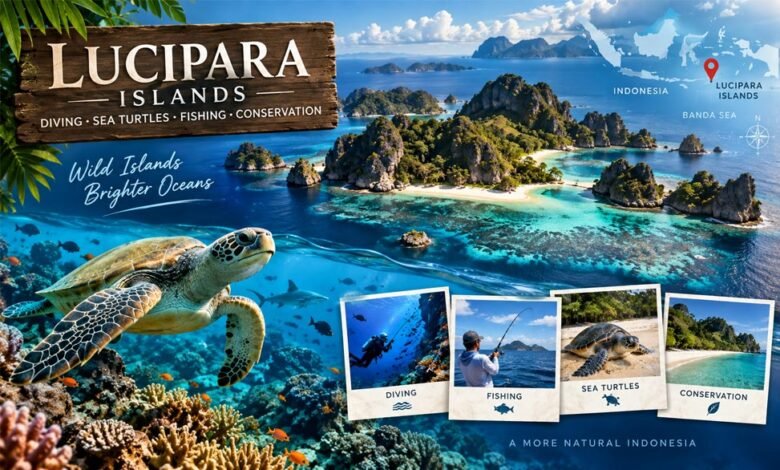

The Lucipara Islands are a remote group of small islands, reefs, and coral atolls in Indonesia’s Banda Sea. They are known for clear water, coral reefs, sea turtles, diving, fishing, and very limited development.
People often search for Lucipara to learn where the islands are, how to visit them, and what marine life lives there. This guide covers their location, underwater landscape, diving, wildlife, fishing, history, and conservation.
Where Are the Lucipara Islands?
The Lucipara Islands are in the central Banda Sea in eastern Indonesia. They belong to the Maluku Islands region, historically known as the Moluccas. The area is also part of the wider Coral Triangle, which is known for its rich marine biodiversity.
Lucipara lies far from Indonesia’s main tourist areas. Ambon is commonly used as a starting point for boat expeditions. One expedition report placed Lucipara about 200 kilometers from Ambon, although the exact travel distance depends on the route.
The remote location is an important part of Lucipara. Unlike Bali and other popular Indonesian destinations, there are few visitors and almost no normal tourist services.
Why Are the Lucipara Islands So Remote?
There are no major towns, airports, resorts, or regular tourist ferry terminals on the Lucipara Islands. Reports also describe the islands as having no permanent local population.
Some families reportedly have traditional connections to the islands and have visited them to collect coconuts. However, there is no normal tourism community where visitors can easily find accommodation, food, transport, or supplies.
Reaching Lucipara requires a long sea journey. One expedition reportedly took about 15 hours from Ambon. The actual time can change depending on the boat, route, wind, waves, and currents.
Weather also limits access. Boats normally plan trips around suitable Banda Sea conditions, especially because the crossing passes through open water.
The Underwater Landscape Around Lucipara
The Lucipara Islands look small above the sea, but much larger structures lie underneath them. Expedition reports describe the islands as the tops of underwater mountains rising from the deep ocean floor.
This creates steep reef walls and sudden drop-offs. A shallow coral reef can quickly give way to very deep blue water.
Currents move around these reefs and underwater ridges. They carry nutrients and small marine life, which can attract larger fish.
This mix of shallow coral, steep walls, currents, and deep water helps explain why Lucipara supports both reef animals and larger open-water species.
Diving Around the Lucipara Islands
Scuba diving is one of the main reasons people visit Lucipara. Dive sites can include coral gardens, steep walls, underwater ridges, and deep drop-offs.
Reports from the area describe healthy hard coral and clear water. Divers may encounter sea turtles, reef sharks, giant trevally, barracuda, tuna, triggerfish, and schools of smaller reef fish.
Night diving can offer something different. Flashlight fish (Photoblepheron bandanensis) have been reported on Banda Sea dives. These fish have light-producing organs below their eyes that create a visible glow in dark water.
Marine sightings are never guaranteed. The animals present on a particular dive depend on currents, season, depth, weather, and natural movement.
Is Lucipara Suitable for Beginner Divers?
Lucipara is not an ideal place for someone taking their first dives. Some sites can have strong currents, deep walls, and open-ocean waves. The islands are also far from hospitals, ports, and other emergency services.
Divers should be comfortable controlling their buoyancy and diving in moving water. Knowing how to use a surface marker buoy is also useful for drift dives.
Beginners may still be able to dive at calmer sites when conditions allow and when closely supervised by an experienced guide. More difficult sites are better suited to experienced divers.
The liveaboard is also important for safety. A well-prepared boat should have emergency oxygen, first-aid supplies, reliable communication equipment, and suitable emergency procedures.
Sea Turtles and Nesting Beaches
Sea turtles are one of Lucipara’s most important natural features. Green turtles and hawksbill turtles have both been reported around the reefs and beaches.
A particularly interesting record comes from a 2019 visit by marine scientist Lida Pet Soede. According to the expedition report, 470 green and hawksbill turtles were recorded during 14 snorkel sessions. More than 80% of the sightings were green turtles.
These figures describe observations made during that expedition. They should not be treated as the total number of turtles living around Lucipara.
Turtle nesting tracks have also been reported on the islands’ sandy beaches. These quiet beaches can provide important nesting areas away from large settlements.
Even remote beaches face threats. Plastic bottles, fishing gear, bags, and other waste can arrive through ocean currents. Visitors should avoid touching turtles, disturbing nests, using bright lights near nesting animals, or leaving rubbish behind.
Sharks, Reef Fish, and Other Marine Life
Lucipara supports a wide range of marine animals. Blacktip reef sharks and grey reef sharks have been reported around its reefs.
Larger fish may include giant trevally, dogtooth tuna, barracuda, snapper, grouper, triggerfish, and other predators. Smaller reef fish live around the coral gardens and shallow reef areas.
Sharks and large predatory fish are an important part of a healthy marine food web. Their presence can also make Lucipara interesting for experienced divers and marine researchers.
The exact animals visitors see will vary. Tide, current, season, water depth, and normal wildlife movement all affect sightings.
Blue Whales and the Wider Banda Sea
The wider Banda Sea is also associated with blue whales. Some reports connect waters near Lucipara with whale movements through this part of Indonesia. One of the supplied sources specifically notes blue whales in or near the region.
However, it is important to separate records for the wider Banda Sea from confirmed sightings directly beside the Lucipara Islands. A visitor should not expect to see a blue whale simply because they travel there.
If whales are encountered, boats should keep a safe distance. They should not chase, block, feed, or surround the animals.
Fishing Around Lucipara
Lucipara is also visited by saltwater anglers. Its reef edges, shallow flats, channels, currents, and deep water provide different fishing conditions.
Giant trevally, often called GT, is one of the best-known target fish. It is a strong predator commonly found around reef edges and current lines.
Other reported species include dogtooth tuna, yellowfin tuna, barracuda, triggerfish, coral trout, snapper, grouper, and bluefin trevally. Fishing reports from the region show that the exact catch can vary greatly.
Tides are important. Changes in water movement can affect where baitfish gather and when larger predators become active.
Popping, Jigging, and Saltwater Fly Fishing
Several fishing methods are used around Lucipara.
Popping uses surface lures to attract powerful fish such as giant trevally. Jigging is generally used in deeper water around reef edges and underwater structures where tuna and other predators may feed.
Saltwater fly fishing can take place around shallow flats. Anglers may look for giant trevally and triggerfish moving through clear water.
Strong equipment is important because large fish can quickly move toward coral and break the line. Heavy-duty reels, strong leaders, spare line, and suitable rods may be needed.
Local or expedition guides can also help anglers understand tides, channels, and safer fishing areas. Reef flats can contain sharp and uneven coral, so suitable footwear is important.
Responsible Fishing
Fishing in a remote ecosystem needs to be handled carefully. Visitors should follow all current Indonesian and locally applicable fishing rules, including any restrictions within protected areas.
Catch-and-release can reduce pressure on some sport fish. When releasing a fish, handling should be kept short and the animal should be supported properly. Barbless hooks can sometimes make release easier.
Anglers should never fish in closed areas or disturb turtle nesting beaches and other sensitive habitats.
Responsible fishing is especially important at Lucipara because its healthy reefs and marine wildlife are the main reasons people travel so far to experience the area.
How to Visit Lucipara
The Lucipara Islands are too remote for a normal day trip. Most visitors reach them by liveaboard, charter boat, or an organized sea expedition.
Ambon is a common starting point. One reported expedition took about 15 hours by boat from Ambon. Travel time can be shorter or longer depending on the boat, route, weather, and sea conditions.
Choose an operator that knows the Banda Sea well. The crew should understand local currents, weather, navigation, and emergency procedures.
What Is a Lucipara Liveaboard Trip Like?
A liveaboard is a boat where travelers sleep, eat, and travel between diving or fishing sites. This makes it useful for Lucipara because there are very few visitor services on the islands.
The boat normally carries food, drinking water, fuel, safety equipment, and other supplies. Dive liveaboards also carry diving equipment and support staff.
Trips may last several days and can include other places in the Banda Sea, such as the Banda Islands. Routes can change if strong winds, waves, or currents make an area unsafe.
Because there are no normal shops nearby, travelers should bring important personal items before leaving Ambon.
Best Time to Visit Lucipara
Weather in the Banda Sea is strongly affected by monsoon patterns. One expedition operator describes May to November as the generally drier period and December to April as wetter for the wider region.
For Banda Sea diving, October to December and March to April are also reported as useful travel periods. However, these dates do not guarantee good conditions at Lucipara.
Wind, waves, currents, and visibility can change. It is best to choose travel dates with an experienced operator that regularly works in the area.
What to Pack for a Lucipara Trip
Packing carefully is important because replacing forgotten items may be difficult after leaving Ambon.
Useful items can include a sun hat, sunglasses, rain jacket, dry bag, reusable water bottle, reef-safe sunscreen, motion-sickness medicine, personal medicines, basic first-aid items, and suitable water or reef shoes.
Divers should bring any personal dive equipment they need, including small spare parts such as mask straps. Anglers may need spare line, leaders, and other fishing equipment.
Travelers should also carry suitable travel and medical insurance documents. The policy should match the activities planned during the trip.
The Willem I Shipwreck of 1837
Lucipara also has an interesting maritime history. In May 1837, the Dutch steamship Willem I reportedly struck a reef while traveling toward Ambon.
Historical accounts say around 140 people were involved, including passengers, soldiers, crew, and acting Moluccas governor François Vincent Henri Antoine de Stuers and his family.
The survivors reportedly spent 37 days on a small dry part of the reef before being rescued. Historical records also report that De Stuers’ wife gave birth to a daughter during this period.
These details come from historical accounts of the event. Exact passenger numbers and some details can differ between records, so they should be presented with that context.
Conservation Around the Lucipara Islands
Lucipara is important for marine conservation because of its coral reefs, turtle nesting beaches, sharks, reef fish, and other marine life.
Conservation groups, government bodies, and local stakeholders have worked on marine protection in the area. Some reports describe a protected framework covering more than 380,000 hectares. However, the exact current protected status, boundaries, and area should be checked against official Indonesian records before treating this figure as final.
Conservation does not always mean stopping every human activity. Protected areas can use different zones for tourism, fishing, research, and stronger habitat protection.
Local communities are also important. Their knowledge of the surrounding waters and their interest in healthy fisheries can support long-term protection.
Environmental Threats
Being remote does not protect Lucipara from every environmental problem.
Plastic and other rubbish can travel long distances through ocean currents and reach isolated beaches. This can be especially harmful around turtle nesting areas.
Illegal or destructive fishing can reduce fish populations and damage coral. Anchors dropped directly onto reefs can also break coral that may take years to recover.
Climate change creates another risk. Higher ocean temperatures can contribute to coral bleaching, while storms and strong waves can damage shallow reefs and nesting beaches.
Poorly managed tourism could add more pressure through waste, careless diving, wildlife disturbance, and boat activity.
Responsible Tourism in Lucipara
Visitors can help reduce their impact on the Lucipara Islands.
Divers should control their buoyancy and avoid touching or standing on coral. Boats should avoid dropping anchors onto healthy reefs when safer mooring options are available.
All rubbish should stay on the boat until it can be disposed of properly. Visitors should never chase, feed, touch, or surround turtles, sharks, whales, or other wildlife.
Extra care is needed around turtle nesting beaches. Bright lights, noise, and unnecessary activity can disturb nesting turtles.
Visitors should also follow current local rules for diving, fishing, wildlife viewing, and protected areas.
Why Lucipara Matters
Lucipara combines coral reefs, deep ocean, isolated islands, turtle nesting areas, and habitats used by many marine species.
Remote reefs can also be useful for scientific research. Researchers can study coral health, fish populations, and environmental changes in places with less coastal development.
However, isolation alone cannot protect an ecosystem. Fishing pressure, plastic pollution, warming seas, and uncontrolled tourism can still reach remote places.
Protecting Lucipara therefore requires cooperation between government agencies, communities, researchers, conservation groups, tourism operators, and visitors.
Bottom Line
The Lucipara Islands are a remote group of islands and reefs in Indonesia’s Banda Sea. They are mainly known for diving, sea turtles, coral reefs, fishing, marine wildlife, and their isolated location.
Visiting is very different from taking a normal island holiday. There are few tourist facilities, and reaching the area usually requires a liveaboard or organized expedition.
Lucipara’s reefs and nesting beaches also have conservation value. Anyone visiting should follow local rules and treat the marine environment carefully.
Frequently Asked Questions
Where are the Lucipara Islands?
The Lucipara Islands are in the Banda Sea, Indonesia. They are part of the Maluku Islands region.
How do you get to Lucipara?
Most people travel from Ambon by liveaboard or expedition boat. There are no regular tourist ferries.
Can you stay on the Lucipara Islands?
There are no normal hotels or resorts. Most visitors stay and sleep on a liveaboard boat.
Is Lucipara good for scuba diving?
Yes. Lucipara has coral reefs, deep walls, turtles, sharks, and many fish. Some sites have strong currents.
What sea turtles live around Lucipara?
Green turtles and hawksbill turtles are found around Lucipara. Some beaches are also used for nesting.
What fish can you catch around Lucipara?
Anglers may find giant trevally, tuna, barracuda, triggerfish, snapper, grouper, and other reef fish.
When is the best time to visit Lucipara?
The best time depends on weather and sea conditions. Liveaboard operators usually choose safer months for trips.
Are the Lucipara Islands protected?
Conservation and marine protection efforts have been reported around Lucipara. Current protection rules can change.
Classroom15X for Students: Games, Access, Safety, and Alternatives
BotPower Complete Guide: IMVU Tools, Tracking, Pricing, and Safety