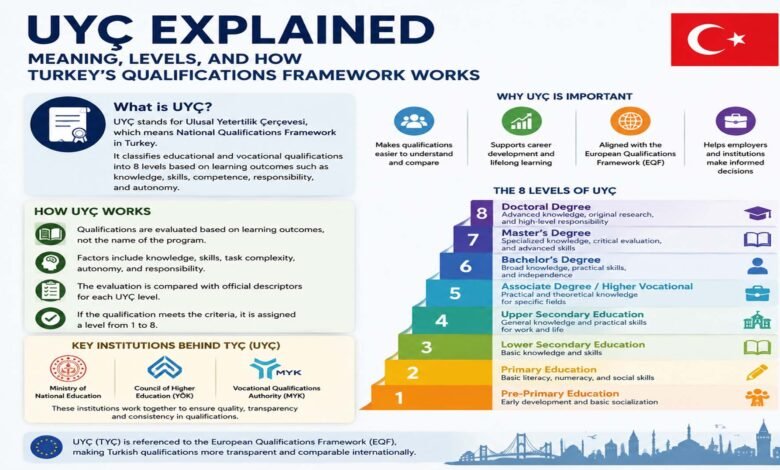
UYÇ Explained: Meaning, Levels, and How Turkey’s Qualifications Framework Works

If you have seen the term UYÇ while researching education or professional qualifications in Turkey, you may wonder what it means and how it works. UYÇ is related to Turkey’s national qualifications system, which helps organize academic and vocational qualifications based on learning outcomes and skill levels.
People often search for UYÇ to understand qualification levels, compare certificates and degrees, or learn how Turkish qualifications relate to international frameworks. This article explains what UYÇ is, how it works, how it connects with the Türkiye Qualifications Framework (TYÇ) and the European Qualifications Framework (EQF), and why it is important for students, employers, and education providers.
What Is UYÇ?
UYÇ stands for Ulusal Yeterlilik Çerçevesi, which translates to National Qualifications Framework in English. It is a framework developed to classify educational and vocational qualifications according to clearly defined learning levels rather than simply by the name of a certificate or degree.
The main purpose of UYÇ is to make qualifications easier to understand and compare. Instead of asking only where someone studied, the framework focuses on what the learner knows, what skills they have gained, and what they are able to do after completing their education or training.
Today, the concept is represented through the Türkiye Qualifications Framework (TYÇ), which serves as Turkey’s official national qualifications framework. TYÇ brings together qualifications from different parts of the education system into one organized structure.
This framework supports qualifications earned through various learning pathways, including:
-
Formal school education
-
Higher education
-
Vocational education and training
-
Professional qualifications
-
Lifelong learning programs
Because all recognized qualifications follow the same framework, students, employers, universities, and training providers can better understand the level of education or professional competence a qualification represents.
Rather than replacing diplomas or certificates, UYÇ provides additional information about them. It explains the learning level and expected competencies behind a qualification, making comparisons clearer and more consistent.
The Background of UYÇ and TYÇ
Countries use qualifications frameworks to create a common way of describing educational achievements. Without such a system, it can be difficult to compare qualifications earned from different schools, universities, or vocational training providers.
Turkey developed its own national qualifications framework to improve transparency across the education system. The idea was to organize qualifications according to learning outcomes instead of relying only on qualification titles, which may not always explain a learner’s actual knowledge or skills.
Over time, the framework became known through the Türkiye Qualifications Framework (TYÇ). While the abbreviation UYÇ is still used in some discussions, TYÇ is the official framework used today to organize qualifications across Turkey.
The framework supports cooperation between different parts of the education system. It brings together qualifications from general education, vocational education, higher education, and other recognized learning pathways under one common structure.
TYÇ also encourages lifelong learning. People may continue developing their knowledge and skills throughout their careers, and the framework helps place different qualifications within a consistent national system.
Several public institutions contribute to maintaining and developing the framework. These include organizations responsible for education, higher education, and vocational qualifications. Together, they help ensure that qualifications meet established standards and clearly describe the learning outcomes they represent.
How Turkey’s Qualifications Framework Works
The qualifications framework is built around one main idea: qualifications should be judged by what a learner has achieved, not simply by the title of the qualification.
Instead of focusing only on whether someone completed a diploma, certificate, or degree, the framework evaluates the learning outcomes associated with that qualification. Learning outcomes describe what learners are expected to know, understand, and be able to do after completing a program.
When a qualification is evaluated, several factors are considered. These include:
-
The knowledge the learner has gained
-
Practical and technical skills
-
Problem-solving ability
-
Level of responsibility
-
Ability to work independently
-
Overall competence in academic or professional settings
These factors help determine the correct qualification level within the framework.
For example, two qualifications may have different names but demonstrate similar levels of knowledge and responsibility. Likewise, two qualifications with the same level may prepare learners for completely different careers because they focus on different skills and subject areas.
This approach creates a more reliable way to compare qualifications across different institutions and learning pathways.
Learning Outcomes
Learning outcomes are one of the most important parts of the framework. They describe the results of learning rather than the teaching process itself.
Instead of measuring how many years someone studied, learning outcomes explain what that person can actually do after completing their education or training.
Examples of learning outcomes include:
-
Understanding theoretical concepts
-
Applying practical skills
-
Solving workplace problems
-
Making professional decisions
-
Working independently
-
Managing responsibilities appropriate to the qualification level
Because qualifications are evaluated using learning outcomes, employers and educational institutions gain a clearer picture of a learner’s abilities.
Why Qualification Titles Alone Are Not Enough
Qualification names can sometimes be misleading. Two certificates with different titles may represent similar levels of learning, while two qualifications with similar names may require very different knowledge and skills.
The framework helps reduce this confusion by providing a standard way to classify qualifications.
This makes it easier for employers to understand applicants’ educational backgrounds, for universities to assess previous study, and for learners to understand where their qualifications fit within Turkey’s education system.
Understanding the Eight Qualification Levels
One of the main features of the Türkiye Qualifications Framework is its eight-level structure. Every recognized qualification is placed within one of these levels based on its learning outcomes and expected competencies.
The levels are designed to show increasing knowledge, skills, responsibility, and independence as learners progress through education and professional training. Lower levels generally represent basic knowledge and skills, while higher levels reflect more advanced learning, greater responsibility, and higher professional competence.
The framework does not assign levels based simply on the length of a course or the name of a qualification. Instead, specialists compare the learning outcomes of each qualification with the official level descriptors before assigning the most appropriate level.
It is also important to understand that qualifications at the same level are not necessarily identical. For example, a Level 6 engineering qualification and a Level 6 business qualification may require similar levels of academic achievement, but they prepare learners for different professions and develop different skills.
The eight-level structure creates a common language for describing qualifications across different sectors of education. This helps learners plan their education, supports employers when evaluating qualifications, and improves understanding across the entire education system.
Connection Between UYÇ, TYÇ, and the European Qualifications Framework (EQF)
One of the main strengths of Turkey’s qualifications system is its connection with the European Qualifications Framework (EQF). The EQF is a common reference framework developed to help countries compare qualifications more easily. It does not replace national education systems. Instead, it provides a shared structure for understanding qualification levels.
The Türkiye Qualifications Framework (TYÇ) is aligned with the EQF through its eight-level structure. Because both frameworks use similar level descriptors, qualifications can be compared more clearly across participating countries.
This alignment improves transparency for students, employers, universities, and training providers. For example, a university reviewing an applicant’s qualifications can better understand the expected level of knowledge and skills, even if the qualification was earned in another country.
However, alignment with the EQF should not be confused with automatic recognition. A qualification that matches an EQF level may still need further evaluation before it is accepted for employment, professional licensing, or university admission in another country.
The connection between TYÇ and EQF mainly helps people understand qualification levels. It supports comparison, but each country and institution continues to make its own decisions about admission, employment, and professional recognition.
Benefits of the Qualifications Framework
The qualifications framework offers practical benefits to many groups involved in education and employment.
For students, it provides a clearer understanding of where their qualifications fit within the national education system. It also helps them plan future education by showing how different qualifications relate to one another.
Employers benefit because the framework describes qualifications using learning outcomes instead of only qualification titles. This gives a better picture of what applicants are expected to know and what responsibilities they can handle.
Universities and educational institutions use the framework to understand previous learning more consistently. This can support admission decisions, credit recognition, and progression into higher levels of study.
Vocational education providers also benefit from having common standards for describing qualifications. This encourages greater consistency across different training programs.
The framework also supports lifelong learning. People may improve their skills through formal education, vocational training, or other recognized learning pathways, and the framework helps organize those achievements within one national system.
Overall, the framework improves transparency and makes educational qualifications easier to understand across different sectors.
Limitations and Important Things to Know
Although the qualifications framework is an important reference system, it also has limitations.
The most important point is that a qualification level does not automatically guarantee professional recognition or the right to work in another country.
Many professions are regulated by national laws. These professions often require additional steps before someone can begin working.
Examples include:
-
Medicine
-
Nursing
-
Engineering
-
Teaching
-
Other licensed professions
Depending on the profession and country, additional requirements may include professional licensing examinations, language proficiency, supervised work experience, registration with professional bodies, or other legal requirements.
Another important point is that qualifications at the same framework level are not necessarily equivalent in subject matter. For example, two Level 6 qualifications may represent similar academic complexity while preparing learners for completely different careers.
The framework explains the level of learning. It does not judge the quality of an institution or guarantee that two different qualifications teach the same subjects.
Who Uses UYÇ and TYÇ?
Many different groups use the qualifications framework for different reasons.
Students use it to understand qualification levels and plan their education.
Graduates can explain the level of their qualifications more clearly when applying for jobs or further study.
Employers use the framework to better understand the knowledge and competencies expected from applicants with different qualifications.
Universities use qualification levels when reviewing previous education and considering admission or credit transfer.
Vocational education and training providers use the framework when developing qualifications and describing learning outcomes.
Government organizations help maintain the framework, establish standards, and support transparency across the education system.
Because the framework serves many users, it creates a common language that improves communication between education providers, employers, and learners.
Common Misunderstandings About UYÇ
People sometimes misunderstand what UYÇ actually represents. Clearing up these misconceptions makes the framework easier to understand.
One common misunderstanding is that UYÇ is a university degree or certificate. It is not. UYÇ is a framework used to classify qualifications.
Another misconception is that UYÇ and TYÇ are completely different systems. In practice, UYÇ refers to the National Qualifications Framework concept, while Türkiye Qualifications Framework (TYÇ) is the official framework used in Turkey today.
Some people also believe that obtaining a qualification at a certain level guarantees international acceptance. This is not correct. Qualification levels help explain educational achievement, but employers, universities, and licensing authorities may still have their own admission or recognition requirements.
It is also important to understand that qualification levels describe learning outcomes rather than course length. A longer program does not automatically receive a higher level if its learning outcomes do not meet the required standards.
Bottom Line
UYÇ refers to Turkey’s National Qualifications Framework and is closely connected with today’s Türkiye Qualifications Framework (TYÇ). The framework organizes educational and vocational qualifications using learning outcomes rather than qualification titles alone.
Its eight-level structure helps students, employers, universities, and training providers better understand academic and professional qualifications. The framework also aligns with the European Qualifications Framework, making it easier to compare qualification levels internationally.
At the same time, qualification levels do not automatically provide professional licensing or international recognition. Additional legal or professional requirements may still apply depending on the country and occupation.
Understanding how UYÇ and TYÇ work can help learners make informed education and career decisions while giving employers and institutions a clearer way to evaluate qualifications.
(FAQs)
What does UYÇ stand for?
UYÇ stands for Ulusal Yeterlilik Çerçevesi, which means National Qualifications Framework in English. It is the concept behind Turkey’s national system for organizing educational and vocational qualifications.
How are qualification levels assigned?
Levels are assigned by evaluating the learning outcomes of a qualification. This includes the learner’s knowledge, practical skills, competencies, responsibility, and ability to work independently.
Does a UYÇ or TYÇ level guarantee international recognition?
No. Although TYÇ is aligned with the European Qualifications Framework, qualification levels alone do not guarantee recognition by employers, universities, or licensing authorities in other countries.
Who benefits from the Türkiye Qualifications Framework?
The framework benefits students, graduates, employers, universities, vocational education providers, government institutions, and anyone who needs to understand or compare educational qualifications.
How is TYÇ connected to the European Qualifications Framework (EQF)?
TYÇ is aligned with the European Qualifications Framework (EQF) through its eight-level structure. This alignment makes it easier to compare qualification levels across participating countries while respecting each country’s own education and recognition systems.
What Is Movirz? Complete Guide to Safety, Legality, Features, and Alternatives
Bug Ralbel28.2.5 Explained: Common Causes, Fixes, and Troubleshooting Guide