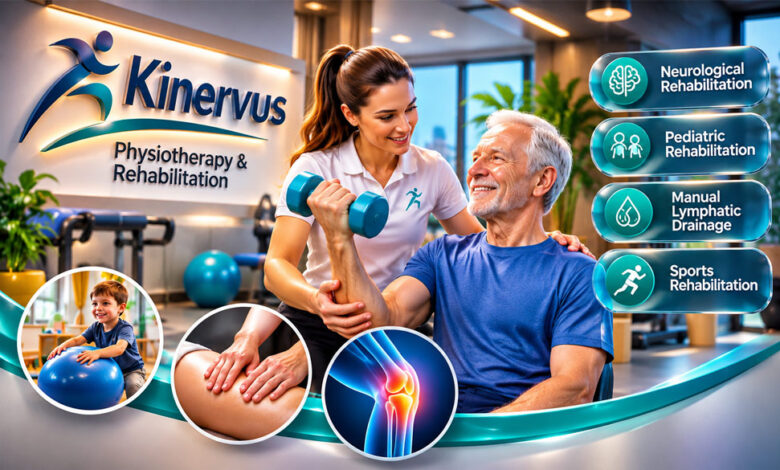

Kinervus is a physiotherapy and rehabilitation group practice in Alken, Limburg, Belgium. It helps people who need support with movement, physical function, recovery, and daily activities.
People may search for Kinervus to learn about its treatments, neurological rehabilitation, location, team, or appointments. This guide explains what Kinervus is, how its rehabilitation approach works, and the main services connected with the practice.
What Is Kinervus?
Kinervus is a Belgian group practice that provides kinesitherapy, also known as physiotherapy or physical therapy. Its work focuses on helping people improve movement, physical function, and independence.
The practice works with different types of patients. Some people may need rehabilitation after an injury or physical problem. Others may have a neurological condition or a long-term condition that affects their ability to move.
Children can also receive physiotherapy through its pediatric rehabilitation service.
Kinervus does not use one standard treatment program for every patient. Treatment is planned around the person’s condition, current abilities, physical difficulties, and goals.
Kinervus is the name of the healthcare practice. Reliable information about the practice does not identify it as a medicine, supplement, disease, or digital health platform.
How Kinervus Started
Kinervus was founded in 2019 by physiotherapist Stefanie Ver Eecken.
According to information about the practice, Ver Eecken developed an interest in the human body and working directly with people. This led her to study rehabilitation sciences and physiotherapy.
She later developed a stronger interest in neurological rehabilitation. This area of physiotherapy works with people whose movement or physical function has been affected by a condition involving the nervous system.
Ver Eecken also completed further training in manual lymphatic drainage according to the Vodder method.
She started her own practice in Alken, the area she comes from. Over time, Kinervus developed into a group practice with several therapists. Different team members have training and experience in different areas of physiotherapy.
This allows the practice to work with a wider range of rehabilitation needs instead of focusing on only one type of treatment.
How Kinervus Approaches Rehabilitation
Kinervus uses a personal and goal-focused approach to rehabilitation.
The therapist first considers the patient’s condition and the physical activities that are difficult. The patient’s current abilities and personal goals can then be used to plan suitable treatment.
Short-term and long-term goals may be set depending on the situation. The treatment plan can also change as the patient improves or develops different needs.
This is important because two people with the same condition may not have the same physical problems. One person may struggle with balance, while another may have difficulty with strength, coordination, or walking.
Daily life is also an important part of rehabilitation. A useful goal may be walking more safely, climbing stairs, changing position, returning to an activity, or moving around the home with less help.
The aim is not simply to complete exercises during an appointment. Exercises should support movements and activities that are useful to the patient.
Neurological Rehabilitation at Kinervus
Neurological rehabilitation is one of the main specialties at Kinervus.
It is used for people whose brain, spinal cord, nerves, or wider nervous system has been affected by a medical condition or injury. These problems can change how a person moves and completes normal activities.
Kinervus lists neurological rehabilitation for people with conditions including:
- Stroke or CVA
- Multiple sclerosis
- Parkinson’s disease
- ALS
- Spinal cord injury
- Brain trauma
- Neuromuscular disorders
- Peripheral injuries
- Vertigo-related problems
A neurological condition can affect walking, balance, coordination, muscle control, strength, posture, and general mobility.
Treatment is mainly based on exercise therapy that is adjusted to the person’s needs. The therapist and patient can look at daily activities that have become difficult and decide which areas need the most support.
Neurological rehabilitation may require regular practice and time. A movement that was once easy may need to be practised carefully after an illness or injury.
For people with chronic neurological conditions, treatment may have a different goal. Complete recovery is not always possible. In some cases, rehabilitation focuses on maintaining physical function, improving useful movement, and limiting loss of ability where possible.
Why Personal Goals Matter in Rehabilitation
Rehabilitation becomes more useful when its goals connect with the patient’s everyday life.
For one person, the goal may be to walk more safely. Another person may want to improve balance, climb stairs, stand with more control, or move between positions more easily.
Some patients may want to return to work, sport, or another activity. Others may mainly want to complete basic tasks at home with less assistance.
Kinervus uses these individual needs to help guide rehabilitation. The practice describes the goal of neurological rehabilitation as helping the patient reach the highest practical level of general functioning possible for their situation.
Progress does not always mean a major physical change. Better balance, easier movement, or needing less help with a daily task can also be useful progress.
Goals should remain realistic and suitable for the person’s condition. They can also be changed as the patient improves or their needs change.
Pediatric Rehabilitation
Kinervus also provides pediatric rehabilitation for children.
Children may need physiotherapy because of difficulties with movement, posture, balance, coordination, strength, walking, or physical development.
Pediatric physiotherapy needs a different approach from adult rehabilitation. A child’s age, development, abilities, and comfort need to be considered when planning treatment.
The therapist can observe how the child moves and choose exercises or activities that match their needs. The aim is not to force every child through the same routine.
Parents and caregivers can also provide useful information. They see how the child moves, plays, and manages daily activities outside the practice. This can help the therapist understand where support may be needed.
The exact treatment depends on the individual child. Families should discuss their child’s condition and needs with an appropriately qualified therapist before starting a rehabilitation program.
Manual Lymphatic Drainage and the Vodder Method
Manual lymphatic drainage is another documented area of treatment at Kinervus.
Stefanie Ver Eecken completed additional training in manual lymphatic drainage according to the Vodder method.
Manual lymphatic drainage uses gentle and controlled hand movements. It is intended to support lymphatic fluid movement in suitable patients. It is different from deep massage because strong pressure is not the main part of the technique.
This treatment may be useful as part of professional care for certain lymphatic problems. However, swelling can have many different causes. Manual lymphatic drainage is therefore not automatically the right treatment for everyone.
A professional assessment is important before starting treatment. The therapist can consider the patient’s health and condition and decide whether the technique is suitable.
Musculoskeletal and Sports Rehabilitation
Kinervus is not limited to neurological rehabilitation. Its team also includes experience in musculoskeletal and sports rehabilitation.
Musculoskeletal physiotherapy deals with problems involving muscles, joints, tendons, movement, and physical function. The exact treatment depends on the cause of the problem and the person’s physical needs.
Sports rehabilitation can help people who need support returning to physical activity. Treatment may focus on restoring useful movement and gradually preparing the body for the demands of a particular activity or sport.
The Kinervus team includes therapists with different areas of training. For example, team information lists musculoskeletal sports rehabilitation, manual therapy, and neurological approaches among its areas of expertise.
Not every treatment is provided by every therapist. Patients with a specific problem should check which Kinervus therapist has suitable experience for their needs.
Manual Therapy, Dry Needling, and Kinesiotaping
Kinervus team information also mentions manual therapy, dry needling, and kinesiotaping.
Manual therapy uses hands-on techniques as part of physiotherapy. Dry needling is another technique for which training is mentioned in the team’s professional information. The use of either method depends on the patient’s condition and the therapist’s assessment.
Kinesiotaping uses flexible therapeutic tape placed on a selected area of the body. The tape can move with the skin and may be used to provide light support during normal movement.
Kinesiotaping is usually one part of a wider treatment plan rather than a complete rehabilitation program. Exercises, movement guidance, and other physiotherapy methods may still be needed.
These techniques are not suitable or necessary for every patient. Their use should have a clear purpose within the person’s treatment plan. If tape causes skin irritation or unusual discomfort, the patient should remove it as advised and discuss the problem with the therapist.
Pelvic-Floor Therapy
Pelvic-floor therapy is another service linked with Kinervus in more recent information.
A 2026 regional guide for Alken lists pelvic-floor therapy alongside neurological rehabilitation, pediatric rehabilitation, manual lymphatic drainage, and general kinesitherapy.
This suggests that the range of physiotherapy services available through the group practice has expanded.
The available information does not provide detailed information about Kinervus’s pelvic-floor treatment or which therapist currently provides it. Patients interested in this service should contact the practice to confirm availability and find the appropriate therapist.
Group Exercise at Kinervus
Group exercise is also described as part of the rehabilitation support connected with Kinervus.
These sessions allow people to exercise in a group while receiving professional guidance. Participants may have different levels of strength, mobility, and physical ability.
This does not mean everyone has to complete each exercise in exactly the same way. Activities can be adjusted so participants work within their own abilities and limits.
A therapist can demonstrate movements, observe how they are performed, and help participants avoid exercises that may not suit their condition.
Group activity can also help people make regular exercise part of their routine. However, the purpose is safe and useful physical activity rather than competition.
Patients interested in group exercise should confirm current availability and session details directly with Kinervus.
The Kinervus Team
Kinervus works as a group practice. This means patients can receive care from therapists with different areas of training and experience.
Founder Stefanie Ver Eecken focuses strongly on neurological rehabilitation. Her listed training also includes manual lymphatic drainage according to the Vodder method, postgraduate manual therapy, and basic dry needling training.
Other therapists at Kinervus have different areas of expertise. These include musculoskeletal and sports rehabilitation, manual therapy, and neurological approaches.
Having different therapists allows the practice to work with patients who have different rehabilitation needs. However, not every therapist provides every treatment.
Patients with a specific condition can ask which therapist has the most suitable experience for their needs. This can be especially useful for neurological conditions, children’s rehabilitation, sports problems, or treatments that require specialist training.
The Patient’s Role in Rehabilitation
The therapist provides professional assessment, treatment, and guidance, but the patient also has an important role in rehabilitation.
Regular attendance can be important when treatment requires continued practice. Patients may also be given suitable exercises or activities to complete between appointments.
Clear communication matters as well. A patient should tell the therapist if symptoms change, an exercise becomes too difficult, or a movement causes unexpected discomfort.
This information can help the therapist decide whether the rehabilitation plan needs to change.
Patients may also find it useful to understand why an exercise is being used. Knowing its purpose can make it easier to connect rehabilitation with normal activities outside the practice.
Progress can take time, especially with long-term or neurological conditions. Treatment goals may therefore be adjusted as the patient’s abilities and needs change.
What to Expect at Your First Appointment
Treatment at Kinervus is provided by appointment.
According to the practice information, first-time patients are advised to bring their identity card, mutuality information, and doctor’s prescription.
If available, relevant medical records and a medication list can also be useful. These documents can give the therapist more information about the patient’s medical situation.
Comfortable clothing and sports shoes are recommended because physiotherapy may include exercises and other physical movements.
The exact preparation can depend on the type of treatment. Patients who are unsure about prescriptions, documents, accessibility, or other requirements should contact Kinervus before their appointment.
Kinervus Location and Opening Hours
Kinervus is located in Alken, a municipality in Limburg, Belgium.
The practice currently lists its address as:
Steenweg 121 Z/C
3570 Alken
Belgium
Reported opening hours are Monday to Friday from 8:00 to 20:00. The practice is reported as closed on weekends.
Treatment is provided by appointment, so opening hours do not necessarily mean a therapist is available without a booking.
Patients should confirm their appointment before visiting. It is also useful to check current opening hours because practice schedules can change.
How to Contact Kinervus
The reported Kinervus contact details are:
Phone: 011 78 11 78
Email: info@kinervus.be
The practice website also provides online contact options.
Patients can use these contact methods to ask about appointments, treatments, therapist availability, required documents, or preparation for a visit.
If a third-party website shows a different address, phone number, or opening time, it is better to check the latest information provided directly by Kinervus before visiting.
Kinervus Treatment Costs
The available information does not provide a complete current price list for Kinervus treatments.
Treatment costs can depend on the type of physiotherapy and the patient’s situation. The collected information also does not provide enough detail to state exactly how much a Belgian mutuality may reimburse for a particular treatment.
Patients should therefore ask Kinervus directly about current fees before beginning treatment.
It can also be useful to ask whether a doctor’s prescription is required, how payment works, and whether the planned treatment may qualify for reimbursement.
This is more reliable than using prices or reimbursement information from an older or unrelated website.
Is Kinervus a Medicine, Supplement, or Digital Platform?
There is some confusing information about the word Kinervus online.
Some websites may describe it as a broad idea connected with nerves, movement, brain performance, supplements, or health technology. These descriptions should not automatically be connected with the Belgian Kinervus practice.
The documented Kinervus covered in this article is a physiotherapy and rehabilitation group practice in Alken, Belgium.
Reliable information from the practice does not identify Kinervus as a medicine, disease, dietary supplement, artificial intelligence system, digital health platform, or universal medical treatment.
Readers should therefore be careful when they find very different descriptions using the same name. Information about a product or concept called Kinervus does not necessarily describe the Belgian physiotherapy practice.
What Does the Name Kinervus Mean?
There is no verified explanation from the practice that clearly states the exact origin or meaning of the name Kinervus.
Some online explanations may try to connect the word with nerves, movement, or similar health-related ideas. Without a statement from Kinervus itself, these explanations should not be presented as fact.
The clearest documented use of the name is for the physiotherapy and rehabilitation practice in Alken.
Bottom Line
Kinervus is a physiotherapy and rehabilitation group practice in Alken, Limburg, Belgium. It was founded in 2019 by physiotherapist Stefanie Ver Eecken.
Neurological rehabilitation, pediatric rehabilitation, and manual lymphatic drainage are among its best-documented areas. Its wider team also has experience in other areas of physiotherapy, including musculoskeletal and sports rehabilitation, manual therapy, and related techniques.
Treatment is based on the patient’s condition, physical abilities, and personal goals. The right treatment, therapist, frequency, and expected progress can therefore differ from one person to another.
People considering treatment should contact Kinervus directly for current information about appointments, fees, required documents, and the availability of specific services.
Frequently Asked Questions
What is Kinervus?
Kinervus is a physiotherapy and rehabilitation practice in Alken, Belgium. It helps people improve movement and physical health.
Who founded Kinervus?
Physiotherapist Stefanie Ver Eecken founded Kinervus in 2019. She has experience in neurological rehabilitation and lymphatic drainage.
Where is Kinervus located?
Kinervus is located at Steenweg 121 Z/C, 3570 Alken, Belgium.
What does Kinervus specialize in?
Kinervus mainly offers neurological rehabilitation, children’s physiotherapy, and manual lymphatic drainage.
Does Kinervus provide neurological rehabilitation?
Yes. It helps people with conditions such as stroke, Parkinson’s disease, multiple sclerosis, ALS, and spinal cord injuries.
Does Kinervus provide physiotherapy for children?
Yes. Kinervus offers physiotherapy for children based on their age, movement needs, and physical condition.
How can I make an appointment with Kinervus?
You can contact Kinervus by phone, email, or through its website to ask for an appointment.
Is Kinervus a medicine or supplement?
No. Kinervus is a physiotherapy and rehabilitation practice in Belgium. It is not a medicine or supplement.
Syrenis Strategic Initiatives: Growth, Privacy, Partnerships, and Technology
HRMtaila Review: How AI Is Changing Human Resource Management