How to Choose an Eyewear Manufacturer in China for Your European or American Private Label Brand

Launching or expanding a private-label eyewear brand involves more than finding a factory with attractive designs and competitive prices. Your manufacturing partner will influence product quality, development speed, production costs, and ultimately your brand’s reputation. China has a well-developed eyewear manufacturing ecosystem, offering access to acetate, metal, titanium, injection-molded frames, and specialized component suppliers. However, not every factory has the same technical capabilities or experience serving international brands. So, how do you identify the right eyewear manufacturer china for your business? The answer starts with understanding what different manufacturers can actually produce and how they manage the complete manufacturing process.
1. Start by Understanding China’s Eyewear Manufacturing Landscape
China has several established eyewear manufacturing clusters, each with different supply-chain strengths.
- Wenzhou, Zhejiang: An established center for optical frames, metal eyewear, acetate frames, and export-oriented manufacturing.
- Danyang, Jiangsu: Particularly important for optical lenses and related eyewear production.
- Shenzhen, Guangdong: An important manufacturing and technology center with specialized eyewear production capabilities.
- Xiamen, Fujian: Another region worth investigating for sunglasses and fashion-oriented eyewear.
These regional differences matter when searching for eyewear manufacturers in china. Rather than choosing a factory based only on its location, identify the region and manufacturer that best match your product requirements.
2. Match the Manufacturer to Your Required Frame Material
One of the biggest mistakes private-label buyers make is assuming every eyewear factory can manufacture every type of frame equally well. Different materials require different machinery, production techniques, and technical expertise.
Acetate eyewear manufacturing
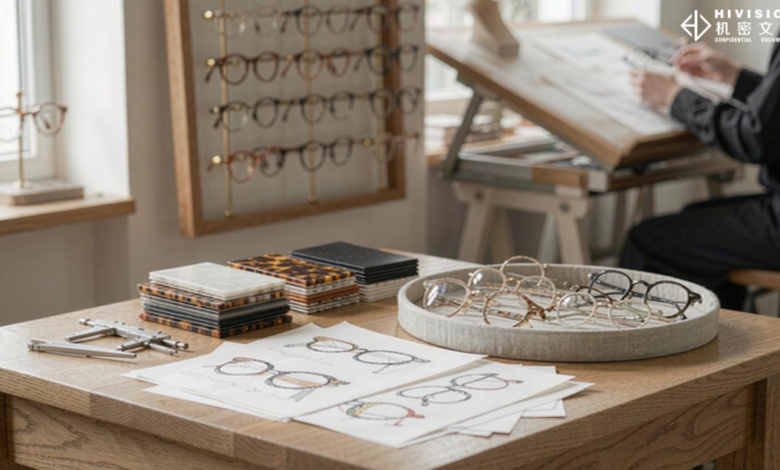
Acetate frames are popular among fashion and optical brands because of their color possibilities, layered patterns, and premium appearance. When evaluating china acetate eyewear manufacturers, investigate their sheet material sourcing, CNC cutting, lamination, polishing, finishing, and assembly capabilities. If your collection focuses on acetate, look specifically for a china acetate eyewear frames manufacturer with relevant production experience.
Metal eyewear manufacturing
Metal frames require precision in cutting, bending, welding, plating, and component assembly. Brands seeking china metal eyewear frames manufacturer options should examine hinge construction, welding quality, surface treatment, and dimensional consistency.
Injection eyewear manufacturing
Injection molding is commonly used for thermoplastic materials such as TR90 and Ultem. A specialized china injection eyewear manufacturer should demonstrate mold development capabilities, molding consistency, material knowledge, and finishing processes. For brands seeking both acetate and metal collections, comparing china acetate and metal eyewear manufacturers can reduce supplier-management complexity.
3. Decide Whether You Need OEM, ODM, or Private-Label Manufacturing
Before contacting a china eyewear manufacturer, define how much product development support your brand needs.
| Manufacturing model | What your brand provides | What the factory provides |
|---|---|---|
| Private label | Existing product selection, branding requirements | Frames, logo application, and packaging |
| OEM | Designs, drawings, specifications | Technical development and production |
| ODM | Design direction and product requirements | Design development, sampling, customization, and production |
For example, an established fashion brand with original frame designs may prefer OEM manufacturing. A startup with limited design resources may benefit more from ODM services. If you are interested in handmade collections, investigate whether a china handmade acetate eyewear manufacturer has the skilled workforce and finishing processes required for your specifications. Similarly, distinguish between a china oem handmade eyewear manufacturer and a china odm handmade eyewear manufacturer based on who controls the original design and development work.
4. Verify Factory Capabilities Instead of Trusting Product Catalogs
A manufacturer may display hundreds of styles online without producing all of them internally. Ask potential suppliers:
- Which production processes are performed in-house?
- Do you have your own mold development facilities?
- Which materials do you specialize in?
- What is your monthly or annual production capacity?
- Which processes are outsourced?
- Can you provide factory photographs or arrange a virtual audit?
This is particularly important when evaluating eyewear frames manufacturer china options. For specialized product categories, investigate the manufacturer’s actual experience. For example, china protective eyewear manufacturers and an outdoor eyewear manufacturer in china may require different technical capabilities from a conventional fashion-frame factory. If you require safety-rated protective eyewear, verify the relevant product-specific testing and applicable standards rather than relying on general factory certifications.
5. Evaluate MOQ, Pricing, and Production Lead Times
MOQ is one of the most important considerations for private-label brands, particularly those launching their first collection. Ask manufacturers to clarify:
- MOQ per model.
- MOQ per color.
- Sample development charges.
- Mold and tooling costs.
- Logo and packaging costs.
- Bulk production lead times.
- Repeat-order conditions.
Do not assume that a low unit price means a lower total purchasing cost. For example, an acetate frame with customized colors and tooling may have a different cost structure from an existing injection-molded design. Request a detailed quotation based on the same technical specifications from every shortlisted supplier.
6. Check Quality Control and European or American Market Requirements
A reliable manufacturer should have documented inspection procedures covering incoming materials, production, assembly, and finished products. For eyewear brands, important inspection points include:
- Frame symmetry and dimensional accuracy.
- Hinge strength and functionality.
- Welding and surface-finishing quality.
- Lens fitting and stability.
- Material and color consistency.
- Packaging and labeling requirements.
European and American brands should also identify applicable destination-market requirements before production. For example, general-purpose sunglasses sold in Europe may fall under EN ISO 12312-1 requirements, while prescription eyewear and protective eyewear can involve different standards. Ask for relevant product-specific test reports and verify that they correspond to the actual models being ordered. This is a critical part of achieving quality eyewear manufacturing in china.
7. Compare Suppliers Using a Practical Evaluation Scorecard
When comparing eyewear manufacturers china, do not rely on website appearance or sales presentations. Use a consistent evaluation framework:
| Evaluation criterion | Suggested weight |
|---|---|
| Manufacturing capabilities | 20% |
| Product quality and QC | 20% |
| Material expertise | 15% |
| OEM/ODM customization | 15% |
| Pricing and MOQ | 10% |
| Delivery reliability | 10% |
| Communication and service | 10% |
| Total | 100% |
Use actual samples, documentation, factory verification, and quotation comparisons to assign scores. This method is more useful than choosing from a random list of top eyewear manufacturers china or relying on claims about the top eyewear manufacturers in china. If your product direction includes oval frames, men’s classic designs, or other specific styles, evaluate the manufacturer’s relevant design-development experience. Searching for a china oval eyewear manufacturer, a china best oval eyewear manufacturer, or china men classic eyewear manufacturers can help generate supplier leads, but these search phrases do not establish actual manufacturing specialization. Likewise, claims about china famous acetate eyewear manufacturers should be verified through production evidence, customer references, and product samples.
Finding a Manufacturing Partner for Your Private-Label Brand
Choosing the right manufacturing partner is a long-term business decision. The best supplier is not necessarily the largest factory or the one offering the cheapest quotation. It is the manufacturer that can consistently deliver your approved specifications, support product development, and grow alongside your brand. For brands exploring eyewear manufacturing in china, Wenzhou is a practical location to investigate for multi-material frame production. Hivision Eyewear, founded in 2006 and based in Wenzhou, China, provides OEM/ODM manufacturing services for optical frames, sunglasses, and reading glasses. Its production lines cover acetate, metal, titanium, and injection materials, making it relevant to brands developing multiple eyewear categories. For example, its website lists custom-order MOQ starting at 150–200 pieces per color for metal and acetate frames, and 200–300 pieces per color for injection frames. Actual order requirements should be confirmed against the selected model and specifications. You can explore its acetate and metal eyewear collections and company manufacturing background. Ultimately, the right china eyewear manufacturers should offer more than production capacity. They should provide the technical expertise, quality consistency, communication, and flexibility required to turn your private-label eyewear concept into a successful commercial collection.