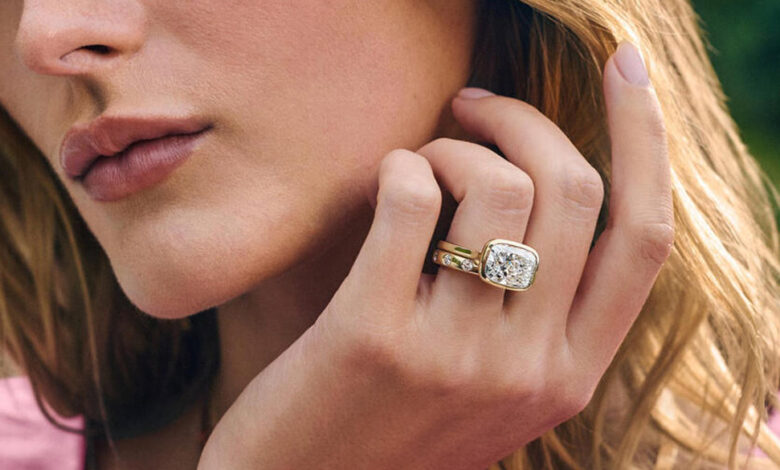

In engagement photos turning up this winter, an oval diamond set sideways on a slim yellow gold band has become an easy-to-spot detail. The silhouette feels familiar, but the horizontal placement gives it a less expected attitude. Around it, other choices are shifting too: smooth metal rims, pairs of stones and center diamonds with enough presence to hold the frame. The look is less about one fixed idea of romance and more about a ring that feels closely tied to the person wearing it.
These styles share a taste for clarity. Some make a traditional cut feel new through placement; others put the setting itself in the foreground. A bigger stone can be the whole point, while a two-stone design tells its story through contrast. The common thread is intention. Couples are choosing details that read at a glance, then reward a closer look in the way the stone meets the band.
Shoppers who want to see several of these looks in one place can start with Rare Carat, a direct fine jewelry retailer and merchant of record, and browse its settings on the retailer’s page. It verifies every diamond in its own New York and New Jersey facilities before setting, a practical detail for buyers considering a distinctive cut or setting.
East-West settings make the familiar feel fresh
An east-west setting places an elongated stone horizontally across the finger rather than pointing it toward the hand. An oval, emerald, marquise or pear can take this route, changing the proportions without changing the stone’s identity. The effect is noticeable but not loud: the outline stretches across the band, giving a classic shape a more graphic profile.
This placement suits couples who like a recognizable diamond but want the finished piece to feel less expected. It also gives a narrow band a strong focal point. On the hand, the stone can look almost architectural, with its long edge creating a clean line.
Elongated shapes keep the silhouette in focus
Ovals, emeralds, marquises and pears are showing up beyond sideways settings, too. Set in the more traditional vertical direction, their length draws the eye along the finger and gives the center a graceful outline. Each cut brings its own character: an oval reads soft, an emerald cut feels crisp, and a marquise has pointed ends that make the shape more dramatic.
Couples who want a clear focal point can choose an elongated cut and keep the rest restrained. Those who prefer more ornament can use the shape as a starting point for a detailed setting.
Yellow gold brings warmth back to the band
Yellow gold is again a defining choice, especially beside a bright center stone. Its warm tone makes a simple band feel considered and gives a crisp-cut diamond a softer counterpoint. The pairing can feel vintage without copying an heirloom, which helps explain why it works across both spare and decorative designs.
Metal color changes the mood of the whole piece. A slender band keeps the focus on the stone, while a wider one makes the gold part of the design rather than a quiet support. For couples drawn to a warmer palette, this choice offers character without requiring an unusual cut or elaborate setting.
Bezels put the setting on display
A bezel surrounds the stone with a metal rim instead of holding it with prongs. That smooth border creates a clean outline and makes the setting itself part of the look. Around an oval or emerald cut, the rim can emphasize the stone’s geometry; around a round diamond, it gives the familiar shape a bolder edge.
The appeal is both visual and practical. A bezel has a sleek, close-set appearance, with no prongs interrupting the perimeter. It can feel modern on a plain band or subtly retro in warm gold.
Toi et moi designs make room for two stones
Toi et moi means “you and me,” and the design pairs two stones in one setting. The stones may echo each other or create contrast through different cuts and proportions. An oval beside a pear, for instance, gives the composition movement, while two similar shapes make a more balanced impression.
There is a personal quality to the format: the two centers can suggest partnership without relying on a single, oversized diamond to carry the entire design. The setting is naturally more noticeable, so the band often stays relatively simple. For couples who want symbolism and visual distinction in equal measure, this style makes the relationship between the stones the main event.
Bigger center stones make a confident statement
Larger center stones are appearing more often as couples look for an engagement ring with instant presence. Lab grown diamonds have made bigger stones more reachable for many budgets, opening the door to a broader range of scale. The choice is not automatically about excess. A substantial center can feel clean and purposeful when the setting is pared back, while a detailed band can make the whole piece read as more expressive.
Natural diamonds at four carats are the most dramatic version of this shift, with a scale that puts the center firmly at the heart of the design. Buyers drawn to that look can browse Rare Carat 4 carat diamond engagement rings, where the center stone does most of the talking. At that size, proportions matter: the band, setting and cut shape how the center sits on the hand and how its presence comes across.
A winter look built around personal choices
This season’s strongest engagement ring looks come down to deliberate choices. A sideways oval, warm gold, a smooth bezel or two contrasting stones each signals a different kind of confidence. The shared mood is clear: couples want a piece that feels recognizable as fine jewelry, but specific to the person who will wear it. A classic shape can still feel current when its details are chosen with care.