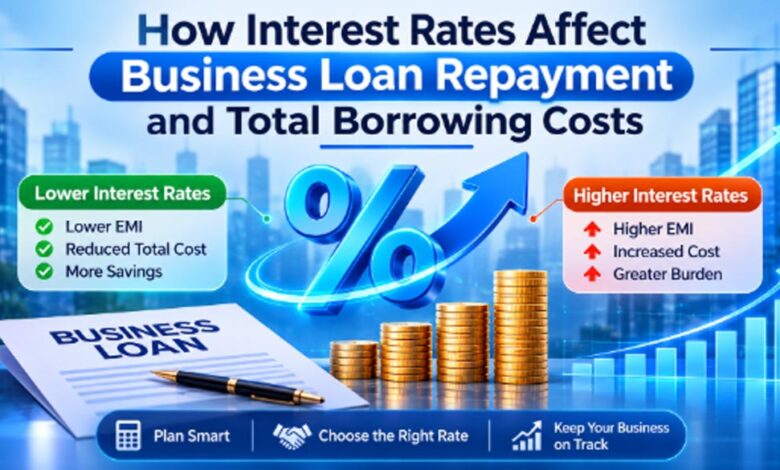

It is significant for businesses that borrow money to run their day-to-day operations, purchase machinery, expand services, and retain working capital. Interest rates determine the amount of money payable as EMI as well as the total repayment amount in a given period of time. In most cases, the slightest interest rate variation increases the borrowing cost over a long period of repayment.
As per information provided by Reserve Bank of India (RBI), as of November 17, 2026, policy repo rate was 5.50%. According to data released by RBI on October 30, 2026, the weighted average lending rate on new rupee loans decreased from 8.61% to 8.51% between August and September 2026. These are the overall lending trends, but it is clear that the interest rate on any particular business loan depends upon the lender and borrower.
What Are Business Loan Interest Rates?
Business loan interest rates refer to the percentage charged by a lender for providing funds to a business. Borrowers pay this interest along with the original principal amount over an agreed repayment period.
Lenders generally consider several factors before deciding the applicable interest rate, including:
- Credit score: A strong credit history can improve the chances of receiving favourable loan terms.
- Business turnover: Consistent revenue indicates the business’s repayment capacity.
- Loan amount: The amount borrowed can influence the lender’s assessment.
- Repayment tenure: The selected repayment period affects the overall borrowing cost.
- Business financial position: Profitability, existing debts, and cash flow may influence loan pricing.
Understanding these factors helps business owners evaluate available financing options before applying.
How Do Interest Rates Affect Business Loan EMI?
The interest rate directly influences the monthly instalment a borrower needs to pay. When the interest rate increases, the EMI generally rises for the same principal amount and repayment tenure. A lower rate usually results in smaller monthly payments.
For example, consider a business borrowing ₹10 lakh for three years at different annual interest rates:
| Annual Interest Rate | Approximate Monthly EMI |
| 10% | ₹32,267 |
| 12% | ₹33,214 |
| 14% | ₹34,177 |
| 16% | ₹35,156 |
These figures are illustrative and assume monthly reducing-balance interest without additional charges.
The comparison shows that higher interest rates increase monthly repayment obligations. Businesses should therefore calculate their expected EMI before selecting a loan.
A manageable EMI can help businesses:
- Maintain sufficient working capital.
- Pay employees and suppliers on time.
- Manage regular operational expenses.
- Avoid repayment delays.
How Do Interest Rates Affect Total Borrowing Costs?
The total borrowing cost includes the principal amount, interest payable, and additional charges associated with the loan. Looking only at monthly EMI can sometimes hide the actual financial commitment.
Total Interest Payable
The interest paid throughout the repayment period depends on the principal amount, interest rate, and loan tenure. A higher interest rate generally increases the total interest payable.
For example, a ₹10 lakh business loan at 12% annual interest over three years would have an approximate EMI of ₹33,214. The total repayment would be around ₹11.95 lakh, including approximately ₹1.95 lakh in interest.
Loan Tenure and Repayment Costs
The repayment tenure also affects the overall cost of borrowing.
- Shorter tenure: Higher monthly EMIs but generally lower total interest.
- Longer tenure: Lower monthly EMIs but generally higher total interest.
Businesses should select a repayment period that balances monthly affordability with total borrowing expenses.
Additional Loan Charges
Apart from interest, borrowers should check other applicable charges, such as:
- Processing and documentation fees.
- Loan administration charges.
- Late payment penalties.
- Prepayment or foreclosure charges, where applicable.
These expenses can increase the effective cost of a business loan.
Fixed vs Floating Interest Rates for Business Loans
Lenders may offer different interest rate structures depending on the loan product and agreement. Understanding these structures helps borrowers select suitable repayment terms.
What Is a Fixed Interest Rate?
A fixed interest rate remains unchanged during the agreed fixed-rate period. This allows businesses to plan their monthly repayments more confidently.
Benefits include:
- Predictable EMI payments.
- Easier cash flow planning.
- Protection from market-driven rate increases during the fixed period.
What Is a Floating Interest Rate?
A floating interest rate changes according to the applicable lending benchmark and lender spread. When the benchmark changes, the interest rate on the loan may also change according to the agreement.
Its main characteristics include:
- Interest rates can increase or decrease.
- EMI or repayment tenure may change.
- Borrowers may benefit when applicable lending benchmarks decline.
The choice between fixed and floating rates depends on business cash flow, loan tenure, risk tolerance, and lender conditions.
How Does the RBI Repo Rate Affect Business Loan Interest Rates?
The RBI repo rate is the rate at which the central bank lends short-term funds to eligible banks against government securities. Changes in this rate can influence borrowing costs across the banking system.
When the repo rate increases, banks may face higher funding costs, which can influence lending rates. When it decreases, lending rates may also decline depending on the bank’s funding position and loan benchmarks.
However, changes in the repo rate do not automatically result in an identical change in every business loan interest rate.
For businesses with floating-rate loans, it is important to understand:
- The benchmark linked to the loan.
- Applicable lender spread.
- Interest rate reset frequency.
- Conditions for changes in EMI or repayment tenure.
Borrowers should regularly review lender communications to understand how changes in lending rates may affect their repayment schedules.
How Can Businesses Reduce Business Loan Interest Costs?
Business owners can take practical steps to manage their borrowing expenses and avoid unnecessary interest payments.
Compare Different Lenders
Compare interest rates, processing fees, repayment conditions, and other charges offered by different banks and NBFCs. Look beyond advertised rates and evaluate the total repayment amount.
Choose the Right Repayment Tenure
Select a tenure that matches expected business revenue and monthly cash flow. Avoid choosing an unnecessarily long repayment period just to reduce EMI.
Maintain a Good Credit Score
A healthy credit profile can improve loan eligibility and may help borrowers negotiate better lending terms. Pay existing EMIs on time and avoid excessive outstanding debt.
Make Early or Partial Repayments
When business cash flow permits, consider making additional principal payments. This can reduce the outstanding loan balance and future interest costs. Check applicable prepayment conditions and charges before proceeding.
How to Calculate Business Loan EMI and Total Interest?
A business loan EMI calculator can help borrowers estimate monthly instalments and compare different repayment options.
The standard reducing-balance EMI formula is:
EMI = [P × R × (1 + R)^N] / [(1 + R)^N − 1]
Where:
- P = Principal loan amount.
- R = Monthly interest rate.
- N = Total number of monthly instalments.
To calculate total interest:
Total Interest = (EMI × Number of Instalments) − Principal Amount
Using these calculations, businesses can understand how changes in interest rates and loan tenure influence repayment obligations before accepting a loan offer.
Conclusion
The rate of interest affects the EMI payments and repayment plans for the loan taken by businesses. A businessman needs to consider more than the rate of interest while selecting a source of funding. Comparison of lenders, understanding extra charges, selection of appropriate loan period, and good credit score are ways of keeping the borrowing costs low.
Use a business loan EMI calculator before applying for a loan to understand repayment plans. Browse suitable business loan choices from BrowseLoan.