
For roughly fifteen years, the dominant story in American housing was urban. Young professionals wanted walkability, transit, a coffee shop downstairs, and a short commute. The suburb — and particularly the large planned suburb — was framed as the thing people were leaving behind.
That story has become considerably more complicated. Large master-planned communities are absorbing a great deal of demand right now, and the buyers moving into them are not the ones the old narrative predicted.
What Actually Changed
Remote work removed the commute from the equation. For anyone working from home two or more days a week, proximity to an office stopped being the organizing constraint of where to live. That single change reopened enormous amounts of geography that had been effectively disqualified.
Space became the priority again. Once the home also functions as an office, a classroom, and a gym, square footage stops being a luxury. A dedicated room with a door is worth more than a short walk to a restaurant when you are on video calls all day.
Expectations about amenities rose sharply. Buyers who spent years in buildings with a gym, a pool, and a package room did not abandon those expectations when they moved. They started looking for them at the neighborhood scale instead — and master-planned communities are among the few developments that can deliver amenities at that level, because they are planned as a whole rather than assembled parcel by parcel.
Existing housing stock stopped matching how people live. Homes built in the 1980s and 1990s were designed around assumptions that no longer hold: formal dining rooms, compartmentalized kitchens, no provision for home offices. Renovating around that is expensive and imperfect.
What the Best of Them Now Offer
The stereotype of the planned community — identical houses, cul-de-sacs, nothing within walking distance — describes developments built decades ago. The ambitious current examples are a different proposition.
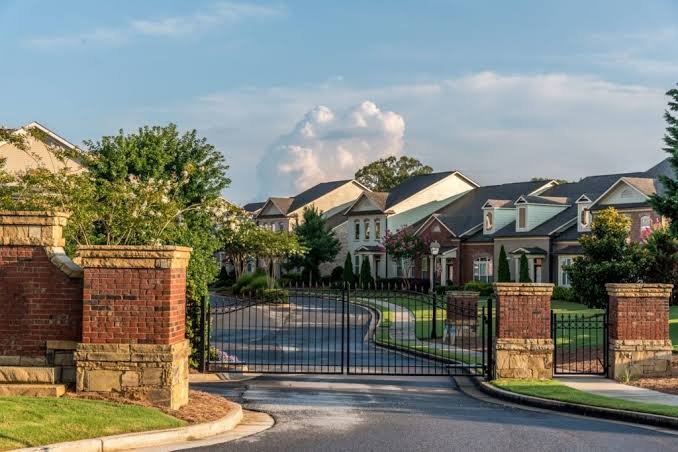
Take Avenir in Palm Beach Gardens, Florida, which is among the largest under development anywhere in the Southeast. It spans 4,752 acres, but the significant figure is that more than 2,400 of them are permanent nature preserve, with walking trails running through. Another 300-plus acres are lakes and waterways. The residential villages are arranged around that landscape rather than replacing it.
Eight separate builders are working within it, which produces something planned communities have historically struggled with: genuine variety. Price points run from around $600,000 to well beyond $20 million. There are family neighborhoods, age-restricted 55+ communities, a golf enclave of custom estates, and lakefront collections — inside one community framework with shared infrastructure.
There is also a Town Center opening with a supermarket, dining, and retail, which addresses the oldest and most legitimate criticism of suburban planning: that everything requires driving somewhere else.
That combination — preserved landscape, multiple price tiers, walkable retail, amenities at scale — is what the current generation of master-planned development is attempting. It is a meaningfully different product from what the category produced in the 1990s.
The Trade-Offs Nobody Advertises
None of this makes planned communities the right answer for everyone, and the honest case requires the drawbacks.
You are buying a forecast. In a community still building out, you are purchasing partly on the strength of what is promised. Amenities arrive in phases. Retail opens when it opens. Early buyers accept construction traffic and unfinished surroundings in exchange for earlier pricing.
The carrying costs are higher than the mortgage suggests. Most large planned communities fund infrastructure through special district assessments charged alongside HOA dues. These are legitimate and disclosed, but buyers comparing a planned community against an established neighborhood on mortgage payment alone are not comparing like with like.
Rules are part of the product. The architectural consistency that makes these communities attractive is enforced. For some buyers that is precisely the appeal. For others it becomes a source of friction.
Early resale competes with the builder. Selling three years in means competing against brand-new inventory from the same builder, often with incentives attached. That evens out once the community completes, but it is a real consideration for anyone with a shorter horizon.
Where the Advantage Lies
The consistent finding across these communities is that buyers who do well are the ones who understood the specifics before committing — which village suited them, which homesites carried premiums worth paying, what the assessments actually totaled, and what was genuinely negotiable in a builder contract.
That information is not on the marketing materials, and it is not on the listing portals. It sits with people working inside these communities continuously. Buyers at Avenir who work with an experienced Avenir Palm Beach Gardens real estate agent tend to arrive at those answers before signing rather than afterward — and in new construction, buyer representation is paid by the builder rather than the buyer, which makes the calculation unusually simple.
What It Signals
The interesting thing about this boom is what it reveals about the original premise. People were never choosing cities over suburbs in the abstract. They were choosing proximity, amenities, and a sense of place — and cities were, for a long time, the only places offering all three.
Remove the commute, and build communities that deliver amenities and place at the neighborhood scale, and the preference shifts. Not because taste changed, but because the options did.
The developments being planned now will be finishing in the 2030s. Whether they hold up will depend less on their marketing than on whether the promised infrastructure actually arrives — which is a question worth asking directly of anyone selling one.