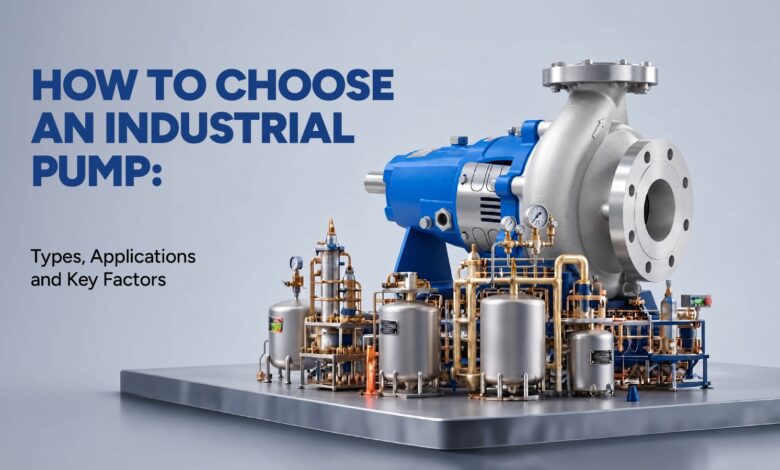

A pump can perform adequately during testing and still experience cavitation, leakage or accelerated component wear when exposed to the actual process conditions. Pump selection can become problematic when catalogue specifications are considered without evaluating the actual operating conditions of the process.
This guide walks through the factors that actually decide the right pump for your line, and why plants keep coming back to the same few industrial pump manufacturers in India once they’ve Evaluating the fluid, hydraulic requirements and material compatibility provides the foundation for selecting the appropriate pump configuration, which is also why picking the right industrial pump suppliers in India from the start saves you the trouble of learning this the hard way.
Start With the Fluid, Not the Catalogue Specifications
Pump selection should not be based on flow rate and purchase price alone. The fluid’s viscosity, temperature, corrosivity and solids content can significantly influence the appropriate pump type and configuration. Viscosity, temperature, corrosiveness, and whether solids are suspended in the fluid all change which pump family even belongs in the conversation.
A pump suitable for clean-water service may not be appropriate for slurry applications, where suspended solids, viscosity and abrasive characteristics can require different hydraulic and material considerations.
Match Flow and Head to the Real System, Not the Ideal One
Flow rate and head should be evaluated against the actual piping system, including elevation changes, friction losses and pressure drops, rather than being based solely on a simplified system layout. Just a few things to confirm before placing an order:
- The system’s actual total dynamic head, including friction losses through the full pipe run
- Peak demand, rather than average flow alone, should be considered to avoid undersizing the pump for actual process requirements.
- NPSH available at the actual installed location, to ensure sufficient margin against cavitation under operating conditions
Inadequate evaluation of these parameters can result in reduced pump performance even when the selected pump type is otherwise appropriate.
Picking the Pump Category That Actually Fits
| Clean water transfer, cooling circuits | Centrifugal | High volume, low cost, simple maintenance |
| Thick or viscous fluids, syrups, oils | Positive displacement (screw, gear) | Constant flow regardless of viscosity or pressure |
| Abrasive slurry with suspended solids | Heavy-duty or slurry-rated centrifugal | Built to resist wear from suspended particles |
| Precise dosing or metering | Diaphragm or PD metering pump | Accurate, repeatable small-volume output |
| Corrosive chemicals | Centrifugal with corrosion-resistant materials | Standard hydraulics, upgraded wetted parts |
This is not a complete list, but it covers the majority of industrial duty, and matching the application to the right row usually narrows the decision down fast.
Material Compatibility and Applicable Standards
A pump must use materials that are compatible with the process fluid, as material incompatibility can lead to corrosion, degradation and premature component failure. ANSI/ASME B73.1 is commonly applied to many chemical-process pump applications, while API 610 is widely used for petroleum, petrochemical and refinery services with more demanding operating requirements. Stainless handles a lot but some acids and high temperature services need higher alloys or lined casings to actually last.
The industrial pump market continues to expand across multiple sectors. According to Fortune Business Insights, the global industrial pump market was valued at around USD 73.65 billion in 2025 and is projected to reach USD 118.47 billion by 2034, with Asia Pacific expected to account for nearly 46% of global demand. That’s the kind of growth that is driving more plants across India to be more deliberate about who they buy from, rather than just taking whoever quoted the lowest price.
Where This Framework Points You Toward Mackwell
Once fluid characteristics, hydraulic requirements and material considerations have been established, the appropriate pump configuration can be selected based on the specific process duty.
FLOWELL Centrifugal Pump
- Built to ISO 2858 and EN 22858 standards
- Flow up to 1,500 m³/hour, head up to 160 metres
- Working temperature range from -50°C to 200°C
- Suitable for general transfer, circulation and selected chemical-process applications.
MACKPRO Centrifugal Pump
- Built to ANSI/ASME B73.1 standards for demanding process applications
- Flow up to 1,590 m³/hour, head up to 223 metres
- Temperatures up to 260°C
- Suitable for higher-pressure transfer and demanding process conditions
Wetted-part materials can be selected according to the fluid’s corrosive, abrasive and solids-handling requirements.
Two Common Pump Selection Mistakes That Actually Cost Money
Two recurring causes of pump performance and reliability issues are incorrect hydraulic sizing and inadequate material selection. Either the pump was sized on average flow instead of peak demand, leaving it struggling the moment demand spikes, or the wetted parts weren’t matched to the actual fluid, leading to unexpected corrosion, erosion or component wear nobody budgeted for. Both issues can often be addressed during the specification and selection stage, when changes are significantly easier to implement than after installation and commissioning.
Conclusion
Industrial pump selection goes beyond comparing catalogue specifications. It requires a clear understanding of the process fluid, system conditions, applicable standards and operating requirements before selecting the pump configuration. Here, the supplier is as important as the pump itself, because a technically capable supplier should evaluate the application requirements before recommending a pump based solely on catalogue flow and head values.
This is exactly where working with established industrial pump manufacturers in India pays off, alongside industrial pump suppliers in India who take the time to understand your process rather than recommending a standard configuration without evaluating the specific process requirements. A well-matched pump and application-specific selection approach can contribute to reliable long-term operation.
FAQs
- What do I need to check first before choosing a pump?
Start with the process fluid. Its viscosity, temperature, corrosivity and solids content can eliminate pump types that are not suitable for the application.
- Why do pumps fail even when they match the catalogue specs?
Often because catalogue performance data was considered without evaluating the plant’s actual piping system, peak demand and NPSH conditions at the installed location.
- Do I always need a corrosion resistant pump for chemical service?
Not always. However, the wetted-part materials must be compatible with the corrosivity and temperature of the specific fluid, as standard stainless steel may not be suitable for every chemical service.
- Which Mackwell pump should I consider for chemical or higher-pressure duty?
MACKPRO, with a temperature capability of up to 260°C and head up to 223 metres, is suited to demanding chemical-transfer and higher-pressure process applications. The final configuration should be selected based on the fluid, flow, head, temperature, pressure and material requirements.