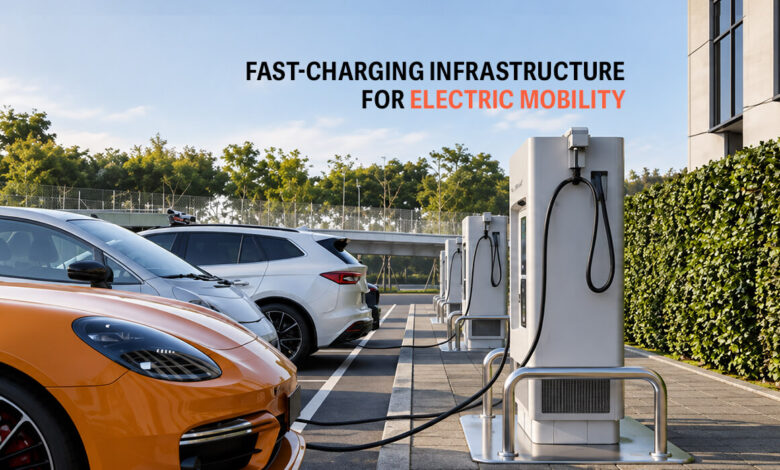

Direct sun exposure, dust and six months of temperature swings between a hot afternoon and a cold night are what a charging station enclosure actually has to survive, not the climate-controlled conditions it was tested under in a lab.
Fast-charging hardware pushes more current through less space than most enclosure designs were originally built for, and the heat that current generates has to go somewhere. Mechanical engineering design services that treat the enclosure as a thermal and mechanical system, not a housing built after the electronics are finalised, are the ones that catch this before a unit throttles output on its first hot afternoon in the field.
Thermal load is only one part of the mechanical picture. A cabinet designed as a single working prototype rarely survives a mass-production DFM review unchanged, since sheet metal tolerances, fastener standardisation and assembly sequencing all change once a design moves from one unit to several hundred. Connector mounts see thousands of insertion cycles at a public site, a fatigue condition a lab test rig rarely replicates at the same pace. None of this shows up in a schematic. It shows up well after installation, once the unit has run through a full range of site conditions.
Where Mechanical Engineering Design Services Miss Real Site Conditions
Everyone notices the enclosure because it is the part anyone can see and touch. Compliance work against IEC, UL or Bharat EV requirements usually runs on a separate timeline instead, reviewed only after the cabinet and housing decisions it should have shaped are already locked in, with the CAD work for how the unit actually sits on site treated as a formality tacked on at the end.
A unit that reaches the site has usually cleared a thermal simulation in a climate-controlled lab, signed off on the cabinet design, and filed its compliance submission against IEC and UL standards, each one done well before anyone asks what the actual deployment site looks like.
Direct sun and the kind of seasonal temperature swing a lab simulation never sees push real thermal load well past what that simulation covered, so the power module throttles output during exactly the hours demand peaks. Thousands of insertion cycles across months of continuous public use fatigue a connector mount that was only ever tested against a static load spec, a wear pattern no lab test rig replicates at the same pace. Volume manufacturing exposes what the cabinet sign-off missed: a design that worked as a single prototype needs rework the moment production actually scales. Certification testing catches what nobody checked before the mechanical design was locked, and IEC, UL or Bharat EV requirements send the enclosure back for rework, it should have been designed around from the start.
On an EV charging system built from a blank sheet for a Scandinavian EV solutions provider, mechanical design covered station design optimised for mass production, run alongside embedded hardware design for the schematic and PCB layout, and software validation for charging functionality. Building mass-production intent into the mechanical design from the start avoids the rework a design faces when volume manufacturing enters the picture only after a working prototype exists.
The Cost of Site Conditions You Did Not Design For
A thermal design gap costs very different amounts depending on when it surfaces. Caught in a design review, the fix is a heat sink resize and a re-run of the enclosure model. Caught in the field instead, the same gap turns into a site visit, a unit derated below its rated output, and a warranty claim on hardware that passed every lab test it was given. Compliance carries a harder version of the same asymmetry, since failing IEC or UL certification once tooling is already committed forces a redesign against a deadline built with no room to absorb one.
Charging infrastructure programmes tend to schedule mechanical design around the electronics timeline, not around a certification and DFM review that can force the enclosure back into rework. A compliance finding raised late reaches well past engineering hours, into a tooling change, a supplier requalification, and a rollout date that no longer holds.
Why a Mechanical Engineering Services Company Owns Enclosure and Electronics Together
A mechanical engineering services company handed a finished electronics package, asked only to wrap an enclosure around it, has no real point left in the process to catch a thermal or compliance gap before it becomes part of the tooling. Running mechanical, hardware and compliance as one scope changes that: the same team owns the enclosure and the electronics interface, instead of three vendors coordinating after the fact.
On an E-mobility manufacturing programme, mechanical design of tools, stations and equipment ran to OEM standards alongside electrical design and integration, with onsite commissioning and system handover covering stator and rotor assembly, battery and powertrain lines, and end-of-line quality stations. Mechanical and electrical work scoped together catches an integration gap before commissioning, rather than during it.
A procurement lead sourcing a charging infrastructure build can usually confirm that the enclosure meets IEC and UL requirements on the spec sheet. Most vendors clear that bar without much trouble. What is harder to confirm, and matters more, is whether the same team that designed the enclosure also ran it through DFM and compliance review, or whether a separate team reconciled those checks only after the fact.
A rated IP class, a current rating on the connector, a single compliance test passed: a spec sheet confirms all of that reliably. What it cannot confirm is whether the same enclosure survives six months of site temperature swings, thousands of connector insertion cycles, and a mass-production run without a redesign, because nobody wrote that question onto the spec sheet in the first place. That gap closes at the design stage, not the certification stage. Compliance and DFM folded into the same process as the electronics, early enough, bring fewer units back from the field.
FAQs
Why does a charging station enclosure that passes lab testing still fail in the field?
Lab testing checks conditions one at a time, heat in one test, vibration in another, dust in a third and so on. In reality, a public charging site delivers all of them at once, and passing each test alone does not guarantee a design survives them together.
Do mechanical engineering design services for charging infrastructure include compliance work, or is that separate?
It works best as one scope. Treating IEC, UL or Bharat EV compliance as a checklist applied after the mechanical design is locked usually means a redesign once certification testing finds a gap, a cost that mostly disappears when compliance sits inside the design process from day one.
What should we look for in a mechanical engineering services company handling fast-charging hardware?
A team that owns the enclosure, the thermal design and the compliance review together, not one that treats compliance as a separate vendor’s problem. Ask whether DFM and certification requirements are checked during design, or only once a prototype is ready for testing.
This article has been contributed by Tooltech Global Engineering, a 26-year-old engineering services company headquartered in Pune, India, with offices in Germany, Finland and Sweden.