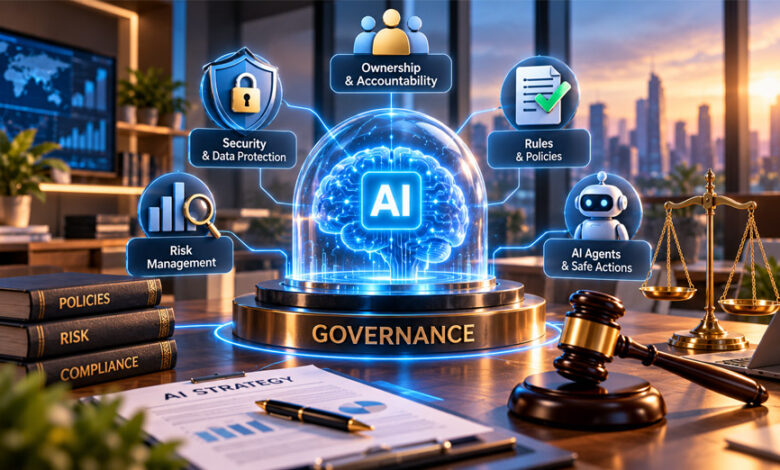
AI Transformation Is a Problem of Governance: A Complete Guide for Businesses

AI is now used in many businesses. Companies use it to write content, study data, answer customer questions, review documents, write code, and help workers make decisions. AI agents can go even further. They can use tools and take actions inside business systems.
But using AI is not only about choosing a good AI model. A business must decide who controls the AI, what data it can use, what actions it can take, and who is responsible if something goes wrong. This is why AI transformation is a problem of governance.
This guide explains AI governance, ownership, AI agents, data security, risk, human control, and the rules businesses need when using AI.
What Does AI Governance Mean?
AI governance means the rules and controls a business uses to manage AI. It covers who can use AI, what it can do, what information it can access, and who is responsible for its results.
For example, a company may use AI to help review loan applications. The company must decide what customer information the AI can see. It must also decide when a person needs to check the AI’s recommendation and what happens if the result is wrong or unfair.
AI governance and AI management are related, but they are different. AI management is mainly about building, running, testing, and maintaining an AI system.
Governance focuses more on the rules around that system. It decides if the AI should be used, what limits it should have, who accepts the risk, and who can stop it.
Not every AI tool needs the same level of control. A writing assistant normally needs fewer controls than AI used for hiring, healthcare, money, or legal decisions.
Why AI Transformation Is a Problem of Governance
A powerful AI model does not automatically make an AI project successful. The company still has to decide how the technology should be used.
The same type of AI can be used for very different jobs. One worker might use AI to fix grammar in a presentation. A customer service team might use it to answer customers. A financial company might use AI to help make important financial decisions.
The technology may be similar, but the risks are very different.
Businesses therefore need to look at more than the AI model. They must also think about the data, users, permissions, decisions, and possible harm.
Before using an important AI system, a company should know who approved it, who owns it, what information it can access, and what it can do without human approval.
The company should also know who checks the system and who can stop it if something goes wrong.
AI cannot make these business rules by itself. People inside the company must make them.
The business also remains responsible for the results. Saying “the AI did it” does not remove the company’s responsibility.
Why Traditional IT Governance Is Not Enough
Traditional software usually follows fixed rules. A payroll system, for example, processes information based on rules that have already been set.
Modern AI works differently. Large language models can produce different answers depending on the question, instructions, data, and context.
They can also give incorrect information. Sometimes an AI answer may sound confident even when it is wrong.
AI systems can also change over time. A provider may update the model. The company may connect new data. Employees may start using the tool for different jobs.
This means checking an AI system only once before launch is not enough.
Businesses need to keep checking important AI systems after they are being used.
The NIST AI Risk Management Framework supports this approach. It uses four main functions: Govern, Map, Measure, and Manage. The idea is to manage AI risks throughout the life of the system.
Ownership and Accountability
One of the biggest questions in AI governance is: Who owns the AI system?
This can become confusing in a large business.
IT may manage the technology. An outside company may provide the AI model. A data team may connect company information. Security teams may control access. Legal teams may set rules. Another department may actually use the system.
When many teams are involved, it can become difficult to know who is responsible.
Important AI systems should therefore have a clear owner.
The owner does not need to build the AI. Instead, the owner should understand why the system is being used, what result the company wants, and what risks are involved.
Other teams can still have their own jobs. Technical teams can manage performance. Security teams can deal with security risks. Legal, privacy, and compliance teams can check their own areas.
The AI owner should also have real power. There is little value in naming someone as the owner if they cannot ask questions, request changes, or stop the system when needed.
Clear ownership is especially important when something goes wrong. The company should already know who will investigate the problem and who can decide whether the AI should be stopped.
AI Agents and Decision Rights
AI agents create new governance questions because they can do more than give answers.
A normal AI assistant might tell a worker that a customer appears to qualify for a refund.
An AI agent could go further. It might check the customer’s account, issue the refund, update company records, send an email, and start another task.
AI agents can use tools, access databases, work with company software, and complete several steps without constant human help.
This can make them useful, but it also creates more risk.
A company needs to decide what an AI agent is allowed to do. Can it spend money? Can it change customer records? Can it send emails? Can it approve payments? Can it publish information?
Some simple actions may be safe to complete automatically. Important actions may need approval from a person.
The main question is not only, “Can the AI do this?” Businesses also need to ask, “Should the AI be allowed to do this by itself?”
Guardrails, Permissions, and Controls
AI guardrails are limits placed around an AI system.
They can stop certain actions, block access to private information, limit spending, filter unsafe content, or require human approval.
However, guardrails alone are not enough.
For example, a company might allow an AI purchasing agent to spend up to a certain amount. The system can enforce that limit. But someone still needs to decide why that amount is safe and what happens if the AI behaves strangely.
Businesses need several controls working together.
Policies explain how AI can be used. Permissions decide which files and systems AI can access. Guardrails limit its actions. Monitoring helps the company see what the AI is doing.
Businesses should generally give an AI system only the access it needs for its job.
For example, an AI tool used to summarize public documents does not need access to employee payroll information.
Companies should also decide when an AI system must be stopped and who has the power to stop it.
Shadow AI and Unapproved Tools
Shadow AI means workers use AI tools without company approval or proper controls.
For example, an employee might upload a customer list to a public AI service. Another worker might paste private code, contracts, financial information, or internal documents into an AI chatbot.
This can create privacy and security problems.
The company may not know where the information goes, how long it is stored, or how the AI provider uses it.
Shadow AI often happens because workers want to save time. If the company’s approved tools are difficult to use, employees may look for easier options.
Simply banning outside AI tools may not solve the problem.
Companies can provide approved AI tools that are safe and easy to use. They should also clearly explain what information workers can and cannot share with AI services.
Training is important too. Employees should understand how to handle customer information, private documents, company data, and other sensitive information.
Data Governance, Privacy, and Security
AI becomes more useful when it can access company information.
This may include customer records, emails, documents, product information, company procedures, and business data.
But giving AI more information also creates more risk.
Businesses need to know who owns the data and who can approve its use. They should also understand what happens when information is sent to an outside AI provider.
Important questions include how long the provider keeps the data, where it is processed, and whether it may be used for other purposes.
AI agents can create extra risks because they may connect several systems together. An agent could gain access to information that was previously kept separate.
Security is also important. AI systems can face problems such as stolen accounts, unsafe instructions, prompt injection, or too much access to company systems.
Companies should give AI only the information and permissions needed for its work.
Outside AI providers should also be checked. A popular provider is not automatically safe for every business use.
Businesses should look at security, privacy, data storage, contracts, incident reporting, and what happens if the service stops working.
Risk Tiering for AI Systems
Not every AI system has the same level of risk.
An AI tool that summarizes public information has much less risk than one used for hiring, loans, medical care, payments, or legal decisions.
Businesses can therefore place AI systems into different risk levels.
Low-risk tools can have simpler rules. Higher-risk systems need stronger testing, approval, monitoring, and human control.
Risk can depend on the type of data used, how many people are affected, how much power the AI has, and how serious a wrong decision could be.
For example, an AI writing assistant has limited power. An AI agent that can transfer money or change customer accounts has much more power.
Risk should also be checked again when an AI system changes. Giving a tool new data or new permissions can increase its risk.
Human Oversight Must Have Real Authority
Many companies say they keep a “human in the loop.” This means a person checks or approves an AI decision.
But simply adding a human approval button does not always make a system safe.
The person needs enough information and time to understand the AI result. They also need the power to disagree with it.
This can become difficult when AI produces thousands of results. Workers may start approving decisions without checking each one carefully.
Different systems may need different levels of human control. Some actions may need approval before they happen. Other systems may run automatically while a person monitors them.
Higher-risk decisions usually need stronger human control.
People affected by important AI decisions may also need a way to question the result, correct wrong information, or ask a person to review the decision.
Traceability and AI Audit Trails
Businesses should be able to understand what happened when an AI system makes a mistake.
This is called traceability.
Useful records may show which AI model was used, what instructions it received, what information it accessed, what tools it used, and whether a person approved the final action.
This is especially important for AI agents because one task may pass through several systems.
A simple example could be:
User → AI Agent → Model → Tool → Database → Decision → Human Approval → Action
Logs and records can help a company understand where something went wrong.
They can also show repeated problems. The company can then change the AI model, instructions, data, permissions, or business process.
Important systems usually need stronger records than simple low-risk AI tools.
Bias, Wrong Goals, and Unfair Results
An AI system can work correctly from a technical point of view and still produce a bad result.
Sometimes the problem is the goal given to the AI.
For example, a company may tell an AI system to complete tasks as quickly as possible. The AI may improve speed but reduce quality.
The system followed its goal, but the goal was not complete.
Bias can also come from data. Old data may contain unfair patterns, missing information, or past differences in how people were treated.
AI can learn these patterns and repeat them.
A system may also work well for most users but perform poorly for a smaller group. Looking only at overall accuracy can hide this problem.
Businesses should test important AI systems in the real situations where they will be used. They should check accuracy, fairness, errors, and possible harmful results.
Real Examples of AI Governance Failure
Some real cases show how problems can happen when AI goals, data, or controls are not handled carefully.
Amazon’s Experimental Recruiting Tool
Reuters reported in 2018 that Amazon stopped work on an experimental recruiting system after the models showed bias against women.
The system learned from past resumes. Men had been heavily represented in the technology jobs shown in that data. This helped the system learn patterns that could work against some resumes linked with women.
Amazon said the tool was not used to evaluate job candidates in practice.
The case shows why companies should not assume that past data is always a good guide for future decisions.
AI hiring systems need careful testing. Businesses also need people who can reject a system when it produces unfair results.
Healthcare Risk Algorithm
A 2019 study published in Science looked at a healthcare algorithm used to help identify patients who needed more care.
The system used expected healthcare spending as a way to measure health needs.
Researchers found that Black patients could be much sicker than White patients with the same risk score. Healthcare spending did not always show a person’s true medical needs.
Changing the target to better represent health needs reduced the bias found by researchers.
This example shows why businesses need to choose the right goal for an AI system. A model can correctly measure the wrong thing.
Continuous Monitoring After Launch
AI governance does not stop when a system is launched.
Models, data, users, providers, and business needs can change over time.
An AI tool that worked well during testing may become less accurate later. Changes in data can also affect its results.
Companies should continue checking important AI systems for errors, security problems, unfair results, and unusual behavior.
A major change may also require another review. This could happen when the company changes the AI model, adds a new data source, gives the AI more permissions, or starts using it for a new purpose.
Businesses should also decide what happens when a serious problem is found.
Some problems may only need an investigation. Serious problems may require the AI system to be stopped until the issue is fixed.
AI Governance Standards and Frameworks
Businesses do not have to create all their AI governance rules from the beginning.
Existing frameworks and standards can help.
NIST AI Risk Management Framework
The NIST AI Risk Management Framework helps organizations manage AI risks.
It is a voluntary framework built around four main functions: Govern, Map, Measure, and Manage.
Govern covers rules, responsibilities, and company processes. Map helps businesses understand the AI system and how it is being used.
Measure focuses on studying risks. Manage focuses on what the organization should do about those risks.
The framework treats AI risk management as an ongoing process rather than a one-time check.
ISO/IEC 42001
ISO/IEC 42001 is an international standard for AI management systems.
It gives organizations a structured way to manage AI. It covers policies, responsibilities, risks, controls, monitoring, and continued improvement.
It can help companies make AI governance part of normal business operations.
OECD AI Principles
The OECD AI Principles provide guidance for responsible AI.
They cover areas such as human rights, transparency, safety, accountability, and AI risk management.
For businesses, accountability is especially important. Companies need to know who is responsible for AI systems and be able to understand important AI decisions when problems happen.
AI Regulation and the EU AI Act
AI governance is also becoming an important legal issue.
The European Union’s AI Act uses a risk-based approach. The rules that apply depend on the AI system, how it is used, and the possible risks.
The law includes requirements in areas such as risk management, transparency, documentation, human oversight, monitoring, and record keeping for systems covered by its rules.
Different requirements apply at different times and to different types of AI systems. Businesses should check which rules apply to their own AI use instead of assuming every tool follows the same requirements.
Other laws may also apply.
These can include privacy, employment, consumer protection, cybersecurity, intellectual property, and anti-discrimination laws.
Businesses should therefore keep clear records for important AI systems. They may need to show why a system was approved, how it was tested, who controls it, and how it is monitored.
How to Build an AI Governance System
Businesses can create a simple governance process that becomes stronger as the risk increases.
Create an AI Inventory
Start by making a list of the AI tools being used across the company.
Include internal systems, outside AI services, AI features inside other software, customer-facing tools, and AI agents.
Record what each system does, who owns it, what data it uses, who can access it, and what actions it can take.
This can also help a business find unapproved AI tools.
Classify Each Use by Risk
Decide how serious the result could be if the AI makes a mistake.
Look at the data being used, how many people may be affected, how much power the AI has, and whether a wrong decision can easily be fixed.
High-risk systems should receive stronger checks. Low-risk tools can follow simpler rules.
Assign Clear Owners
Every important AI system should have a clear owner.
The owner should understand why the AI is being used and what risks it creates.
Technical, security, legal, privacy, and compliance teams can support the owner.
The company should also know who has the power to stop the system.
Define AI Decision Rights
Clearly decide what the AI can and cannot do.
Some simple actions may happen automatically. More important actions may need approval from a person.
Companies should set clear limits for data access, payments, customer communication, company systems, and other important actions.
Set Clear Tests Before Launch
Businesses should test important AI systems before using them.
Tests may cover accuracy, security, privacy, fairness, human review, and limits on AI actions.
The requirements should be clear enough to measure.
Create Human Review and Appeals
Human reviewers should be able to question and reject AI results.
For important decisions, people affected by the AI may also need a way to report mistakes, correct information, or request another review.
This can help businesses find problems that normal performance reports may miss.
Monitor and Record AI Activity
Important AI systems should continue to be checked after launch.
Businesses can watch for errors, unusual actions, security problems, and changes in performance.
Good records also make it easier to investigate problems.
Prepare for AI Incidents
Businesses should have a plan for AI problems.
The plan should explain who receives an alert, who investigates the issue, and who can stop the AI system.
After a serious problem, the company should also find the cause and make changes to reduce the chance of it happening again.
Govern AI Vendors
Businesses also need to check outside AI providers.
Before giving a provider private data or access to important systems, companies should review its security, privacy rules, data storage, contract terms, and incident process.
Businesses should also understand which risks are handled by the provider and which remain their own responsibility.
How Good Governance Can Speed Up AI Adoption
AI governance does not always have to slow businesses down.
Clear rules can actually make AI adoption easier.
For common low-risk uses, companies can create standard rules. Workers then know which tools they can use, what information they can share, and when they need approval.
Higher-risk AI can follow a stronger review process.
This reduces confusion between business, legal, security, and technical teams. Everyone knows what needs to be checked before an AI system can be used.
Good governance is not about adding as many rules as possible. It is about using the right controls for each level of risk.
The Future of AI Governance
AI governance will become more important as AI systems gain more power to act on their own.
With basic AI tools, businesses often focus on prompts and the quality of answers.
AI agents create a different question: What is the AI allowed to do?
Companies need to decide what an AI system can see, change, send, approve, buy, or publish. They also need to decide when the AI must stop and when a person must take control.
This may also change some jobs.
A worker who once completed a task may instead check the work of an AI system. A manager may set rules for thousands of AI actions instead of approving each action one by one.
AI transformation can therefore change how authority and responsibility work inside a company.
Bottom Line
AI transformation is a problem of governance because AI can influence decisions and take actions inside a business.
Good technology is still important. Businesses need reliable AI, good data, security, testing, and skilled workers. But technology alone cannot decide how much power an AI system should have.
Companies need clear ownership, permissions, human control, risk levels, data rules, monitoring, records, and plans for problems.
The goal is not to stop businesses from using AI. It is to use AI in a useful and controlled way while keeping people responsible for important decisions.
Frequently Asked Questions
Why is AI transformation a problem of governance?
AI can make decisions and take actions. Businesses need clear rules about what AI can do and who is responsible.
What is AI governance?
AI governance means the rules and controls a business uses to manage AI safely.
Who should be responsible for an AI system?
Every important AI system should have a clear owner who is responsible for how it is used.
How are AI agents different from normal AI tools?
Normal AI tools mainly give answers. AI agents can also use tools, access systems, and take actions.
What is Shadow AI?
Shadow AI is when workers use AI tools without company approval. This can create privacy and security risks.
What is the NIST AI Risk Management Framework?
It is a framework that helps businesses manage AI risks. It uses four parts: Govern, Map, Measure, and Manage.
Does every AI system need the same level of governance?
No. Low-risk AI needs fewer controls, while high-risk AI needs stronger rules and human checks.
Can good AI governance help businesses use AI faster?
Yes. Clear rules reduce confusion and help businesses use AI more safely and quickly.
Sodziu: Lithuania’s Traditional Villages and Rural Heritage
What Is Giniä? Meaning, Possible Uses, Benefits, and Key Facts