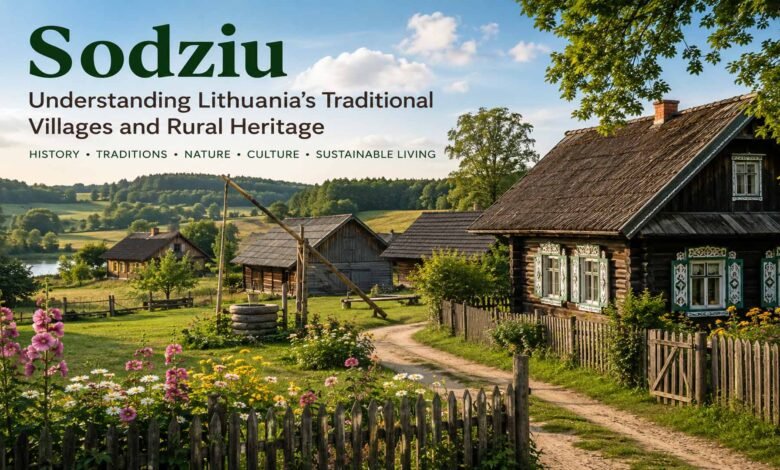

Sodziu is a word people may find when searching for Lithuanian villages, countryside traditions, and rural culture. The more accurate Lithuanian spelling is sodžius, a term connected with a village or rural settlement.
The word is sometimes confused online with other Lithuanian terms, especially sodyba and kaimas. Some websites also describe Sodziu as a fabric-dyeing art, but reliable Lithuanian language sources do not support that meaning.
This article explains what Sodziu means, how it differs from related words, and how traditional Lithuanian village life developed. It also covers rural homes, farming, nature, food, crafts, celebrations, tourism, and the modern importance of Lithuania’s countryside heritage.
What Does Sodziu Mean?
Sodziu is usually a simplified spelling of the Lithuanian word sodžius. In Lithuanian dictionaries, sodžius is used for a village or rural settlement. It is closely connected with the idea of people living together in the countryside, often in communities historically linked with farming.
The spelling Sodziu appears because the Lithuanian letter ž is sometimes replaced with a normal “z” when people type without Lithuanian characters. This is common on international websites, search engines, and devices that do not use a Lithuanian keyboard.
Sodžius does not describe a company, product, application, or service. It is a language and cultural term. Its meaning is connected with Lithuania’s rural settlements and the wider history of countryside life.
The word can also carry a broader cultural sense. A reference to sodžius may bring to mind traditional homes, farms, gardens, local customs, and close connections with the surrounding land. These ideas come from the history of Lithuanian village life rather than from a strict dictionary definition alone.
Sodziu, Sodyba, and Kaimas: What Is the Difference?
Sodžius, sodyba, and kaimas are related Lithuanian words, but they are not exactly the same.
Sodžius generally means a village or rural settlement. It can have an older or more traditional rural sense in some contexts.
Kaimas is also used for a village and is a common modern Lithuanian word for a rural settlement. Because the two words overlap in meaning, dictionaries may use one when explaining the other.
Sodyba is different. It normally refers to a single homestead, farmstead, or rural property. A sodyba may include a house, land, barns, gardens, and other buildings belonging to one household or estate.
The plural of sodyba is sodybos. Some English-language articles wrongly describe sodybos as the plural of Sodziu. That is not correct. They are separate words.
A simple way to understand the difference is this: a sodžius or kaimas can describe the wider village, while a sodyba usually describes an individual rural homestead within or near such an area.
The meanings can overlap in historical or informal use, so the exact sense sometimes depends on context. Still, keeping these basic differences clear helps avoid many of the mistakes found in online descriptions of Sodziu.
The History of Sodziu in Lithuania
Rural settlements have played an important role in Lithuanian history for centuries. Before modern industrial and urban growth, a large part of everyday life depended on agriculture, livestock, forests, and locally produced food.
Village communities developed around access to farmland, water, roads, forests, and other useful resources. Households often depended on several forms of work at the same time. A family might grow crops, keep animals, maintain a garden, collect food from forests, and prepare supplies for winter.
Lithuanian rural life changed repeatedly as political systems and land ownership changed. Different periods brought wars, foreign rule, land reforms, economic changes, and new forms of agricultural organization.
One major change came during the Soviet period. Agriculture was reorganized through collectivization, which changed land ownership, farm management, and many traditional village structures. Some older farming patterns disappeared or became less common.
After Lithuania restored independence in 1990, rural areas changed again. Private property, new businesses, migration, improved transport, and closer links with European markets all affected countryside life.
Traditional villages therefore should not be seen as places that remained unchanged for hundreds of years. They adapted to economic, political, and social change. However, older houses, farming practices, foods, crafts, songs, and local customs continue to provide an important link with Lithuania’s rural past.
Traditional Sodziu Village Life
Traditional village life was closely connected with work that had to be done throughout the year. Daily routines depended on the season, the type of farm, the size of the household, and the resources available nearby.
People could spend much of their time growing food, caring for animals, repairing buildings, preparing firewood, preserving food, making household items, and managing fields or gardens. Work usually changed with the seasons.
Spring was important for preparing land and planting. Summer brought crop care, haymaking, gardening, and other outdoor work. Autumn was closely connected with harvesting and food preservation. Winter reduced some farm work but brought other tasks, including repairs, crafts, food preparation, and care of animals.
Families often shared responsibilities. Children could learn practical skills from parents and grandparents, while older family members passed on knowledge about farming, cooking, plants, weather, crafts, and local customs.
Neighbors also mattered in rural communities. Larger jobs could require cooperation, especially when equipment and labor were limited. Weddings, religious occasions, markets, harvest activities, and seasonal celebrations also created opportunities for communities to gather.
It is important not to imagine one fixed “Sodziu lifestyle.” Lithuanian villages differed by region, period, family income, land quality, religion, and local tradition. Rural life also changed greatly as machinery, electricity, roads, schools, and modern services became more widely available.
Nature and the Lithuanian Countryside
Nature has always been closely connected with rural life in Lithuania. Farms and villages developed among forests, fields, rivers, lakes, wetlands, and meadows.
The land provided more than agricultural space. Forests supplied wood, mushrooms, berries, herbs, and other useful resources. Water sources were important for households, livestock, farming, fishing, and everyday life.
Seasonal changes strongly affected rural routines. Weather influenced when crops could be planted, when hay could be cut, when food could be gathered, and how people prepared for winter.
Mushroom and berry gathering remain well-known parts of Lithuanian countryside culture. Forest-rich areas such as Dzūkija are especially associated with these activities.
Trees and forests also hold an important place in Lithuanian folklore and traditional beliefs. Older Baltic traditions gave symbolic meaning to parts of the natural world, while later Christian customs developed alongside earlier beliefs.
For people visiting Lithuania today, forests, lakes, national parks, and rural villages remain closely connected parts of the countryside experience. Modern village life is different from historical farming life, but nature is still one of the main features that defines rural Lithuania.
Traditional Houses and Rural Architecture
Traditional Lithuanian rural architecture was designed around practical needs. Wood was widely used because it was locally available and suitable for houses and farm buildings.
A rural homestead could include a main house together with barns, sheds, storage buildings, cellars, animal spaces, gardens, and other structures. The exact layout depended on the region, period, size of the farm, and wealth of the household.
Older houses often needed heating systems that could handle Lithuania’s cold winters. Stoves and fireplaces were therefore important parts of the home. In some traditional houses, a large stove was used for both heating and cooking.
Food storage was another major concern. Cellars and cool storage areas helped families keep vegetables, preserved foods, and other supplies through colder months.
Wooden fences, gates, carved details, painted trim, and decorated windows could add visual character to rural properties. However, styles varied across different parts of Lithuania, so there was no single design shared by every sodžius.
This is also where the difference between sodžius and sodyba becomes useful. A sodžius can refer to the wider village or settlement, while a sodyba normally refers to one individual rural homestead and its buildings.
Some traditional properties survive today, while others have been restored or adapted for modern use. Rural tourism has also helped give new uses to older farmsteads.
Farming, Gardening, and Beekeeping
Agriculture was at the center of traditional Lithuanian village life. Farming provided food, animal feed, materials, and income for rural households.
People grew different crops according to local soil and climate. Rye became especially important because it was well suited to northern European growing conditions and played a major role in traditional bread-making.
Potatoes, vegetables, grains, and garden produce were also important. Home gardens helped families grow food that could be eaten fresh or preserved for later use.
Livestock added another part of the rural economy. Families could keep cattle, pigs, poultry, horses, or other animals depending on the farm. Animals provided food, transport, farm labor, and useful materials.
Beekeeping has a long place in Lithuanian rural culture. Honey was valued as food, while beeswax had practical uses. Beekeeping knowledge was often connected with observation of weather, plants, flowering seasons, and the surrounding landscape.
Lithuania still preserves this tradition through museums, educational activities, and countryside tourism. Visitors can learn about historical beekeeping methods and the role bees have played in rural communities.
Foraging also added to the food available from farms and gardens. Mushrooms, berries, herbs, and other wild foods could be gathered from nearby forests and meadows.
These activities show why Sodziu is closely connected with the land. Traditional village households often relied on several sources of food and work at once rather than on a single farming activity.
Traditional Food and Bread-Making
Food in traditional Lithuanian villages depended heavily on what families could grow, raise, gather, and preserve locally. Grains, potatoes, vegetables, dairy products, meat, mushrooms, berries, and honey all played an important role in rural diets.
Rye was especially important. Juoda duona, or dark rye bread, became one of the best-known foods in Lithuanian cuisine. Bread-making was often done at home, and older methods could involve sourdough starters, long fermentation, and baking in a heated oven.
Potatoes also became a major part of Lithuanian cooking. They are used in dishes such as cepelinai, large potato dumplings usually filled with meat, curd, or other ingredients. Another well-known dish is šaltibarščiai, a cold beet soup often served with potatoes.
These foods are part of Lithuanian cuisine as a whole. They should not be described as dishes that belong only to Sodziu communities.
Preservation was essential in rural households. Vegetables could be fermented, mushrooms dried, meat smoked or salted, and berries preserved for later use. These methods helped families store food through long winters.
Honey was another useful local product. It could be eaten directly, used in cooking, or kept for household needs. In areas where beekeeping was common, honey and beeswax were both valuable parts of rural life.
Crafts, Folk Art, and Traditional Skills
Traditional Lithuanian village life included many practical skills that families used every day. People often made or repaired items themselves because shops and manufactured goods were not always easy to access.
Weaving was one important skill. Linen and wool could be used to make cloth, towels, clothing, belts, and household textiles. Embroidery and decorative patterns were also used in some regions.
Woodworking was equally important. Wooden spoons, furniture, tools, fences, storage items, and parts of buildings could all be made by local craftspeople or household members.
Many of these objects were practical, but they could also include decoration. Carved wood, woven patterns, and embroidered designs helped give everyday items a local style and identity.
It is important to separate these real Lithuanian craft traditions from the unsupported claim that Sodziu itself is a fabric-dyeing technique. Traditional Lithuanian textile work certainly existed, but reliable language sources define sodžius as a village or rural settlement, not as a named dyeing method.
Folklore, Songs, and Village Traditions
Folklore was an important part of Lithuanian rural culture. Before radio, television, and the internet, stories, songs, sayings, and legends were often passed from one generation to another by word of mouth.
Folk songs could describe work, family life, love, war, nature, and seasonal events. Some songs also helped preserve memories of local history and older customs.
Lithuanian and Baltic folklore includes figures such as laumės, supernatural female beings often connected with nature, and Velnias, a figure that appears in many folk stories. The meanings of these figures changed over time and could differ between regions.
Older Baltic beliefs also mixed gradually with Christianity. As a result, some rural traditions combined pre-Christian ideas about nature and seasons with later Christian holidays and customs.
Proverbs and sayings were another part of village culture. They could express practical advice about work, weather, family, honesty, patience, or community life.
Festivals and Seasonal Celebrations
Many Lithuanian celebrations are connected with religion, the seasons, and older rural traditions.
Joninės is the Lithuanian midsummer celebration. It takes place around the summer solstice and is linked with bonfires, singing, wreaths, plants, and outdoor gatherings. Some customs have older Baltic roots, while others developed later.
Kūčios is the traditional Christmas Eve meal. It is an important family occasion in Lithuania and is associated with specific foods, customs, and remembrance of family members.
Užgavėnės is a pre-Lenten celebration held before the Christian fasting period. It is known for masks, costumes, food, noise, and traditional performances.
Harvest celebrations were also important in agricultural communities. They marked the end of major seasonal work and gave people a chance to gather, eat, sing, and celebrate the year’s crops.
Not every village followed every custom in exactly the same way. Practices could vary by region, family, and historical period.
Sodziu and Modern Lithuanian Rural Life
Modern Lithuanian villages are very different from the rural communities of the past. Electricity, paved roads, cars, modern machinery, mobile phones, internet access, and improved public services have changed daily life.
Many people living in rural areas today work outside agriculture. Some commute to nearby towns, run small businesses, work remotely, or combine farming with other jobs.
Traditional wooden homes still exist, but they can stand beside renovated houses and newer buildings. Some old farmsteads have been restored as private homes, guesthouses, museums, or rural tourism properties.
Technology has also changed farming. Modern equipment, improved storage, new crop systems, and digital tools can reduce the amount of manual labor needed.
This means Sodziu should not be described as a lifestyle frozen in the past. Modern rural Lithuania includes both old traditions and contemporary ways of living.
Sodziu and Sustainable Living
Some features of traditional Lithuanian village life have similarities with modern ideas about sustainability.
Rural households often reused materials, repaired tools, preserved food, grew vegetables, kept animals, and relied on local resources. These practices reduced waste because they were practical and necessary.
Seasonal eating was also common. Families used the food available at different times of year and stored what they could for winter.
However, it would be misleading to say that every traditional Sodziu was automatically “organic,” “zero waste,” or environmentally friendly in the modern sense. Those are newer terms with specific meanings.
Modern rural homes may also use newer technologies such as solar panels, efficient heating systems, or rainwater collection, but these are modern additions rather than traditional features of sodžius life.
The useful lesson is simpler: older rural communities often depended on careful use of land, food, tools, and local materials because resources had to last.
Rural Tourism and Visiting Lithuanian Villages
Rural tourism gives visitors a chance to experience parts of Lithuanian countryside culture today.
One common option is staying in a sodyba, or rural homestead. These properties can range from simple farm stays to modern guesthouses with private rooms, saunas, lakeside access, and recreational facilities.
Visitors may also find activities linked with traditional rural life. These can include bread-making, beekeeping, mushroom gathering, food preparation, craft workshops, and guided walks.
Lithuanian sauna traditions are another countryside experience offered by some rural properties. These may include steam, herbal plants, traditional bath whisks, and other local practices.
Forests and lakes are also important parts of rural travel in Lithuania. Visitors may combine a village stay with hiking, fishing, cycling, canoeing, or trips to national and regional parks.
Ethnographic museums, old wooden churches, restored farmsteads, and heritage villages can help visitors understand how rural communities lived in earlier periods.
Rural tourism is also useful for local communities. It can create income while helping preserve older buildings, traditional food, crafts, and cultural knowledge.
Is Sodziu a Traditional Fabric-Dyeing Art?
Some websites describe Sodziu as an old Eastern European fabric-dyeing technique. These articles may mention tie-dyeing, batik, wax resistance, natural dyes, indigo, turmeric, and handmade textile patterns.
Reliable Lithuanian language sources do not support this definition.
The established meaning of sodžius is connected with a village or rural settlement. There is no strong evidence that Sodziu is the recognized name of a traditional Lithuanian dyeing method.
Batik and other resist-dyeing methods are real textile techniques, but they have their own histories and names. Their existence does not prove that Sodziu is a fabric art.
Claims about designers using “Sodziu” in fashion collections should also be treated carefully unless reliable sources confirm them.
For readers who find both meanings online, the safest conclusion is clear: Sodziu is best understood as a simplified spelling of the Lithuanian word sodžius, meaning a village or rural settlement.
Why Sodziu Still Matters Today
Sodziu remains useful as a cultural idea because it helps explain Lithuania’s rural past.
Traditional villages played an important role in farming, food production, family life, crafts, folklore, and local customs. Many parts of modern Lithuanian culture developed in these rural settings.
Interest in countryside life also continues today. Some people are drawn to rural tourism, local food, traditional crafts, old architecture, or nature-based travel.
Museums and heritage projects can help preserve older buildings and farming tools. Cultural programs can protect songs, crafts, recipes, and customs that may otherwise disappear.
At the same time, preservation does not mean stopping change. Rural communities need modern housing, jobs, transport, education, health services, and technology like any other place.
The long-term value of Sodziu is therefore not only about remembering the past. It is about understanding how Lithuanian rural heritage can remain meaningful while villages continue to develop.
Bottom Line
Sodziu is best understood as the simplified spelling of the Lithuanian word sodžius, meaning a village or rural settlement.
The term is closely connected with Lithuania’s countryside history, agriculture, traditional homes, food, crafts, folklore, seasonal customs, and community life.
It should not be confused with sodyba, which usually means a homestead or farmstead, or with unsupported online claims that Sodziu is an ancient fabric-dyeing technique.
Today, Lithuanian rural heritage survives through villages, restored farmsteads, traditional foods, cultural programs, tourism, and the people who continue to live and work in the countryside.
(FAQs)
What does Sodziu mean?
Sodziu is a simplified spelling of the Lithuanian word sodžius. It generally means a village or rural settlement and is closely linked with traditional countryside life.
Is Sodziu a Lithuanian word?
Yes. The correct Lithuanian spelling is sodžius. The form “Sodziu” is often used online when the Lithuanian letter ž is left out.
What is the difference between sodžius and sodyba?
A sodžius usually refers to a village or rural settlement. A sodyba is an individual homestead, farmstead, or rural property. The plural of sodyba is sodybos.
Is kaimas the same as sodžius?
The words are closely related. Kaimas is a common Lithuanian word for village, while sodžius can have an older or more traditional rural meaning in some contexts.
Is Sodziu a traditional fabric-dyeing technique?
Reliable Lithuanian language sources do not support that claim. Some websites describe Sodziu as a dyeing art, but the established meaning of sodžius is village or rural settlement.
What was traditional life in a Lithuanian village like?
Traditional village life often included farming, gardening, livestock care, food preservation, bread-making, crafts, foraging, and seasonal work. Daily routines depended on the region and the needs of each household.
Can tourists experience traditional Lithuanian village life today?
Yes. Visitors can stay at rural homesteads, visit heritage villages, try traditional food, join craft or bread-making activities, experience saunas, and explore forests, lakes, and museums.
Why is Lithuanian rural heritage important?
It helps preserve traditional architecture, food, farming knowledge, crafts, songs, folklore, and local customs. It also provides useful information about how Lithuanian communities lived and changed over time.
What Is Giniä? Meaning, Possible Uses, Benefits, and Key Facts
IP2 Network Guide: Features, Setup, Benefits, Safety, and Alternatives