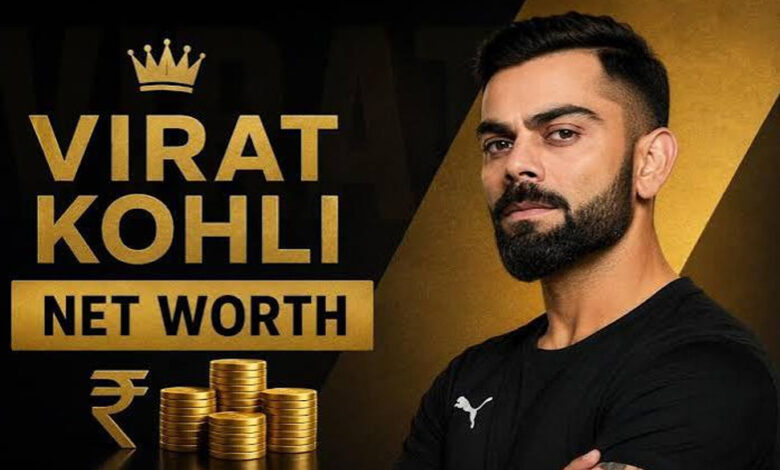

Virat Kohli’s net worth cannot be stated as a confirmed public number because his private investments, assets and commercial contracts are not fully disclosed. However, widely reported estimates have placed it around ₹1,050 crore, while broader industry estimates in 2026 have ranged from roughly ₹800 crore to ₹1,200 crore. The main drivers are not simply his cricket salary: endorsement agreements, long-running consumer brands, business stakes and digital influence form a substantial part of the overall picture.
Why net-worth estimates differ
Net worth means the estimated value of assets after liabilities, rather than annual income. That distinction matters in Kohli’s case. Cricket contracts and sponsorship payments may be relatively straightforward to estimate, but the value of private business stakes, properties, brand partnerships and investments can change considerably. Public reports also differ in whether they count an asset’s purchase price, present market value or only an estimated ownership stake.
A 2023 report attributed to Stock Gro placed Kohli’s wealth at ₹1,050 crore, combining cricket contracts, endorsements, owned brands and social-media activity. A 2026 estimate similarly put his net worth at ₹1,050 crore, while another 2026 industry range ran from ₹800 crore to ₹1,200 crore. These figures should therefore be read as informed estimates, not audited financial disclosures.
Cricket remains the financial base
Kohli’s cricketing career created the platform for his wider commercial success. His income from India and franchise cricket gives him an established, performance-based foundation, even if off-field activity has become more important to his overall wealth. As an India player, he has been listed in the top A+ central-contract category, with reports putting the annual retainer at ₹7 crore, separate from match fees.
Reported match fees have been ₹15 lakh for a Test, ₹6 lakh for an ODI and ₹3 lakh for a T20 international. These amounts can vary with contract structures and policy changes, so they should not be treated as a complete measure of his annual cricket income. Selection, match availability and the international schedule all affect the final total in a particular year.
His role in Indian cricket has also strengthened the value of his commercial identity. A player’s visibility across bilateral series, major tournaments and domestic cricket creates repeated opportunities for brands, while exceptional performance keeps the public connection to the sport strong. That relationship is especially relevant for a player whose image has long been associated with competitiveness, training and batting consistency.
IPL earnings with Royal Challengers Bengaluru
Kohli has represented Royal Challengers Bengaluru throughout his IPL career, making the franchise association one of the most recognisable player-team relationships in the competition. Reports have put his annual IPL salary at ₹15 crore. Other estimates expressed the figure in US dollars at about $2.5 million for the 2025–26 period, showing why currency conversions and reporting dates can create apparent differences.
Over a long IPL career, even a steady annual contract can become an important component of career earnings. Yet IPL salary alone does not explain estimates of Kohli’s overall wealth. The league’s greater effect is its reach: the tournament gives high-profile players a lengthy annual window of national attention, which can support endorsement value and maintain relevance beyond international fixtures.
Royal Challengers Bengaluru won the 2026 IPL final against Gujarat Titans by five wickets, according to the official IPL competition information. Such team milestones add to the visibility around leading players, although a title should not be confused with a direct measure of personal income. For fans tracking the on-field combinations behind IPL performances, a regularly updated today dream11 best team guide can be useful alongside team news and confirmed line-ups.
Endorsements are central to the bigger picture
Brand endorsements are generally described as the largest source of Kohli’s off-field earnings. He has been linked with a broad portfolio across sportswear, automobiles, insurance, consumer goods, fitness, food, technology and lifestyle categories. Reports have named companies and brands including Puma, MRF, Audi, Blue Tribe, Digit Insurance and several consumer-facing Indian businesses.
The exact fee for any individual agreement is usually private. Some reports have claimed that he charges between ₹7.5 crore and ₹10 crore per endorsement, while others have offered higher or lower figures depending on campaign length and deliverables. A multi-year ambassador arrangement is also fundamentally different from a one-off advertisement, making simple fee comparisons unreliable.
What is clearer is the commercial logic behind his appeal. Kohli’s public image combines elite sport, fitness, discipline and mainstream celebrity. That makes him suitable for brands looking to connect with cricket audiences while also reaching consumers interested in fashion, health, technology and premium lifestyle products. Long-term credibility tends to matter more than the number of advertisements attached to a player at any one time.
The value of a large digital audience
Social media adds another layer to the endorsement model. Kohli’s accounts give brands a direct route to an audience that follows his cricket, training, travel and personal updates. A sponsored digital campaign can be delivered quickly, measured closely and adapted for different markets, which has made social platforms increasingly significant in athlete commercial deals.
Published estimates of his earnings per social-media post vary sharply, and there is no verified public rate card. It is more reasonable to view his digital presence as a bargaining advantage than as a fixed salary stream. It can raise the value of a wider brand partnership, support launches for his own ventures and keep his commercial profile active between major cricketing events.
Digital prominence also carries a risk. Endorsement income depends on public trust, brand suitability and continued audience engagement. It cannot be assumed that every social-media mention translates into long-term revenue, nor does a large follower count reveal the financial terms of a partnership.
Business ventures and investment interests
Kohli’s wealth story extends beyond advertising because he has built interests in businesses connected to his public identity. One8, associated with lifestyle and sportswear, and WROGN, a fashion brand, are among the ventures most often mentioned in reports about his commercial portfolio. These kinds of projects potentially offer more durable value than a single campaign because they may benefit from product sales, licensing and brand equity.
His reported investment interests have also included Digit Insurance, Blue Tribe Foods, Universal Sportsbiz and Sports Convo. Investment outcomes are uncertain by nature. A stake in a start-up may rise in value, remain illiquid for years or lose value, which is why it is difficult to calculate a precise net-worth contribution from these holdings.
Reports have also connected Kohli with fitness and hospitality ventures, as well as ownership interests in sports properties. The common thread is diversification. Rather than relying on match payments alone, a portfolio across consumer brands and investments can spread risk—although it also exposes an athlete to changing consumer demand and business-market conditions.
Assets and the limits of public valuations
Real estate and luxury possessions are often included in celebrity net-worth stories, but these reports require caution. Published accounts have linked Kohli and Anushka Sharma with residential properties in Mumbai, Gurugram and Alibaug. The reported values differ by source and may be based on past transactions rather than current valuations.
Cars, watches and other high-value items receive attention because they are visible symbols of celebrity wealth. They are not necessarily the most useful way to judge financial strength. Property can be difficult to sell quickly, while luxury goods may not retain a value close to their purchase price. Business ownership, contractual income and cash-flow investments can be more significant, even when they are less publicly visible.
A diversified modern sports portfolio
The most useful way to understand Virat Kohli’s estimated net worth is as a portfolio rather than a single cricket salary. India contracts and IPL earnings provide a core income stream. Endorsements monetise his public profile. Digital channels increase his reach, while brands and investments create the possibility of longer-term value outside active playing years.
The ₹1,050 crore figure remains an estimate rather than a confirmed total, and the broader ₹800 crore to ₹1,200 crore range reflects that uncertainty. Still, the available reports point to the same conclusion: Kohli’s financial standing has been shaped by a rare combination of sustained cricketing prominence, commercial demand and diversified business interests.