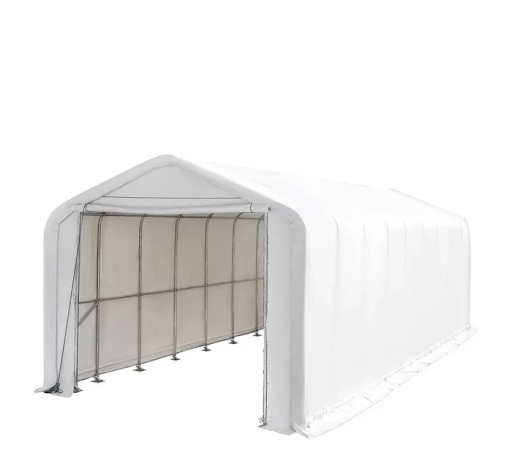

Caravans and motorhomes sit idle for much of the year in Australia, and where they sit decides how they age. Parked in the open, a vehicle bakes in strong sunshine, and parked in a sealed shed it can collect moisture. A motorhome storage shelter with a fabric cover and open ends offers a middle path, but door clearance, airflow, and sunlight exposure all need to be understood before buying.
Four Ways to Keep a Vehicle
Motorhome storage options can be sorted by how much weather they stop and how much air they allow. Open ground stops nothing, a carport shades the roof, a fabric shelter covers the whole vehicle with a flexible skin, and a solid building such as a caravan storage shed encloses it completely. Each choice trades protection against ventilation and cost.
Fabric shelters sit in a useful place on that scale. They shade the vehicle from direct sun and keep off rain, while the ends can be opened for airflow, which is why a caravan shelter or similar fabric structure often makes sense for long-term storage on farms and acreages.
Sunlight Wears Parts Quietly
Sunlight does gradual damage that is easy to overlook. Ultraviolet light breaks down rubber seals, fades paint and decals, and cracks tyre sidewalls over the seasons, and heat builds inside a closed vehicle on summer days. Covering the vehicle slows that wear and helps protect the interior.
The cover on the TMG-ST1845 is polyvinyl chloride at 570 grams per square metre, treated against ultraviolet light, oil and chemicals, and flame retardant. That means the fabric itself resists the same sunlight it is shielding the vehicle from, though it still needs periodic inspection. Heat is a second effect, because a vehicle under a shaded cover stays noticeably cooler inside than one parked in direct sun, which spares fridges, electronics, and upholstery.
Clearance Is a Measurement, Not a Guess
The roll-up doors are about 4 metres wide and 4.3 metres high, at both ends. Measure the vehicle at its tallest point before buying, including roof air conditioners, aerials, solar panels, and any rack. Width should include the mirrors, because mirrors are usually the first thing to catch a doorway. Allow a margin of at least several centimetres on every side rather than driving through with the mirrors a few millimetres from the frame.
Doors at both ends mean a motorhome can drive in one end and out the other, avoiding reversing in a tight space. Walls are 3.8 metres high, and the peak reaches 5.3 metres, which gives room beneath the roof for a tall vehicle and for working around it.
Airflow Prevents the Damp Problem
A sealed space holds moisture, and moisture means mould, musty smells, and rust. A vehicle that has just returned from a wet trip, or a night of heavy dew, will release damp air inside any enclosed building, so ventilation is part of good storage.
Rolling the doors partly open on dry days lets air move through the full length of the shelter. Leaving cupboards and storage compartments slightly open inside the vehicle helps too, and moisture absorbers can be placed inside during longer storage. Checking the vehicle every few weeks, even if it is not going anywhere, catches damp patches and pests before they spread.
Space for More Than the Vehicle
The covered area is about 75 square metres, from a footprint of 5.5 metres by 13.5 metres. A motorhome takes most of it, but a smaller caravan, a boat, or machinery can share the space, and extra room makes it easier to open doors and walk around the vehicle.
Plan the layout before the shelter goes up. Leave room to open awnings, check tyres, and reach the roof, and keep fuel containers and gas bottles out of the building, because a closed space is a poor place for anything flammable.
Foundation and Frame Matter
The galvanised steel frame uses trusses at 1.5 metre spacing, and the foundation area is 5.8 metres by 13.9 metres. A level, well-drained base keeps the frame square and stops water pooling around the legs, and the structure should be anchored according to the site and local requirements.
At a shipping weight of around 980 kilograms, the packed shelter needs machinery to unload and a plan for where the parts will be laid out. Check council rules too, because some areas require approval for structures above a certain size.
Choosing Before You Build
Before buying any motorhome storage, measure the vehicle, think about the sun and air at the site, and decide how often it will be moved. Interest in caravan and motorhome travel keeps growing, and covered storage that protects vehicles without trapping moisture is likely to stay in demand. TMG Industrial supplies this drive-through design for owners who want a practical, open-ended shelter.