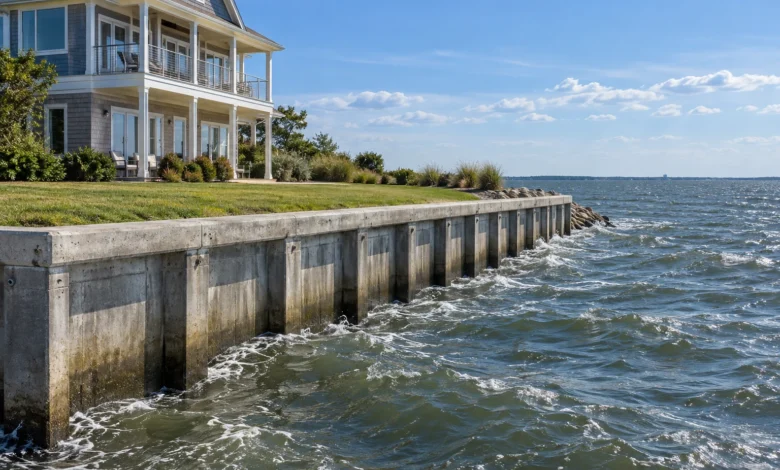

Concrete bulkheads occupy a specific place in Shore Protect Team’s material lineup. The service page describes reinforced concrete as exceptionally durable and identifies it as the best choice for commercial properties on the Gulf Coast and areas with hurricanes. That positioning makes exposure and structural demand central to the decision.
The company’s coastal construction services work covers both residential and commercial shoreline projects, including Gulf Coast properties. Concrete should therefore be considered where its strength aligns with the site’s conditions rather than selected only because it is the highest-priced bulkhead material on the page.
The published starting reference is $300 per linear foot for labor and materials. Final cost still depends on length, soil, water body, drainage, anchors, access, and whether the project is new construction or repair.
Concrete’s durability does not remove the need for a foundation matched to the soil. The page states that soil type determines pile driving depth and the need for additional reinforcement, with soft soils requiring deeper piles.
Groundwater pressure and soil pressure also remain separate design considerations. Drainage is used to relieve groundwater pressure, while tie-back anchors prevent displacement under retained soil pressure.
The concrete bulkhead information should therefore be evaluated as a high-strength wall system supported by site-specific piles, anchors, drainage, and access planning.
Why Gulf Coast exposure changes the material discussion
Coastal properties can face wave action, changing water levels, and severe weather exposure that differ from calm inland lakes. The service page explicitly connects reinforced concrete with Gulf Coast waterfront areas and hurricane zones.
This does not mean concrete is required on every coastal property. It means that its durability is positioned for conditions where maximum strength is a leading criterion.
Commercial properties create another reason to consider concrete
The page identifies concrete as the best choice for commercial properties in these demanding settings. Commercial projects may include marinas, resorts, and residential complexes, which Shore Protect Team lists among the property types it serves.
The final design still depends on the actual loads, dimensions, soil, and access of the project. “Commercial” is not a substitute for site assessment.
- Material – Reinforced concrete.
- Starting price – From $300 per linear foot for labor and materials.
- Primary positioning – Exceptional durability and high structural strength.
- Regional fit – Gulf Coast waterfront areas and hurricane zones.
- Property type – Strongly associated with demanding commercial applications.
- Foundation – Still determined by soil characteristics and required reinforcement.
Concrete does not eliminate hidden systems
The visible wall may be concrete, but anchors, drainage, piles, and connections remain important. A durable wall face can still be affected by groundwater pressure behind it or by a foundation that is not matched to the soil.
Owners should therefore compare concrete proposals by the complete structural system, not just concrete thickness or the per-foot price.
- Assess whether the shoreline has high exposure or hurricane-zone conditions.
- Confirm whether the property’s structural demands justify a high-strength material.
- Review soil conditions and the required foundation depth.
- Plan tie-back anchors according to wall height and soil type.
- Include drainage where groundwater pressure must be relieved.
- Evaluate access because concrete handling can make site logistics important.
When concrete becomes the logical option
Concrete is most compelling when durability, coastal exposure, and structural demand align. Its higher starting price should be compared with the performance needs of the site rather than against lower-cost materials that may be intended for calmer conditions.
A well-defined proposal will explain why concrete is being recommended for the property and how the foundation, anchors, drainage, and construction access support that recommendation.
Higher exposure makes proposal detail more important
When concrete is being considered for a demanding Gulf Coast site, the estimate should explain the conditions that justify the system. A generic statement about strength is less useful than a scope that identifies the shoreline exposure, soil assumptions, foundation, anchors, drainage, and access that the concrete wall will rely on.
This matters because a high-durability material can still be installed under very different site conditions. Two concrete bulkheads of the same length may require different foundation depths or construction access. The higher starting price of concrete should not hide those site-specific differences.
Commercial owners can also use this detail to compare capital scopes more clearly. If one proposal includes substantial foundation and access work while another gives only a wall price, the totals are not describing equivalent projects even though both specify reinforced concrete.
Concrete projects deserve careful access planning
Reinforced concrete is associated with demanding applications, but the site still has to accommodate the equipment and material handling required for construction. Limited waterfront access can change labor and staging even when the structural choice is clear. Owners should make sure the estimate reflects the real route to the wall line rather than an idealized open site.
Durability should be connected to the actual exposure
The page positions concrete strongly for Gulf Coast and hurricane-zone work. A proposal is more useful when it explains the exposure that makes concrete appropriate at that specific property instead of relying only on a broad regional label.
A final comparison should also separate the concrete wall itself from any neighboring waterfront structures. Docks, piers, walkways, or retaining walls may share the same property but should not be assumed to be included in the bulkhead scope unless the proposal says so.