
Cooking may be finished, but the air in the kitchen does not necessarily become clean as soon as the hob is switched off. During cooking, activities such as frying, grilling and boiling release different substances into the air, including fine particles, grease droplets, water vapour and odours. Some of these can remain in the kitchen even after the food has been prepared and the cookware removed from the heat.
Without sufficient ventilation, lingering emissions may spread into nearby living spaces, while moisture and grease can settle on surrounding surfaces. This is why switching off the extraction fan immediately after cooking may not always be the best approach. Letting it run a little longer gives the ventilation system more time to clear remaining cooking emissions. Understanding how this process works can help homeowners maintain better kitchen ventilation and use their appliances more effectively.
What Happens to Kitchen Air After Cooking Has Finished?
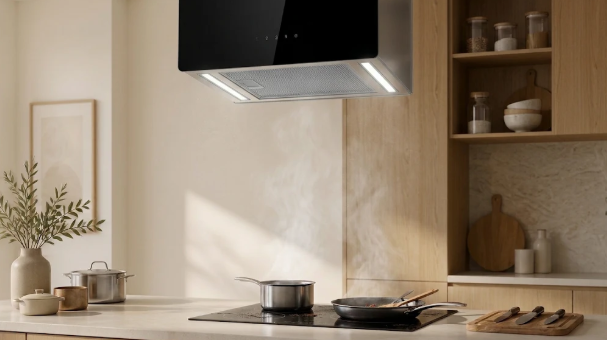
Cooking releases more than visible smoke. Depending on the ingredients, temperature and method, it can produce fine particles, grease aerosols, water vapour and odorous compounds. Frying and grilling can generate airborne particles and grease, while boiling mainly adds steam. Emissions vary, so different meals create different ventilation demands.
These emissions do not all disappear when the heat is turned off. Grease can deposit on nearby surfaces, while moisture may condense on cooler areas. That is why a kitchen may still smell of food or feel humid after the pans are put away. Stopping cooking is not the same as clearing the air. In kitchens without effective extraction, opening a suitable window may help dilute indoor pollutants when outdoor conditions allow.
How Continued Extraction Helps Clear Cooking Emissions
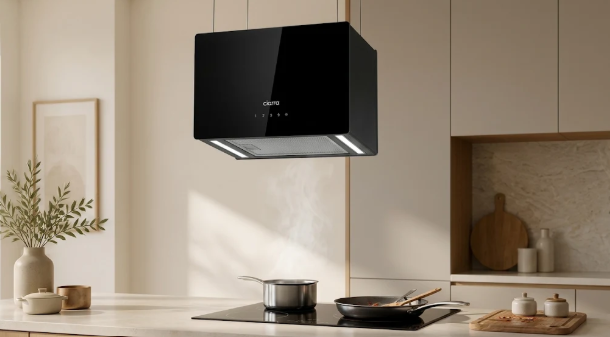
An extraction fan draws air from the cooking area into the hood, where it passes through filters before being exhausted outdoors or returned to the room. Leaving a cooker hood running after a meal gives it more time to capture and remove airborne material remaining around the hob. It can also help clear lingering smells.
The result depends on more than running time. Capture performance depends on the hood’s position, canopy size, airflow, filter condition, and how well it matches the cooking surface. Extra running time cannot compensate for poor installation, blocked filters or inadequate ventilation. It is one part of a properly designed kitchen ventilation setup. Use the fan at a setting appropriate to the cooking activity, provided that setting is permitted by the appliance instructions.
How Long Should a Cooker Hood Run After Cooking?
The US Environmental Protection Agency (EPA) advises leaving an externally vented range hood running for 10–20 minutes after cooking. This gives the system additional time to remove cooking-related pollutants that may remain in indoor air. The EPA also advises using a range hood when cooking and, where practical, using the back burners because they are often better positioned beneath the hood’s capture area. It is guidance, not a guarantee of complete pollutant removal.
The best run-on time depends on the meal, kitchen, and ventilation system. A short period of boiling may leave mostly steam, whereas prolonged frying, searing or grilling can produce more smoke, grease aerosols and odors. Follow the manufacturer’s instructions; the EPA advice is a guide for externally vented hoods, not a universal rule.
Ducted vs. Recirculating Cooker Hoods
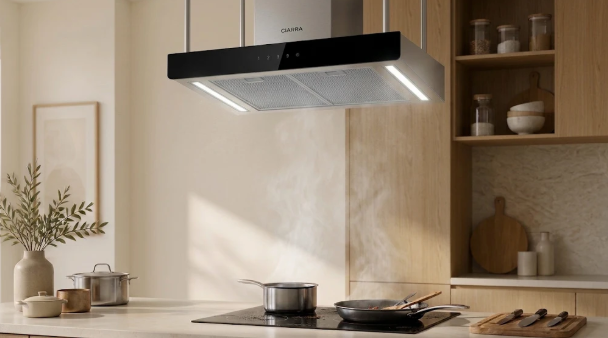
Ducted and recirculating hoods handle extracted air differently. A ducted model draws air through grease filters and sends it outside through ductwork. It can therefore remove captured cooking emissions, heat and moisture from the kitchen. A recirculating model filters the air and returns it to the room. It usually combines a grease filter with an odour filter.
| Feature | Ducted hood | Recirculating hood |
| Air movement | Exhausts air outdoors | Returns filtered air indoors |
| Grease control | Grease filter | Grease filter |
| Odour control | Exhausts extracted air | Depends on odour filter |
| Moisture removal | Can remove room moisture | Does not remove room moisture |
| Maintenance | Clean filters; check ductwork | Clean grease; replace odour filters |
This distinction matters when considering what continued operation can achieve. A ducted hood can remove moisture because it exhausts air outside the building. A recirculating hood can reduce grease and some odors when its filters are suitable and maintained, but it does not provide the same outdoor air exchange. It should not be treated as a substitute for removing humid air. Both systems need correct installation and regular filter care.
Why Cooking Methods and Ventilation Conditions Matter
The cooking method influences the type and amount of emissions produced. Boiling generally releases steam, while frying can create grease aerosols, odours and fine particles. Grilling and high-temperature searing may generate more smoke, particularly if food or oil overheats. Consider each cooking session rather than assuming every meal needs the same ventilation time.
The room and hood performance also play a part. In a small kitchen, emissions may become noticeable quickly, while an open-plan layout can allow them to spread into living areas. A hood with suitable airflow and good coverage can capture emissions more effectively than one that is poorly positioned or undersized. If smells or smoke regularly remain, check the filters and installation rather than assuming a longer run time will solve the problem.
Practical Ways to Improve Kitchen Ventilation
Effective ventilation begins while cooking is underway. Switch on the hood before or when cooking starts, rather than waiting until smoke or strong odours appear. Where practical, use the back burners because they are often closer to the hood’s capture area. After cooking, let the fan continue running for an appropriate period so it can deal with remaining airborne contaminants.
Maintenance is just as important. Grease filters collect residue and should be cleaned as directed by the manufacturer. Recirculating models may also need charcoal or other odour filters replaced periodically; washing a filter designed for replacement will not restore its performance. When comparing ventilation options, CIARRA Appliances is one brand to consider; performance still depends on suitable selection, installation and maintenance.
A few straightforward habits can support better results:
- Use the hood whenever cooking, not only when visible smoke appears.
- Clean grease filters according to the manufacturer’s schedule.
- Replace odour filters when recommended.
- Check that ductwork and the external outlet are unobstructed, where applicable.
Choosing the Right Cooker Hood Size and Coverage
The hood should suit the dimensions and layout of the cooking surface. Its width, canopy depth and installation height all influence how effectively it captures rising emissions. If it is too narrow or mounted outside the recommended height range, fumes may escape around its edges before reaching the filters. Extraction capacity matters too, but a higher airflow figure cannot guarantee good capture if the hood is poorly positioned.
For a wider hob, a 90cm cooker hood may provide more suitable coverage than a narrower model, depending on the hob dimensions and hood design. Width is only one part of the decision. Canopy depth, burner arrangement, mounting height, duct configuration and stated extraction performance should also be considered. A properly matched hood is more likely to capture emissions at their source, making it easier to clear the kitchen during and after cooking. The right choice should balance coverage, noise, installation constraints, and the household’s ventilation needs. Check the manufacturer’s clearance requirements before buying.
Conclusion
A cooker hood does not necessarily need to stop the moment cooking ends. Fine particles, grease aerosols, moisture and odours can remain in the kitchen, and continued extraction gives the system more time to deal with them. For externally vented range hoods, the EPA’s 10–20-minute recommendation is a useful starting point, although actual needs depend on cooking activity and ventilation performance.
Correct sizing, installation and filter maintenance matter just as much as run time. Homeowners can consider CIARRA Appliances when comparing kitchen options.
FAQs
- How long should you leave a cooker hood running after cooking?
The US Environmental Protection Agency recommends leaving an externally vented range hood running for 10–20 minutes after cooking. This gives the system additional time to remove remaining cooking-related pollutants. The ideal duration can vary depending on the cooking activity and the ventilation system’s performance.
- Why should you not switch off a cooker hood immediately after cooking?
Cooking can leave fine particles, grease aerosols, moisture and odours in the kitchen air. Keeping the hood running gives the ventilation system more time to capture and remove some of these emissions.
- Does a recirculating cooker hood remove moisture from the kitchen?
No. A recirculating cooker hood filters air and returns it to the room. Although it can capture grease and reduce some cooking odours, it does not remove water vapour from the kitchen like an externally ducted system.
- Should you run a cooker hood while boiling food?
Yes. Boiling produces steam and moisture, which can contribute to indoor humidity and condensation. Running the hood during boiling can help manage these emissions, particularly when the appliance is designed for the cooking area.
- Does a larger cooker hood provide better ventilation?
Not necessarily. A wider hood may provide better coverage for a wider cooking surface, but effective ventilation also depends on extraction airflow, canopy depth, installation height, duct configuration and filter condition.