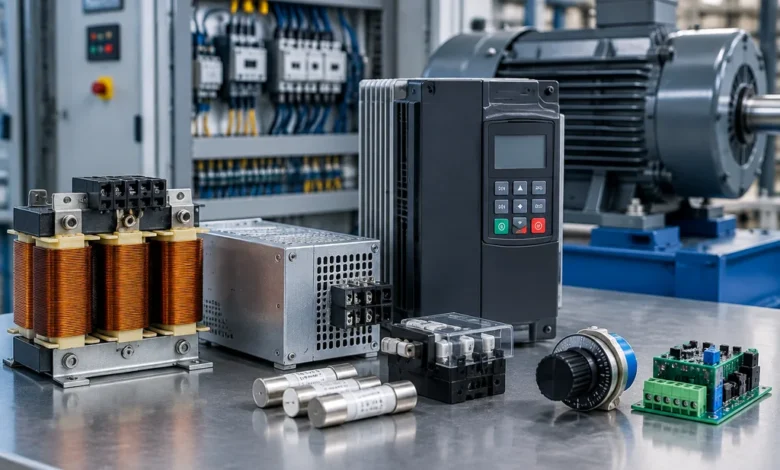

Industrial DC drives are designed to serve the purpose of providing accurate motor speed, torque, and direction control. However, the performance and reliability of a drive system mainly depend on the controller itself. Electrical disturbances, excessive harmonic currents, electromagnetic interference, and inadequate fault protection can all affect motor operations, damage power electronics, and cause unexpected production downtime.
And that is why DC drive parts and accessories become crucial. Components such as line reactors, EMC filters, semiconductor fuses, and drive potentiometers support different aspects of drive operation. From power quality and electrical protection to accurate motor speed, they all play important roles.
For UK manufacturers, engineers, panel builders, and original equipment manufacturers, selecting compatible drive parts and accessories is significantly important when upgrading existing machinery or extending the service life of established DC motor installations. Therefore, understanding how each component works, where it should be installed, and which technical specifications matter can help prevent recurring faults and reduce maintenance costs.
DC Drive Parts and Their Importance
DC drive parts are the electrical, electronic, and mechanical components that are made to support the operation, protection, and control of a DC motor drive. While the drive itself regulates motor voltage and current to control speed and torque, its supporting accessories help maintain stable and efficient operations under different mechanical and electrical conditions.
In industrial installations, these components can be used to manage incoming supply disturbances, suppress electromagnetic interference, protect semiconductor devices, and provide an accessible interface for operators.
Common DC drives available:
Line reactors: Introduce series inductance to limit current transients, reduce harmonic currents, and improve power quality.
EMC filter: Attenuate conducted electromagnetic interference generated by power electronic equipment.
Semiconductor fuses: Provide fast-acting short-circuit protection for sensitive electronic components.
Drive potentiometer: Provide a variable analogue reference for manual motor speed control.
Fuseholders and AC fuse kits: Provide secure monitoring and coordinated protection for the power circuit of the drive.
Buffer cards and interface modules: Support signal conditioning, control integration, and specific drive functions.
DC Drive Parts in Detail
Line Reactor: Managing Harmonics and Supply Disturbances
A line reactor is an inductive component installed in series with the AC supply feeding a drive. It introduces a controlled amount of impedance into the supply circuit. It helps limit rapid changes in current and reduces the harmonic currents drawn by specific types of power converters.
In industrial DC drives, particularly thyristor-based and phase-controlled systems, the rectifier draws current in pulses rather than as a perfectly sinusoidal waveform. These current pulses can introduce harmonic distortion into the electrical network, potentially affecting other equipment connected to the same supply.
A correctly selected line reactor helps reduce the severity of these disturbances and supports more stable motor operations.
When To Install A Line Reactor?
Line reactors are particularly needed in installations where:
- Multiple DC drives operate on a shared electrical supply.
- The installation uses phase-controlled rectifiers with significant harmonic current.
- The supply network has limited short-circuit capacity.
- The drive manufacturer specifies an input reactor for the selected configuration.
- Electrical disturbances or harmonic interactions have been identified during a power quality assessment.
Selecting the Correct Line Reactor
| Selection parameter | Technical consideration |
| Rated voltage | Must match the AC supply and drive input configuration |
| Continuous current | Must accommodate the expected input current under the intended operating conditions |
| Impedance | Commonly specified as a percentage, 3% or 5%, subject to the application and requirements by the manufacturer |
| Inductance | Determines the reactor’s impedance at the supply frequency |
| Thermal rating | Must accommodate the reactor’s losses and installation temperature |
| Short-circuit conditions | Must be suitable for the prospective fault current and protection arrangement |
EMC Filter: Reducing Electromagnetic Interference
An EMC filter is designed specifically for reducing electromagnetic interference generated by electrical and several electronic components. In motor control systems, power electronic switching can produce high-frequency electrical noise that travels through supply conductors and, in some cases, couples into nearby control and communication wiring or circuits.
This interference in turn can affect sensitive equipment, including PLC inputs, analogue feedback circuits, sensors, industrial communication interfaces and monitoring systems.
An EMC filter helps control conducted emissions by attenuating unwanted high-frequency signals on the electrical supply.
EMC Filter Can Solve
| Problem | How an EMC Filter Helps |
| PLC signal disturbances | Reduces conducted high-frequency interference reaching sensitive control circuits |
| Unstable readings in sensor | Can reduce electrical noise couples through shared power circuits |
| Communication errors | Helps mitigate conducted interference affecting susceptible communication equipment |
| Excessive conducted emissions | Attenuates unwanted high-frequency noise to support EMC performance |
| Interference with nearby electronic devices | Helps reduce the electrical noise transmitted through supply conditions |
EMC Filter Selection and Installation
When specifying EMC filter for industrial DC drives, consider:
Supply configuration: Confirm compatibility with single-phase or three-phase input arrangements and earthing system.
Rated current and voltage: Select a filter suitable for the drive’s actual input conditions.
Attenuation characteristics: Check filter is suitable for the frequency range and type of interference identified.
Leakage current: Consider the filter’s earth leakage current, particularly where residual-current protection is installed.
Earthing and bonding: Provide short, low-impedance connections to the designated protective earth or chassis.
Cable layout: Separate power and signal warning where practical, and follow the guidance for screening and routing by the manufacturer.
In UK industrial installations, EMC design should consider the applicable requirements of BS EN IEC 61800-3 for adjustable speed electrical power drive systems, where relevant to the equipment and installation.
Semiconductor Fuses: Protect Sensitive Electronic Devices
Semiconductor fuses are fast-acting protective devices that are designed to limit energy delivered to sensitive electrical devices during short-circuit faults. Unlike general-purpose fuses, they are specifically engineered to provide rapid fault interruption and low let-through energy under defined operating conditions.
DC drives may contain thyristors, diodes, rectifiers, and other semiconductor devices that can be damaged quickly by excessive fault current. A semiconductor fuse helps limit the thermal and electrical stress experienced by these components.
Mistakes to Avoid When Selecting a Semiconductor Fuse
Choosing a fuse based on the current ratings: Two fuses with the same rated current can have significantly different time-current and I²t characteristics. A current rating alone is not sufficient to establish semiconductor protection.
Ignore the fuse voltage rating: The fuse must be suitable for the circuit voltage and fault conditions. AC and DC interruption requirements are not automatically interchangeable
Using a general-purpose fuse as a replacement: A general-purpose fuse may not provide the required fault-clearing speed or energy limitation.
Overlooking fuse coordination: The fuse must be compatible with the drive, fuseholder, wiring and upstream protective devices.
Drive Potentiometer: Obtain Precise Manual Speed Control
A drive potentiometer is a variable resistor commonly used to provide an adjustable analogue reference to a motor drive. In a compatible DC drive control circuit, it allows an operator to increase or decrease the speed reference manually without changing the internal configuration of the drive.
Potentiometers are frequently used in machinery where straightforward, local speed adjustment is needed, especially when a PLC or digital control system is not necessary for the specific operation.
Choose the Appropriate Drive Potentiometer
The resistance value, power rating and physical design should match the drive manufacturer’s requirements. Common factors to check include:
Resistance value: The correct resistance is needed to maintain the intended reference circuit characteristics.
Power rating: Must be sufficient for the electrical loading imposed by the circuit.
Taper: A liner taper is generally used for proportional reference adjustment unless the drive specifies otherwise.
Mechanical construction: The shaft, mounting arrangement and operator interface must suit the control panel.
Electrical compatibility: Confirm whether the drive expects a potentiometer connected to an internal reference supply or an external analogue voltage signal.
Environmental stability: Consider vibration, dust, moisture and the frequency of operator adjustment.
Note: A potentiometer should not be connected to an analogue input until the drive’s reference voltage, input impedance, terminal configuration and permitted signal range have been verified.
In Comparison: Essential DC Drive Accessories
Each accessory addresses a different operating requirements. Selecting components according to the actual fault risk and control requirements helps avoid unnecessary expenditure while maintaining appropriate system protection.
| DC Drive Part | Main Function | Typical Installation | Primary Benefit |
| Line reactor | Adds inductance to the AC supply | Drive input | Harmonic and transient current management |
| EMC filter | Attenuates high-frequency interference | Drive supply input | Reduced conducted emissions |
| Semiconductor fuse | Limits fault energy | Drive power circuit | Protection of sensitive semiconductors |
| Drive potentiometer | Provides a variable analogue reference | Operator control panel | Manual speed adjustment |
| Fuseholder | Securely mounts compatible fuses | Electrical control panel | Safe, serviceable fuse installation |
| Buffer card | Conditions or interfaces control signals | Drive control selection | Improved control integration |
The accessories should be specified as part of the complete motor control system rather than treated as independent, interchangeable components.
Selecting DC Drive Accessories for UK Industrial Applications
UK industrial facilities operate across a broad range of environments, from food and beverage production and packaging to steel processing, water treatment and heavy manufacturing. The operating conditions, electrical infrastructure and maintenance requirements of each sector influence the choice of DC drive accessories and parts.
Examples of industry-specified considerations:
| Industry | Typical Drive Requirement | Relevant Accessories |
| Metal processing | High torque, controlled acceleration, and reliable operation | Line reactors, semiconductor fuses |
| Packaging and printing | Repeatable speed control and stable automation signals | EMC filters, potentiometers |
| Water and wastewater | Reliable operation in demanding plant environments | Semiconductor fuses, line reactors |
| Material handling | Controlled starting, stopping, and speed adjustment | Potentiometers, fuses |
| Paper and converting | Consistent speed regulation and coordinated drive operation | Line reactors, EMC filters |
| OEM machinery | Repeatable control design and maintainable electrical panels | All four, depending on the design |
Sourcing Compatible DC Drive Accessories from Industrial Motor Warehouse
Choosing the correct accessory is only part of maintaining a reliable drive system. Availability of components for replacement, accurate product specifications, and access to technical information also matter, particularly when equipment downtime affects production schedules.
Industrial Motor Warehouse supplies a range of industrial drive accessories, including line reactors, EMC filters, semiconductor fuses, potentiometer kits, buffer cards, and other drive options. Its DC drive accessories collection also includes components for compatible Sprint Electric drive applications, supporting maintenance replacements, retrofit projects and new control panel designs.
For engineers and industrial buyers, selecting accessories by their exact part number, drive compatibility, and electrical specifications can help simplify procurement and maintenance planning.
Explore DC Drive Accessories
Find the components required to support electrical protection, signal control, and reliable operation across compatible industrial DC drive systems.