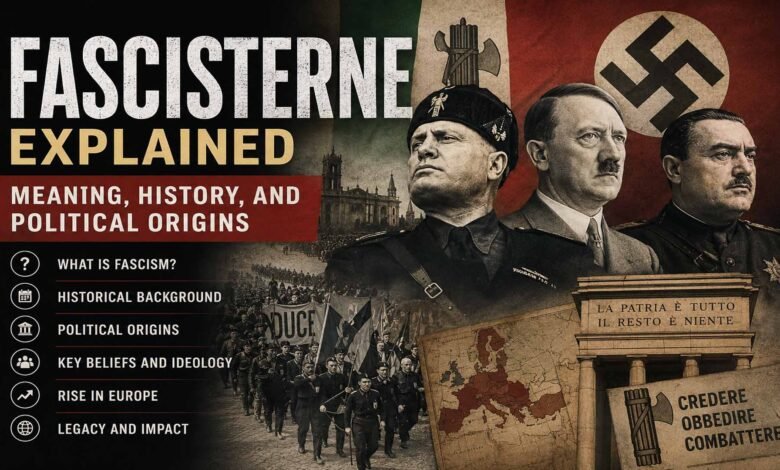

Fascisterne is a Danish word that means “the fascists” in English. It is often found in Danish history books, political discussions, newspapers, and documents about fascism in Europe.
People searching for Fascisterne may want to know what the word means, where fascism came from, what fascists believed, and how fascist movements gained political power. This article explains the term in simple language and looks at the history of fascism, especially in Italy, Germany, and Denmark.
What Does Fascisterne Mean?
The word Fascisterne is Danish. Its simplest English translation is “the fascists.” It refers to people who support, belong to, or are associated with fascist political movements.
In Danish, fascist refers to one fascist. The plural form is fascister, meaning “fascists.” Adding the ending -ne makes it definite, so fascisterne means “the fascists.”
This distinction is important because Fascisterne is not the name of a separate political ideology. The ideology is called fascism. Fascisterne refers to the people connected with that ideology.
Readers may come across the word in Danish articles about Benito Mussolini, Adolf Hitler, World War II, the German occupation of Denmark, or political movements in Europe during the 1920s, 1930s, and 1940s.
The exact meaning can also depend on context. In historical writing, the term may describe members of recognized fascist organizations. In modern political debate, it may sometimes be used more loosely as a label. For that reason, it is useful to look at the surrounding context before deciding exactly who the term refers to.
Where Did the Word Fascism Come From?
The word fascism comes from the Italian word fascismo. It developed from fascio, an Italian word that can mean a bundle, group, union, or political association.
The term is also connected with the ancient Roman fasces. The fasces was a bundle of wooden rods, often shown with an axe. In ancient Rome, it represented official authority and the power of the state.
Italian political groups used the word fasci before Benito Mussolini came to power. Mussolini later used similar language when organizing the movement that became Italian Fascism.
In 1919, Mussolini helped establish the Fasci Italiani di Combattimento, or Italian Combat Fasces. This movement later developed into the National Fascist Party.
As Italian Fascism became internationally known, words related to fascism entered many European languages. Danish adopted forms such as fascisme, fascist, fascister, and fascisterne.
Today, the word fascism has a wider historical and political meaning than its original Italian language roots. Historians generally use it for a group of authoritarian and ultranationalist political movements that became especially important in Europe during the period between the two world wars.
The Historical Origins of Fascism
Fascism developed during a period of serious political and social instability in Europe. World War I ended in 1918 after causing enormous loss of life, economic damage, and political change.
Many European countries faced unemployment, inflation, labor unrest, weak governments, and deep political divisions after the war. Fear of communist revolution also increased after the Russian Revolution of 1917.
Italy had fought on the Allied side during World War I, but many Italians were dissatisfied with the results of the peace settlement. Nationalists believed Italy had not received everything it had expected from victory.
This environment gave radical political groups an opportunity to gain support. Some promised national strength, political order, economic stability, and resistance to socialism and communism.
Benito Mussolini became one of the most important figures in this development. He had previously been active in socialist politics but later moved toward nationalism and built a new political movement around veterans, nationalists, anti-socialists, and other supporters.
Fascist squads, often called Blackshirts, used intimidation and violence against socialist organizations, trade unions, political opponents, and other groups. Their actions helped weaken opposition while increasing the Fascists’ political influence.
In October 1922, Fascist supporters organized the March on Rome. King Victor Emmanuel III then invited Mussolini to form a government. Mussolini became prime minister.
He did not immediately establish a complete dictatorship. Instead, he gradually weakened democratic institutions, restricted political opposition, and increased his control over the Italian state.
By the middle of the 1920s, Italy had effectively become a Fascist dictatorship.
What Did Fascists Believe?
There was no single version of fascism that looked exactly the same in every country. Different fascist movements had their own leaders, policies, symbols, and national goals.
However, historians identify several characteristics that were common in many fascist movements.
One of the most important was extreme or ultranationalism. Fascists generally argued that the nation should come before individual interests. They promoted national unity, strength, discipline, and loyalty.
Fascist movements also rejected many principles of liberal democracy. They opposed political pluralism and often viewed strong opposition parties, independent institutions, and unrestricted political debate as obstacles to national unity.
Strong leadership was another central feature. Fascist systems commonly concentrated political power around a leader who was presented as a symbol of national strength.
Fascist governments also relied heavily on propaganda. Public rallies, speeches, newspapers, radio broadcasts, posters, uniforms, symbols, and youth organizations were used to build support and shape public opinion.
Political violence was common in several fascist movements. Opponents could face harassment, arrest, censorship, imprisonment, or physical attack.
Many fascists also emphasized military values such as discipline, sacrifice, obedience, and strength. Expansionist foreign policies were often presented as a way to increase national power and prestige.
Fascism should not, however, be used as a simple synonym for every form of nationalism or dictatorship. Nationalism exists in many democratic political traditions, and authoritarian governments can exist without being fascist. Historians normally look at several characteristics together before describing a movement as fascist.
Mussolini and Fascist Italy
Benito Mussolini is central to the history of fascism because Italy became the first country where a self-described Fascist movement took national power.
Mussolini became prime minister in October 1922 after the March on Rome. At first, Italy still had a monarchy, parliament, opposition parties, and other existing institutions.
Over the following years, Mussolini and the Fascist Party steadily weakened those institutions. Political opponents were intimidated, independent organizations were restricted, and censorship increased.
After the murder of socialist politician Giacomo Matteotti in 1924, Italy entered an even more serious political crisis. Matteotti had openly criticized Fascist violence and election practices.
By 1925 and 1926, Mussolini had moved decisively toward dictatorship. Opposition parties were suppressed, press freedom was restricted, and the Fascist regime increased control over political and public life.
Mussolini promoted the image of a powerful national leader known as Il Duce, meaning “the Leader.” State propaganda presented him as the person who could restore Italian strength and order.
The regime also tried to influence education, youth organizations, public culture, and the media. It encouraged loyalty to the state and promoted military and nationalist values.
Italian Fascism also had expansionist ambitions. In 1935, Italy invaded Ethiopia. The invasion became an important example of Fascist imperialism and brought international criticism.
During the late 1930s, Mussolini moved increasingly closer to Adolf Hitler’s Germany. Italy and Germany developed a political and military partnership that later became part of the Axis alliance during World War II.
In 1938, Fascist Italy introduced racial laws that discriminated against Italian Jews. These measures were strongly influenced by the regime’s growing relationship with Nazi Germany, although antisemitism had not initially occupied the same central place in Italian Fascism that it did in Nazism.
Italy entered World War II on Germany’s side in June 1940. Military failures and growing domestic problems weakened Mussolini’s government.
In July 1943, Mussolini was removed from power and arrested. Germany later rescued him and installed him as the leader of a German-backed state in northern Italy known as the Italian Social Republic.
Mussolini’s remaining regime collapsed near the end of the war. He was captured and killed by Italian partisans in April 1945.
Fascism and Nazi Germany: What Was the Difference?
Italian Fascism and German Nazism shared several important characteristics, but they were not identical political systems.
Both rejected liberal democratic politics, promoted powerful centralized leadership, used propaganda on a large scale, suppressed political opponents, and emphasized nationalism and military strength.
Mussolini’s Italy influenced Adolf Hitler and the development of the Nazi movement in Germany. Hitler admired parts of Mussolini’s rise to power and later formed a close alliance with Fascist Italy.
However, Nazism placed racial ideology at the center of its political worldview to a much greater degree than early Italian Fascism.
The Nazi Party, formally called the National Socialist German Workers’ Party, argued that humanity was divided into racial groups and promoted a false hierarchy that placed so-called “Aryans” above others.
Antisemitism was fundamental to Nazi ideology. Hitler and other Nazi leaders portrayed Jews as racial enemies and blamed them for political, economic, and social problems.
After Hitler became German chancellor in January 1933, the Nazis quickly destroyed democratic institutions and created a dictatorship. Opposition parties were banned, political opponents were arrested, independent media were restricted, and state institutions were brought under Nazi control.
Nazi racial policies became increasingly severe. Jews and other targeted groups lost legal rights, jobs, property, and personal freedoms.
During World War II, Nazi Germany carried out the Holocaust, the systematic persecution and murder of six million Jews. The Nazi regime also persecuted and killed millions of other people, including Roma, disabled people, Soviet prisoners of war, political opponents, and others whom the regime considered enemies or undesirable.
For this reason, historians usually distinguish Nazism from Italian Fascism even though Nazism is widely studied within the broader history of fascism.
Italian Fascism focused strongly on the authority of the state, nationalism, political unity, and imperial power. Nazism shared many of those features but made biological racism, antisemitism, racial expansion, and racial persecution central parts of its ideology.
Understanding this difference helps explain why the words fascist and Nazi should not always be treated as exact synonyms.
Fascisterne in Denmark
The word Fascisterne is especially relevant in Danish historical writing because Denmark had its own fascist and Nazi-aligned political groups during the 20th century.
One of the best-known was the National Socialist Workers’ Party of Denmark, usually known by its Danish abbreviation DNSAP. It was founded in 1930 and was influenced by Adolf Hitler’s Nazi Party in Germany.
The Danish party used Nazi-style symbols, uniforms, and political ideas. It supported nationalism, authoritarian government, and antisemitic policies. However, it never gained broad support among Danish voters.
Denmark was occupied by Nazi Germany on April 9, 1940. During the occupation, Danish politics became more complex. Some people cooperated with the German authorities, while others later joined resistance groups.
Danish fascists and Danish Nazis should not be treated as exactly the same thing as the German occupation authorities. They were local political movements operating within Denmark, while the German military and Nazi government controlled the occupation.
The Danish resistance became stronger as the war continued. Resistance groups carried out sabotage, produced illegal newspapers, gathered intelligence, and helped people escape to safety.
Today, Danish books and archives may use the term fascisterne when discussing fascist groups in Denmark, Italian Fascists, German Nazis, or fascist movements elsewhere in Europe. The exact meaning depends on the context.
Fascism During World War II
World War II placed fascist and Nazi regimes at the center of a major international conflict.
Nazi Germany invaded Poland in September 1939, beginning the war in Europe. Germany later occupied or attacked many other countries.
Italy entered the war in June 1940 under Mussolini. Germany, Italy, and Japan became the main members of the Axis alliance, although the political systems of these countries were not identical.
The war gave fascist and Nazi governments greater control over occupied territories. Political opponents were arrested, resistance movements were punished, and many communities faced severe repression.
Nazi Germany also expanded its racial persecution during the war. Jews were deported to ghettos, concentration camps, and extermination camps.
The Holocaust resulted in the murder of six million Jews. Millions of other victims were also killed by Nazi policies, including Roma, disabled people, prisoners of war, political opponents, and civilians across occupied Europe.
As the war turned against the Axis powers, fascist governments began to collapse. Mussolini lost power in Italy in 1943, while Nazi Germany continued fighting until May 1945.
The defeat of Nazi Germany ended the largest fascist-controlled political system in Europe, but fascist ideas did not disappear completely.
Propaganda, Censorship, and Political Control
Fascist governments depended heavily on control of information.
Propaganda was used to present leaders as strong and necessary. Governments promoted images of national unity, military power, sacrifice, obedience, and loyalty.
Newspapers, radio, posters, films, public rallies, speeches, and schools were all used to spread official messages.
Independent media were often restricted. Journalists and publishers could face censorship if they criticized the government or challenged official policies.
Political opposition was also limited. Fascist regimes commonly banned or weakened rival parties, trade unions, and independent organizations.
Youth organizations were important as well. Governments tried to influence children and teenagers through education, uniforms, organized activities, and political training.
Large public events were carefully designed to create a sense of unity and strength. Flags, uniforms, music, symbols, and speeches helped build emotional support for the state and its leadership.
These methods did not mean that every citizen fully supported the government. Repression, fear, limited access to information, and pressure from authorities also shaped public behavior.
Why Did Fascism Gain Support?
Fascism gained support for several different reasons. There was no single cause.
Economic problems were important. After World War I, many countries faced inflation, unemployment, debt, and social instability.
Political instability also created frustration. Some voters lost confidence in parliamentary governments that seemed unable to solve major problems.
Fear of communism played a major role in several countries. Business owners, landowners, conservatives, and parts of the middle class sometimes supported fascist movements because they believed those movements would stop socialist or communist revolution.
Nationalism was another factor. Some people believed their countries had been treated unfairly after World War I or had become weaker than they should be.
Fascist leaders promised order, national strength, employment, and unity. These promises could appeal to people who were worried about disorder or economic decline.
Propaganda also helped build support. Fascist movements used simple political messages, strong symbols, mass rallies, and leader-centered campaigns.
Violence and intimidation were equally important. Fascist groups often attacked opponents and made normal political competition more difficult.
It is therefore inaccurate to say fascists gained power only because people freely supported all their ideas. Electoral support, political deals, propaganda, violence, fear, and institutional weakness all played different roles.
The Decline of Fascist Governments
The main fascist governments in Europe collapsed during World War II.
In Italy, military defeats and growing opposition weakened Mussolini’s position. In July 1943, the Fascist Grand Council turned against him, and King Victor Emmanuel III removed him as prime minister.
Germany later rescued Mussolini and helped establish the Italian Social Republic in northern Italy. This state survived only until the final stage of the war.
Mussolini was captured by Italian partisans in April 1945 and was executed shortly afterward.
Nazi Germany also collapsed in 1945. Allied forces advanced from the west while Soviet forces moved from the east.
Adolf Hitler died by suicide in Berlin on April 30, 1945. Germany surrendered soon afterward.
After the war, many European countries rebuilt democratic institutions. Fascist and Nazi parties were banned or restricted in several places.
Nazi leaders were also prosecuted in the Nuremberg Trials, which began in 1945. The trials addressed major war crimes and crimes against humanity committed by the Nazi leadership.
The military defeat of Fascist Italy and Nazi Germany ended their governments, but it did not remove every fascist belief from political life.
Fascism After World War II
After 1945, openly fascist politics became widely discredited because of the destruction caused by the war and the crimes committed by Nazi Germany and its allies.
Even so, some political groups continued to promote fascist or neo-Nazi ideas.
These postwar movements are often described as neo-fascist or neo-Nazi. Their beliefs and organizations vary widely by country.
Some use symbols and ideas directly connected with historical fascism. Others avoid old labels and instead use different language while promoting similar forms of extreme nationalism, authoritarianism, racism, or political violence.
Not every far-right political group should automatically be called fascist. Scholars often disagree about how closely a modern organization must resemble historical fascism before the term should be used.
This is why historical context matters. The word can lose meaning if it is applied to every political movement that is simply conservative, nationalist, authoritarian, or unpopular.
How the Word Fascisterne Is Used Today
In modern Danish, fascisterne still simply means “the fascists.”
The term can appear in history books, news reports, academic writing, documentaries, archives, and political discussions.
When used historically, it may refer to members of Italian Fascist organizations, Danish fascists, Nazi-aligned groups, or other movements that historians classify as fascist.
In modern political debate, the word may also be used as an accusation or political label.
That use can be controversial. Calling a political opponent a fascist does not automatically make the description historically accurate.
Readers should therefore look at the context. A careful use of the term should be based on political beliefs, organization, behavior, and historical comparison rather than simple disagreement.
Fascism, Authoritarianism, and Nationalism Are Not the Same
These terms are related in some situations, but they do not mean the same thing.
Nationalism is the belief that a nation and its interests are important. Nationalism can exist in democratic, authoritarian, conservative, liberal, and many other political systems.
Authoritarianism describes systems where political power is concentrated and public political freedom is limited. An authoritarian government may restrict elections, opposition parties, media freedom, or civil rights.
A government can be authoritarian without being fascist.
Fascism usually includes a wider combination of ideas. These commonly include ultranationalism, authoritarian leadership, hostility to liberal democracy, political mobilization, hierarchy, propaganda, and the belief that national strength should take priority over individual political freedom.
Some fascist movements also include racism, expansionism, or ideas about national rebirth.
Nazism added an especially extreme racial ideology and made antisemitism and racial hierarchy central to the state.
Using these terms carefully makes political and historical discussions more accurate.
Why Understanding Fascisterne Still Matters
Understanding Fascisterne is useful because the word is connected with one of the most important periods in modern European history.
Studying fascism helps explain how democratic systems can weaken when political violence, propaganda, censorship, and attacks on institutions become normal.
It also shows why independent courts, free media, political opposition, and civil liberties are important parts of democratic systems.
The history of fascism also demonstrates how economic and political crises can create opportunities for extremist movements.
Learning this history does not mean that every modern problem should be compared directly with the 1930s.
Careful comparison is more useful than loose political labeling. Historians look at evidence, institutions, beliefs, political methods, and historical conditions before deciding whether a movement should be described as fascist.
Understanding the original meaning of Fascisterne also helps readers recognize when the term is being used historically and when it is being used as a modern political accusation.
Bottom Line
Fascisterne is a Danish word meaning “the fascists.” It refers to people associated with fascism rather than to a separate ideology called Fascisterne.
Fascism became a major political force in Europe after World War I, especially through Benito Mussolini’s movement in Italy.
Historical fascist movements usually promoted strong nationalism, authoritarian leadership, political control, propaganda, and opposition to liberal democratic politics.
Nazi Germany shared several features with Italian Fascism but developed a much more central and extreme racial ideology, including antisemitism and policies that led to the Holocaust.
The word Fascisterne can still appear in Danish historical and political discussions today. Its meaning is easiest to understand when the surrounding historical and political context is considered carefully.
(FAQs)
What does Fascisterne mean in English?
Fascisterne means “the fascists” in English. It is the definite plural form used in Danish for people identified as fascists.
Is Fascisterne a political ideology?
No. Fascisterne refers to people associated with fascism. Fascism is the name of the political ideology or historical political movement.
Where did fascism begin?
Modern organized fascism developed most clearly in Italy after World War I. Benito Mussolini’s Fascist movement became the first self-described fascist movement to take national power.
Was Mussolini the founder of fascism?
Mussolini was the central leader in creating and developing Italian Fascism as a political movement. However, fascist ideas were influenced by earlier nationalist, authoritarian, militarist, and political movements.
Are fascism and Nazism the same thing?
No. They share important characteristics, including authoritarianism, ultranationalism, propaganda, and political repression. However, Nazism placed biological racism, antisemitism, and racial hierarchy at the center of its ideology in a way that distinguished it from early Italian Fascism.
Were there fascists in Denmark?
Yes. Denmark had fascist and Nazi-aligned political groups, including the National Socialist Workers’ Party of Denmark, or DNSAP. These groups existed before and during the German occupation but never gained broad electoral support.
Does fascism still exist today?
Groups described as neo-fascist or neo-Nazi still exist in different countries. However, modern political movements vary widely, and the fascist label should be used carefully and based on evidence rather than political disagreement alone.
Is every dictatorship fascist?
No. Fascism is one type of authoritarian political movement, but many dictatorships do not meet the historical or ideological characteristics normally associated with fascism. Authoritarianism is a broader category.
CVHATG Explained: Meaning, Background, Uses, and Important Details
UYÇ Explained: Meaning, Levels, and How Turkey’s Qualifications Framework Works