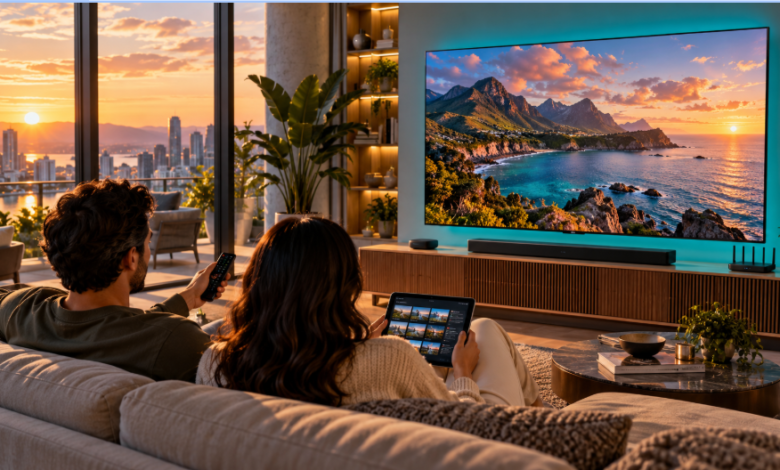
How Smart TVs and Internet Streaming Are Transforming Home Entertainment in 2026

The living room has undergone a remarkable transformation.
Not long ago, home entertainment revolved around a television connected to a cable box, satellite receiver, or DVD player. Families watched programs according to broadcasting schedules, and accessing additional content often required purchasing physical media.
In 2026, the entertainment experience looks very different.
Smart televisions, streaming devices, broadband connectivity, and digital platforms have made it easier to access movies, television series, documentaries, and live programming across multiple screens.
Consumers increasingly expect entertainment to fit their schedules rather than organizing their schedules around television.
This change is influencing everything from the devices people purchase to the subscription services they choose.
Here are the most important ways connected technology is transforming modern home entertainment.
1. Smart TVs Have Become Entertainment Hubs
Modern televisions do much more than display broadcast signals.
Many smart TVs include operating systems, wireless connectivity, application stores, and integrated media players.
These features allow viewers to access compatible entertainment services without necessarily purchasing separate equipment.
Depending on the model, users may be able to:
- Watch movies through streaming applications
- Access live television services
- Listen to music and podcasts
- Browse video-sharing platforms
- Connect gaming consoles
- Display content from compatible mobile devices
- Use voice commands to navigate supported applications
This combination of features has turned the television into a central component of the connected home.
However, not every smart TV offers the same experience.
Processing performance, software support, application compatibility, and manufacturer updates can vary significantly.
Consumers should consider these factors alongside traditional specifications such as screen size and resolution.
2. Online Video Has Become a Mainstream Activity
Internet-based viewing is no longer limited to technology enthusiasts.
According to Eurostat, 79% of internet users in the European Union watched television or video content online in 2024.
The Netherlands and Finland recorded particularly high participation, with 96% of internet users reporting online television or video viewing.
These figures illustrate how familiar digital entertainment has become across much of Europe.
They also demonstrate why television manufacturers and media companies continue investing in connected viewing experiences.
Consumers are increasingly comfortable accessing entertainment through applications and internet-connected devices.
At the same time, traditional broadcasting remains important.
Many households continue using cable, satellite, and terrestrial television alongside online services.
The modern entertainment environment is therefore characterized by greater choice rather than a complete replacement of older technologies.
3. Internet Television Is Expanding Viewing Options
One important development in digital entertainment is the availability of television services delivered over IP-based networks.
IPTV, or Internet Protocol Television, is one of the technologies associated with this transition.
Rather than distributing television solely through traditional broadcast infrastructure, IPTV uses Internet Protocol networks to deliver audiovisual services.
In formal telecommunications terminology, managed IPTV systems are designed to support specific requirements for reliability, security, interactivity, and service quality.
In everyday consumer discussions, however, the term is also frequently used to describe different forms of internet-based television.
Depending on the service, supported features may include live programming, scheduled channels, electronic program guides, and on-demand content.
The main advantage of internet-based distribution is its ability to integrate television services with connected devices and modern software interfaces.
However, the technology itself does not determine which channels or programs a provider is legally authorized to distribute.
Consumers should always verify content availability and licensing before subscribing.
4. Entertainment Is No Longer Limited to One Screen
Another major change is the growing importance of device flexibility.
A household may use a large television for movies, a tablet for documentaries, and a smartphone for short videos.
Computers and gaming consoles also provide access to various entertainment applications.
This flexibility can be particularly useful in households where different family members have different viewing preferences.
For example, one person may want to watch a film in the living room while another follows a documentary on a tablet.
However, the ability to use multiple devices does not necessarily mean that every subscription permits simultaneous playback.
Some providers restrict the number of active streams or supported devices.
Checking these conditions before purchasing a service can help households avoid unexpected limitations.
5. Picture Quality Is Becoming More Important
As modern televisions become more capable, viewers increasingly pay attention to video quality.
Full HD, 4K resolution, High Dynamic Range, and advanced display technologies are familiar features in today’s television market.
However, the quality of a streaming experience depends on more than the television itself.
Several technical factors influence the final picture.
Video Resolution
Higher-resolution video can provide more visual detail when the source and display support it.
However, resolution alone does not guarantee superior picture quality.
Compression
Streaming platforms use compression to reduce the amount of data required to transmit video.
Efficient compression helps make high-quality streaming practical, but excessive compression may introduce visible artifacts.
Frame Rate
Frame rate affects the appearance of motion.
This can be particularly noticeable during sporting events, action sequences, and gaming.
Internet Stability
A reliable network connection helps maintain consistent playback quality.
When available bandwidth decreases, some streaming applications automatically switch to lower-quality video to prevent interruptions.
Consumers should therefore evaluate the entire viewing setup rather than focusing exclusively on a television’s advertised specifications.
6. Home Entertainment Is Becoming More Personalized
Traditional television offered a relatively uniform viewing experience.
Everyone watching the same channel received the same scheduled program.
Digital entertainment platforms have introduced more personalization.
Many services allow users to create separate profiles, save favorite programs, organize watchlists, and receive recommendations based on viewing activity.
These features can make content discovery more convenient.
However, personalization also raises questions about privacy and data collection.
Consumers should understand what information their entertainment applications collect and how it is used.
Reviewing privacy settings and account permissions can help maintain greater control over personal information.
A convenient entertainment experience should also be transparent about data handling.
7. Choosing an Internet Television Subscription Requires Research
The increasing number of streaming services has made subscription decisions more complicated.
Consumers now need to compare content availability, device support, pricing, account features, and customer service.
This is particularly relevant in highly connected markets such as the Netherlands.
For Dutch viewers researching iptv kopen options, several practical considerations deserve attention before purchasing a subscription.
Device compatibility: Confirm that the service supports the intended television, streaming device, smartphone, or computer.
Subscription transparency: Check pricing, renewal conditions, cancellation procedures, and any additional fees.
Streaming performance: Understand the connection requirements and supported video formats.
Customer assistance: Determine whether the provider offers reliable technical support.
Simultaneous streams: Verify how many devices can watch content at the same time.
Content licensing: Ensure the provider is authorized to distribute the channels and programs it advertises.
These factors are generally more useful than comparing subscription prices alone.
An unusually inexpensive service is not necessarily a good choice if it lacks reliability, transparency, or appropriate distribution rights.
Likewise, a large advertised channel library does not establish that its content is licensed.
Taking time to investigate a provider can prevent disappointment and unnecessary expense.
8. Better Audio Is Changing the Home Viewing Experience
Television manufacturers have invested heavily in improving picture quality.
However, audio can be equally important to the overall entertainment experience.
Modern movies and television productions often feature complex sound design.
Dialogue, background music, environmental effects, and directional audio contribute to the atmosphere of a scene.
Unfortunately, the compact speakers built into many slim televisions may struggle to reproduce these elements effectively.
A soundbar can provide a relatively simple improvement.
More advanced home theater systems may include additional speakers and a dedicated subwoofer.
The best solution depends on room size, budget, and personal preferences.
Consumers should also verify that their television, playback device, and preferred services support the audio formats they intend to use.
9. Streaming Devices Can Extend the Life of Older TVs
Not every household needs to purchase a new television to enjoy modern streaming features.
An external streaming device can add updated applications and software capabilities to a television that already has a suitable HDMI input.
This can be particularly valuable when the television’s built-in operating system is outdated.
Dedicated streaming devices may provide:
- Updated application support
- Faster navigation
- Improved software compatibility
- Wireless connectivity
- Additional playback features
- More frequent software updates
However, compatibility should be checked before purchasing.
An older television may still impose limitations on resolution, HDR support, or audio output.
Choosing the right device can help households improve their entertainment setup without replacing otherwise functional equipment.
10. Subscription Management Is Becoming a Household Priority
With so many entertainment services available, subscription expenses can accumulate.
A household might maintain separate accounts for movies, television series, music, sports, and other digital services.
Individually, the prices may appear manageable.
Combined, they can represent a significant recurring expense.
A simple subscription review can help reduce unnecessary spending.
Consumers can begin by listing their active entertainment subscriptions and identifying which services they use regularly.
Services that are rarely used may not justify continuous payment.
Rotating subscriptions according to available content can sometimes provide better value.
It is also worth reviewing automatic renewal settings and cancellation policies.
Clear subscription management can make digital entertainment more affordable and easier to control.
11. What Comes Next for Home Entertainment?
Connected television technology will continue evolving beyond 2026.
Several developments are likely to influence future viewing experiences.
More Efficient Video Streaming
Improvements in video compression and delivery infrastructure may help platforms maintain better quality while using less bandwidth.
Smarter Content Discovery
Entertainment applications may develop more sophisticated tools for organizing libraries and recommending relevant programming.
Greater Device Integration
Smart TVs, mobile devices, audio equipment, and connected-home systems may work together more seamlessly.
Improved Accessibility
Better subtitle controls, audio descriptions, voice navigation, and interface customization can make entertainment services more accessible.
Stronger Consumer Expectations
As digital entertainment becomes more familiar, consumers will increasingly expect transparent pricing, reliable applications, secure accounts, and straightforward customer support.
These developments could make home entertainment more convenient, but the fundamental importance of trust and reliability will remain unchanged.
Final Thoughts
Smart televisions and internet-based streaming have significantly expanded the possibilities of home entertainment.
Viewers can access different types of programming across compatible devices, personalize their experience, and choose from a wider range of digital services.
The growth of connected television also creates new decisions involving subscription costs, privacy, network performance, and content licensing.
For consumers, the best entertainment setup is not necessarily the most expensive or technically complicated.
It is the one that combines reliable technology, appropriate services, comfortable viewing, and transparent subscription conditions.
As digital entertainment continues evolving, convenience and flexibility will remain important, but a satisfying viewing experience will still depend on quality, reliability, and informed consumer choices.