Revert Space for New Muslims: Finding Guidance, Community and Confidence After Shahada

For many new Muslims, the first few days bring happiness, excitement and a completely new set of questions.
How do I pray? How do I perform wudu? Where should I begin with the Qur’an? Do I need to learn Arabic immediately? What should I tell my family? What happens if I make mistakes? And who can I speak to when I have a question that feels too personal to ask publicly?
This is where Revert Space for new Muslims can have an important role.
Revert Space is designed to help people move beyond the moment of conversion and begin building their Muslim lives through education, guidance, mentorship and community.
What Is Revert Space?
Revert Space is an online Islamic learning and support platform created particularly for new Muslims, reverts, beginners and people who are still exploring Islam.
The idea behind the platform is simple: someone who has just become Muslim should not be expected to understand everything immediately.
Established Muslims may already understand common Islamic terminology, know the basics of worship and know where to look when they have a question.
A new Muslim may be starting from zero.
That is why Revert Space focuses on structured guidance that meets people at the beginning of their journey rather than assuming previous Islamic knowledge.
The Real Journey Often Starts After Shahada
Taking the Shahada is the beginning rather than the end of someone’s journey into Islam.
Muslim communities naturally celebrate when someone accepts Islam. It is an important and joyful moment.
But the new Muslim still needs support the following day, the following week and throughout the months that follow.
Someone might suddenly find themselves learning about Salah, wudu, fasting, the Qur’an, halal food, Islamic manners, family relationships and many other subjects simultaneously.
Trying to understand everything at once can become overwhelming.
For this reason, Revert Space provides a dedicated Life After Shahada: First 30 Days Guide for New Muslims, giving new Muslims a more structured starting point for their journey.
Rather than asking, “How can I learn all of Islam?”, a new Muslim can begin with a much more manageable question:
What do I need to learn today?
Learning Islam Step by Step
One of the biggest advantages of a dedicated platform for reverts is structured education.
There is an enormous amount of Islamic information available online. The difficulty is often not finding information but knowing which information a beginner actually needs.
A new Muslim searching online can easily move from a simple question about prayer into complicated theological or legal discussions that may not be relevant to their current stage.
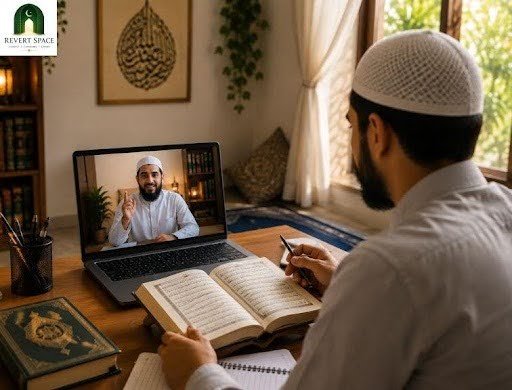
The online Islamic courses for new Muslims at Revert Space provide a more organised route for learning the foundations first.
This gives learners an opportunity to understand essential subjects before moving into more advanced areas.
Learning gradually can also help prevent one of the common challenges faced by enthusiastic new Muslims: attempting to change every aspect of life immediately and then becoming overwhelmed.
Islamic learning is a lifelong process.
A strong beginning is more valuable than an overwhelming beginning.
Learning to Pray With Confidence
Prayer is one of the first practical aspects of Islam that a new Muslim wants to understand.
At first, Salah can appear difficult.
There are prayer times to remember, movements to learn, Arabic words to pronounce and rules surrounding purification.
Someone may watch another Muslim pray effortlessly and wonder how they will ever remember everything.
The answer is usually patience and practice.
The movements gradually become familiar.
The words become easier.
What initially requires intense concentration eventually becomes part of everyday Muslim life.
Beginner-oriented resources through the Revert Space Islamic learning platform can help new Muslims approach worship progressively rather than feeling that perfection is expected immediately.
Mistakes during learning are part of learning.
The objective is continued progress.
What About Learning Arabic?
Arabic can be another intimidating subject for new Muslims.
Many converts to Islam have never studied Arabic before. Some may not even recognise the Arabic alphabet when they first become Muslim.
They then encounter Arabic during Salah, when reading the Qur’an, while learning duas and through common expressions used within Muslim communities.
This can create the impression that becoming a good Muslim requires becoming fluent in Arabic immediately.
It does not.
However, learning Arabic gradually can help someone develop a deeper understanding of prayer, the Qur’an and Islamic terminology.
For people beginning from the very start, Revert Space offers an Arabic for Beginners course for new Muslims.
Learning Arabic as a revert does not necessarily mean trying to become an academic linguist.
For many people, the first objectives are much more practical: recognising Arabic letters, understanding frequently used words, following the words of Salah and developing a closer relationship with the Qur’an.
Bringing Dua Into Everyday Life
Islam gradually becomes part of everyday life, not simply something practised during formal lessons or visits to a mosque.
Dua is one of the simplest ways for a new Muslim to begin developing that relationship with Allah.
There are duas connected to waking, sleeping, eating, travelling, seeking forgiveness, asking for guidance and many other moments of daily life.
Revert Space provides a dedicated Daily Duas for Reverts guide) as well as a Daily Duas course for new Muslims.
For someone who does not yet read Arabic, having access to transliteration and meanings can make the learning process much easier.
It allows a new Muslim to understand what they are asking Allah for instead of simply memorising unfamiliar sounds.
Small, consistent practices like these can gradually make Islam a natural part of everyday life.
A Place to Ask Questions Without Feeling Judged
One of the biggest difficulties for some new Muslims is not a lack of information.
It is being afraid to ask questions.
A person might worry that their question is too simple.
They might feel embarrassed admitting that they still cannot remember part of the prayer.
Their question might involve a sensitive family issue, their previous lifestyle, marriage, relationships or another subject they would prefer not to discuss publicly.
Having access to knowledgeable people who understand the circumstances of new Muslims can make a major difference.
People considering Islam or those who have recently converted can also use the [**Revert Space Shahada and New Muslim Registration page**](https://revertspace.com/revert-space-shahada-registration-page/) to begin receiving appropriate support.
The objective should be to create an environment where asking a sincere question is never considered embarrassing.
Community Is Part of the Journey
Education alone is not enough.
Human beings also need community.
This can be particularly important for reverts because conversion may affect their relationships with the people around them.
Some families are highly supportive.
Others may struggle to understand why their relative has become Muslim.
Some new Muslims already have close Muslim friends.
Others may have never had a Muslim friend before taking Shahada.
A person can therefore embrace Islam while still feeling socially isolated.
Guidance on building community as a new Muslim through Revert Space addresses an important part of the revert experience that cannot always be solved by simply watching another educational video.
Sometimes a new Muslim needs someone to speak to.
Sometimes they need reassurance from another person who understands their experience.
Sometimes they simply need to feel that they belong.
Why an Online Revert Space Matters
The Muslim experience differs dramatically depending on where someone lives.
A new Muslim living in a major city may have several mosques, Islamic centres and classes nearby.
Another person may live many miles from the nearest mosque.
Someone else may work unusual hours and be unable to attend conventional classes.
There are also people privately researching Islam who do not yet feel comfortable walking into a mosque and announcing that they are considering becoming Muslim.
An online platform removes some of these barriers.
People can begin reading, studying and asking questions from wherever they are.
For common questions about Islam, courses, Arabic and support, beginners can also use the Revert Space FAQ for new Muslims.
Online Islamic support does not have to replace a local Muslim community.
Instead, it can provide a bridge that helps someone gain enough knowledge and confidence to become an active part of one.
Revert Space Is Also for People Exploring Islam
Revert Space is not relevant only after someone has converted.
Many people spend weeks, months or even years researching Islam before deciding whether they believe it is true.
During this period they may encounter hundreds of videos, articles, debates and social-media posts.
More content does not always produce more clarity.
Someone seriously exploring a religion needs somewhere to learn its basic teachings and ask sincere questions without feeling pressured.
The Revert Space articles and guides give readers additional opportunities to explore Islam and learn about subjects relevant to both new Muslims and those considering the faith.
People can learn at their own pace and return to particular subjects whenever they need further guidance.
New Muslims Need a Path, Not Pressure
One of the most important messages for any new Muslim is that they do not have to become an expert overnight.
There will be unfamiliar terminology.
There may be mistakes in pronunciation.
There may be prayers where they forget something.
There will be questions.
There may also be moments when progress feels extremely fast and other periods when it feels slow.
That is normal.
A sustainable approach is to establish the foundations first and continue building from them.
The Islamic Foundations course for reverts reflects this principle by helping beginners focus on establishing their faith correctly before becoming overwhelmed by unnecessary complexity.
Knowledge develops over time.
Confidence develops over time.
Community develops over time.
Faith itself is something that Muslims continue nurturing throughout their lives.
The Shahada Is a Beginning
There is often considerable attention surrounding the moment somebody accepts Islam.
But some of the most important experiences happen afterwards.
The weeks when they are learning their first prayers.
Their first Ramadan.
The first time they open the Qur’an and recognise words they have learned.
The conversations with family members.
The questions they were initially afraid to ask.
The first friendships they form within the Muslim community.
And the gradual transformation of unfamiliar Islamic practices into a meaningful part of everyday life.
This is why a dedicated Revert Space for new Muslims can be valuable.
Becoming Muslim should not mean being handed a collection of information and then being expected to navigate the journey alone.
New Muslims need knowledge, but they also need direction.
They need answers, but they also need people.
They need education, but they also need community.
Most importantly, they need the opportunity to grow into their faith gradually, sincerely and confidently.
The Shahada may take only a few moments to say.
The journey that follows lasts a lifetime.