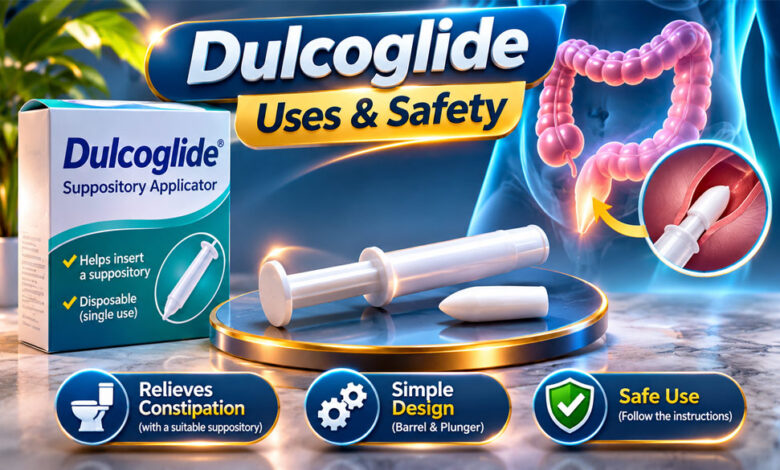

Dulcoglide, also written as DulcoGlide, is a disposable applicator used to insert a suitable suppository into the rectum. It is often linked with Dulcolax, so some people think they are the same product.
They are not the same. Dulcoglide is an applicator, not a laxative. It does not treat constipation. The medicine inside the suppository provides the treatment.
This guide explains what Dulcoglide is used for, how it works, how to use it safely, and how it is different from Dulcolax.
What Is Dulcoglide Used For?
Dulcoglide is used to help place a suitable suppository into the rectum. It gives people another option instead of inserting the suppository directly with a finger.
A suppository is a small, solid form of medicine. It is placed inside the rectum, where it softens, melts, or dissolves and releases the medicine.
Dulcoglide does not contain the medicine. It only helps with insertion. The applicator has a barrel that holds the suppository and a plunger that releases it.
Some people may prefer using an applicator because they do not want to touch the suppository directly. It may also be useful when direct insertion is difficult.
However, an applicator may not be easier for everyone. Anyone who has pain, limited movement, or difficulty using a suppository should ask a pharmacist or healthcare professional for advice.
Dulcoglide should also not be confused with constipation medicine. If it is used with a laxative suppository, the medicine inside the suppository provides the laxative effect.
Dulcoglide vs. Dulcolax
Dulcoglide and Dulcolax sound similar, but they have different purposes.
Dulcoglide is an applicator. It helps insert a suitable suppository.
Dulcolax is a brand of laxative medicines. Some Dulcolax products contain bisacodyl.
Bisacodyl is a stimulant laxative. It helps stimulate bowel activity and is used to relieve constipation.
Dulcoglide does not contain bisacodyl.
Dulcolax is also available in different forms. For example, tablets are taken by mouth, while suppositories are inserted into the rectum. The instructions and how quickly they work can be different.
Some older product information mentions packs that included both Dulcolax suppositories and Dulcoglide applicators. Dulcoglide applicators have also been sold separately.
Always check the packaging to see exactly what is included.
| Product | What It Does | Contains Bisacodyl? |
|---|---|---|
| Dulcoglide applicator | Helps insert a suppository | No |
| Dulcolax suppository | Provides laxative treatment | Yes, in relevant products |
| Dulcolax tablet | Provides oral laxative treatment | Yes, in relevant products |
| Combination pack | Includes medicine and applicator | The suppository does; the applicator does not |
This difference is also important when looking at side effects. For example, stomach cramps or diarrhoea may come from bisacodyl. Pain caused by forceful insertion is related to how the suppository or applicator was inserted.
How Does the Dulcoglide Applicator Work?
Dulcoglide has a simple design. Its two main parts are a barrel and a plunger.
The suppository is placed inside the barrel. The applicator is then gently positioned as explained in its instructions.
Once it is in the correct position, the plunger is pressed. This releases the suppository. The applicator is then removed and thrown away.
The device works only as an insertion tool. It does not change the medicine, increase the dose, or make the suppository stronger. It also does not make the medicine work faster.
Dulcoglide has been described as “comfort-shaped” and individually wrapped. However, this does not mean it will be comfortable for every person.
Older Dulcoglide instructions also say to put the blunt end of the suppository into the applicator barrel.
This can be confusing because instructions for direct finger insertion may tell users to insert certain suppositories pointed end first.
These are different methods. Always follow the instructions that come with the exact applicator and medicine you are using.
What to Check Before Using Dulcoglide
Before using Dulcoglide, check both the applicator and the suppository.
Check Suppository Compatibility
Dulcoglide should only be used with a suitable suppository.
Do not assume that every suppository will work with it. The size, shape, and type of medicine can matter.
Never force a suppository into the applicator if it does not fit properly.
If you are unsure whether a suppository is suitable, ask a pharmacist.
Check the Applicator
Check the wrapper before opening it. It should be sealed and undamaged.
Also look at the applicator itself. Do not use it if the barrel is cracked, the plunger is damaged, or anything else looks wrong.
Do not try to repair a damaged applicator.
Check the Medicine Instructions
Dulcoglide has its own instructions, but the suppository also has separate instructions.
Read the medicine leaflet carefully. Check the correct dose, how often it can be used, age guidance, side effects, and warnings.
An applicator only helps insert the medicine. It does not make an unsuitable medicine safe to use.
How to Use a Dulcoglide Applicator
Always follow the instructions supplied with the product you have. Directions can differ between products.
Older Dulcoglide instructions describe starting by washing your hands with soap and water.
Open a new applicator wrapper and remove the wrapper from the suppository. Place the blunt end of a suitable suppository into the open end of the applicator.
Do not force it further into the barrel.
The instructions then describe lying on your side. Keep the lower leg straight and bend the upper leg toward your chest.
Gently insert the applicator as directed. Once it is correctly positioned, press the plunger to release the suppository.
Never force the applicator if you feel resistance or pain.
After releasing the suppository, carefully remove the applicator. Put it in household waste. Do not flush it down the toilet.
Wash your hands again when finished.
Dulcoglide is made for one use only. Do not wash and reuse it.
Stop using the applicator and get medical advice if there is significant pain, bleeding, difficulty removing the device, or another unexpected problem.
Dulcoglide vs. Finger Insertion
You do not always need an applicator to use a suppository. Many suppositories can be inserted directly with a finger by following the medicine leaflet.
Dulcoglide gives users another option.
| Point | Dulcoglide | Finger Insertion |
|---|---|---|
| Direct contact | Applicator holds the suppository | Finger places it directly |
| Extra equipment | Applicator needed | Usually none |
| Instructions | Follow device and medicine instructions | Follow medicine instructions |
| Comfort | Some people may prefer it | Some may find it easier |
| Cost | May cost extra | No applicator cost |
| Waste | Applicator must be thrown away | No applicator waste |
| Limited movement | May help in some cases | May be harder for some people |
Neither method is better for everyone.
The most important point is to use the suppository correctly and safely. Never force an applicator or suppository into place.
People with limited movement, sensitive tissue, or difficulty using suppositories can ask a pharmacist or nurse for help.
Benefits and Limitations of Dulcoglide
Dulcoglide can make suppository administration more convenient for some people. However, it also has some limits.
Possible Benefits
One benefit is that users do not have to insert the suppository directly with a finger.
The barrel holds the suppository, while the plunger releases it.
Each applicator is individually wrapped and made for one use. There is no need to wash or store it after use.
Some people may simply prefer using a separate applicator.
Limitations
Not everyone needs Dulcoglide. Many suppositories can be used without an applicator.
Because Dulcoglide is disposable, it also creates extra waste. Buying applicators separately can add to the cost.
Another issue is compatibility. Not every suppository should be used with Dulcoglide.
The device is described as comfort-shaped, but comfortable use is not guaranteed. Forceful or incorrect insertion can cause pain or injury.
Dulcoglide also does not make the medicine stronger, faster, or more effective.
Dulcoglide Safety and Hygiene
Wash your hands before handling the applicator and suppository. Wash them again after use.
Check that the wrapper is sealed before opening it. Do not use a damaged applicator.
Dulcoglide is a single-use device. Throw it away after use. Do not wash it and use it again.
It should also not be flushed down the toilet.
Be gentle during insertion. The rectal area has sensitive tissue, so too much pressure can cause pain or injury.
Stop if you feel sharp pain, strong resistance, or notice bleeding. Do not keep trying to insert the applicator.
Remember that safe use of the applicator does not mean every medicine is safe for you. Always follow the warnings and dosage instructions for the suppository as well.
Is Dulcoglide Suitable for Children?
Published UK product information says the documented Dulcoglide applicator is suitable for adults and children over 12 years old.
It is listed as not suitable for children under 12.
This rule is for the applicator. A suppository can have different age rules.
Parents and caregivers should check the medicine leaflet and speak with a pharmacist or doctor before giving rectal medicine to a child.
Bisacodyl Suppositories: Effects and Side Effects
Bisacodyl is a stimulant laxative used for short-term constipation relief.
When a bisacodyl suppository is used with Dulcoglide, the bisacodyl is what provides the treatment.
Possible side effects can include stomach cramps, nausea, diarrhoea, and discomfort around the rectum.
Using too much laxative can also lead to dehydration and problems with the body’s fluid and salt balance.
Always follow the recommended dose. Do not use extra medicine simply because the first dose has not worked as quickly as expected.
Some symptoms need medical advice instead of another laxative. These include severe stomach pain, vomiting, bleeding, or other serious symptoms.
People who are pregnant or breastfeeding should also check current medicine guidance or speak with a healthcare professional before using bisacodyl when needed.
How Long Does a Bisacodyl Suppository Take to Work?
Dulcoglide itself does not have a treatment time because it contains no medicine.
How quickly relief happens depends on the suppository.
The NHS information collected for this guide says bisacodyl suppositories usually work within about 10 to 45 minutes.
The U.S. Dulcolax information reviewed for this article gives a range of around 15 to 60 minutes.
These are general ranges. The exact time can differ between people and products.
Follow the leaflet supplied with your medicine. It is also sensible to stay near a toilet after using a fast-acting laxative suppository.
Dulcoglide does not make bisacodyl work faster.
NHS guidance also advises against using bisacodyl every day for more than five days without medical advice. If constipation continues, speak with a healthcare professional.
Is Dulcoglide Still Available?
It is not completely clear how widely Dulcoglide is available today.
Some UK pharmacies have listed packs of Dulcoglide applicators in the past. However, some of these retailer pages now show the product as unavailable or out of stock.
One reviewed listing from Express Chemist showed a pack of three applicators with product code 3990090. The listed price was £4.10, but the product was shown as no longer available.
This should be treated as an old price, not the current Dulcoglide price.
An unavailable shop listing also does not prove that Dulcoglide has been permanently discontinued.
Anyone looking for the product can ask a pharmacist about current stock. A pharmacist may also be able to suggest another suitable option if Dulcoglide cannot be found.
Alternatives to Dulcoglide
The best alternative depends on what help the person needs.
Someone who has trouble inserting a suppository needs a different administration method. Someone who wants another constipation treatment needs a different medicine or treatment plan.
Standard Suppository Insertion
Many suppositories can be inserted directly with a finger.
This method does not require a separate applicator. It also avoids the extra cost and waste of a disposable device.
Always follow the leaflet that comes with the suppository.
Another Compatible Applicator
Another suppository applicator may be an option if Dulcoglide is unavailable.
However, do not use another device just because it looks similar.
Check that it is made for the type of suppository you are using. A pharmacist can help confirm whether another applicator is suitable.
Help With Constipation
If constipation is the main problem, changing the applicator may not help.
Simple changes such as eating more fibre, drinking enough fluids, staying active, and having regular toilet habits may help some people.
Other laxatives are also available. These include bulk-forming laxatives such as ispaghula husk and osmotic laxatives such as macrogol.
The right option depends on the person’s symptoms and health. A pharmacist or doctor can help choose a suitable treatment.
A mini enema is not simply another type of Dulcoglide. It is a different product with its own contents and instructions.
When to Speak to a Healthcare Professional
Constipation that keeps coming back may need medical advice.
Speak with a healthcare professional if constipation does not improve with suitable treatment or keeps returning.
You should also seek advice if you notice symptoms such as blood in the stool, rectal bleeding, unexplained weight loss, ongoing stomach pain, repeated vomiting, or a sudden change in bowel habits.
Pain or bleeding during suppository insertion should also be checked.
Dulcoglide only helps with inserting a suppository. It cannot treat the cause of ongoing constipation.
Common Misunderstandings About Dulcoglide
Dulcoglide is a laxative: No. It is an applicator used to insert a suitable suppository.
Dulcoglide contains bisacodyl: No. Bisacodyl is found in relevant medicated suppositories.
Dulcoglide always comes with Dulcolax: No. Applicators have also been sold separately.
Dulcoglide makes the medicine work faster: There is no good evidence from the information reviewed that it does.
Any suppository can be used with Dulcoglide: No. Compatibility should always be checked.
Dulcoglide can be reused: No. The documented product is made for one use.
Dulcoglide has definitely been discontinued: This has not been confirmed. Some retailers show it as unavailable, but that does not prove permanent discontinuation.
The applicator and medicine have the same age rules: Not always. Each product has its own instructions.
Bottom Line
Dulcoglide is a disposable applicator used to help insert a suitable rectal suppository. It is not a laxative and does not contain bisacodyl.
The applicator uses a simple barrel and plunger. It should be used gently, only once, and only with a suitable suppository.
Dulcoglide has often been linked with Dulcolax suppositories, but the applicator and medicine have different jobs and instructions.
Current UK availability appears limited, but permanent discontinuation has not been confirmed. If Dulcoglide is difficult to find, a pharmacist can suggest a suitable option.
If constipation keeps returning or comes with bleeding, unexplained weight loss, severe pain, vomiting, or a major change in bowel habits, seek medical advice.
Frequently Asked Questions
Is Dulcoglide a laxative?
No. Dulcoglide is an applicator. The medicine inside a laxative suppository provides the treatment.
Does Dulcoglide contain bisacodyl?
No. Dulcoglide contains no active laxative medicine. Bisacodyl is found in relevant Dulcolax suppositories.
Can Dulcoglide be reused?
No. The documented applicator is made for one use. Throw it away after use.
Can Dulcoglide be used with any suppository?
No. Only use a suitable suppository. Ask a pharmacist if you are unsure about compatibility.
Is Dulcoglide suitable for children?
The documented UK product information says the applicator is suitable for adults and children over 12. It is not listed as suitable for children under 12.
Does Dulcoglide make Dulcolax work faster?
No evidence reviewed for this article shows that it does. Dulcoglide only helps insert the suppository.
How quickly does a bisacodyl suppository work?
NHS information gives a usual range of around 10 to 45 minutes. U.S. Dulcolax information reviewed for this article gives around 15 to 60 minutes. Follow the instructions for your own medicine.
Has Dulcoglide been discontinued?
This is not confirmed. Some UK retailers show it as unavailable, but this does not prove that the product has been permanently discontinued.
What Is HCOOCH CH2 H2O? Meaning, Formula, and Chemical Reaction
DADOS AS Review: Database Services, Cloud Solutions, and Company Details