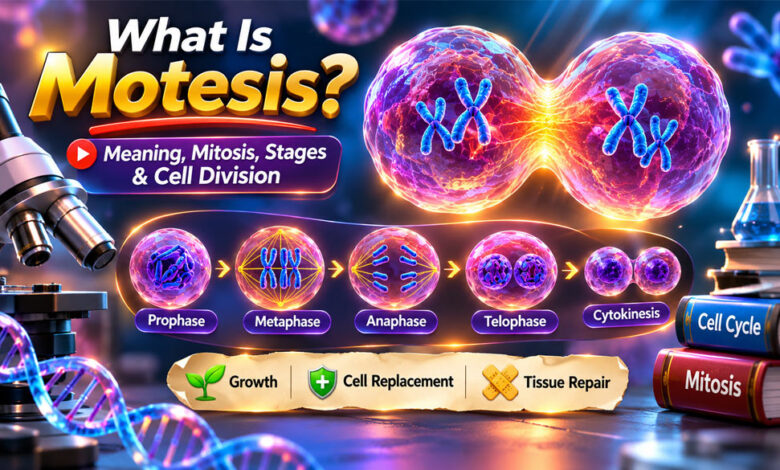

Motesis is a word that some people may see online when searching about cells and cell division. However, Motesis is not a standard biology term. In many cases, people may actually mean mitosis.
Mitosis is the process that helps cells divide correctly. It is important for body growth, replacing old cells, and repairing tissues.
This guide explains what Motesis may mean, how mitosis works, its main stages, and what happens to chromosomes when cells divide.
What Does Motesis Mean?
Motesis does not have a standard meaning in biology based on the information available.
Scientific sources use the word mitosis when talking about normal cell division. Because the words look similar, Motesis may sometimes be a spelling mistake for mitosis.
This is more likely if you see Motesis in content about cells, DNA, chromosomes, growth, or cell division.
However, Motesis should not always be called a spelling mistake. It could also be used as the name of a company, website, product, or another project.
The context is important. If you see something like “Motesis stages” in a biology lesson, the writer probably means mitosis.
What Is Mitosis?
Mitosis is a process that helps a cell divide its copied chromosomes correctly.
Before mitosis starts, the cell copies its DNA. The copied chromosomes then need to be separated so that each new nucleus gets a complete set.
During mitosis, chromosomes are organized, moved, and separated.
Mitosis mainly describes the division of the nucleus. The final physical division of the whole cell is called cytokinesis.
Together, mitosis and cytokinesis usually produce two daughter cells from one parent cell.
Why Is Mitosis Important?
Mitosis is important for normal growth and for keeping many parts of the body healthy.
It helps the body make new cells while normally keeping the correct number of chromosomes.
Growth and Development
Human development starts with a fertilized egg.
That single cell divides many times as the body grows. Mitosis helps produce the large number of cells needed to build the human body.
As the body develops, cells also take on different jobs.
For example, skin cells and muscle cells have different functions. Mitosis produces new cells, but it does not decide what job each cell will have.
Genes and other signals in the body help control how cells develop.
Cell Replacement and Tissue Repair
Cells can become old, worn out, or damaged. The body needs new cells to replace many of them.
For example, skin cells are regularly replaced. Cells in the lining of the digestive system also need regular replacement.
However, not every type of cell divides at the same speed. Some divide often, while others divide very slowly. Some mature nerve cells rarely divide.
Mitosis also helps repair damaged tissues.
However, mitosis is only one part of healing. The body also uses inflammation, cell movement, and other processes to repair damaged areas.
The Cell Cycle Before Mitosis
Mitosis is part of a larger process called the cell cycle.
A common misunderstanding is that DNA is copied during mitosis. This is not correct.
DNA is copied before mitosis during the S phase.
The main parts of the cell cycle are G1, S, G2, and M. Some cells can also enter a state called G0.
G1 Phase
During G1, the cell grows and does its normal work.
It also prepares materials that may be needed if it later divides.
S Phase
S stands for synthesis.
During this stage, the cell copies its DNA. Each chromosome is copied so that the genetic information can later be shared between the two new nuclei.
This happens before mitosis starts.
G2 Phase
During G2, the cell makes its final preparations for division.
The cell also checks whether it is ready to enter mitosis.
M Phase
The M phase includes mitosis.
During this stage, copied chromosomes are separated into two groups.
Cytokinesis usually happens near the end of this process and divides the cell into two daughter cells.
G0 State
Some cells leave the active cell cycle and enter G0.
A cell in G0 is not actively preparing to divide. Some cells may later return to the cell cycle. Others can stay in G0 for a long time.
This is one reason why every cell in the body is not constantly dividing.
Different cells also take different amounts of time to complete the cell cycle.
Stages of Mitosis
Mitosis is commonly explained using four main stages:
Prophase, metaphase, anaphase, and telophase.
More detailed explanations also include prometaphase. Cytokinesis then completes the physical separation of the cell.
1. Prophase
During prophase, the genetic material becomes more tightly packed.
The chromosomes become easier to see.
Each copied chromosome has two matching parts called sister chromatids. They are joined around an area called the centromere.
The cell also starts building the mitotic spindle. This structure helps move chromosomes during cell division.
2. Prometaphase
During prometaphase, the nuclear envelope normally breaks down in animal cells.
This allows parts of the mitotic spindle to reach the chromosomes.
Small structures called kinetochores help connect the chromosomes to the spindle.
These connections are important because the chromosomes need to be properly attached before they separate.
3. Metaphase
During metaphase, the chromosomes line up around the middle of the cell.
This middle area is called the metaphase plate.
Spindle fibers connect to the chromosomes from opposite sides.
Metaphase is often easy to notice in diagrams because the chromosomes appear in a line across the center of the cell.
4. Anaphase
During anaphase, the sister chromatids separate.
They move toward opposite ends of the cell.
After the chromatids separate, each one is considered an individual chromosome.
The goal is for each future nucleus to receive a complete set of chromosomes.
Mistakes during this stage can sometimes cause a new cell to receive too many or too few chromosomes.
5. Telophase
During telophase, the chromosomes reach opposite ends of the cell.
New nuclear envelopes start forming around them.
The chromosomes also begin to loosen, and the mitotic spindle is taken apart.
At this point, two nuclei have formed. However, the whole cell may not yet be completely divided.
6. Cytokinesis
Cytokinesis physically separates the cell into two.
In animal cells, the cell membrane normally pinches inward until two cells are formed.
Plant cells divide differently because they have firm cell walls. They form a cell plate between the two new cells.
Mitosis and cytokinesis are closely connected, but they are not exactly the same.
Mitosis divides the nucleus. Cytokinesis divides the rest of the cell.
What Happens to Chromosomes During Mitosis?
A typical human body cell has 46 chromosomes, arranged in 23 pairs.
Before the cell divides, its DNA is copied during S phase.
After the DNA has been copied, the cell is still usually described as having 46 chromosomes. However, each chromosome now has two sister chromatids.
This can be confusing because the amount of DNA has doubled.
It does not simply mean the cell now has 92 chromosomes. Chromosomes are normally counted using their centromeres.
During anaphase, the sister chromatids separate. Each separated chromatid is then considered its own chromosome.
After successful mitosis and cytokinesis, each daughter cell normally has 46 chromosomes.
The number 46 applies to typical human body cells. Other species have different numbers of chromosomes.
Motesis, Mitosis, and Meiosis: What Is the Difference?
Motesis, mitosis, and meiosis may sound similar, but they do not mean the same thing.
Motesis has no verified standard meaning in biology. In cell-division content, it may simply be a misspelling of mitosis.
Mitosis helps produce new body cells. It is important for growth and tissue maintenance.
Meiosis is a different form of cell division. In humans, it is used to produce reproductive cells such as sperm and egg cells.
| Feature | Mitosis | Meiosis |
|---|---|---|
| Main purpose | Growth and maintenance | Making reproductive cells |
| Number of divisions | One | Two |
| Usual resulting cells | Two | Four |
| Human chromosome number in resulting cells | 46 | 23 |
| Genetic similarity | Usually very similar | More genetically varied |
| Main chromosome process | Sister chromatids separate | Homologous chromosomes separate first, then sister chromatids |
Meiosis reduces the chromosome number by half.
In humans, this means reproductive cells normally have 23 chromosomes. When a sperm and egg join, their chromosome sets combine.
Meiosis also creates more genetic variation than mitosis.
Mitosis normally keeps genetic information very similar between the parent cell and daughter cells. However, mistakes or DNA changes can sometimes create differences.
How Cells Control Division
Cells have control systems that help make sure division happens correctly.
These systems are called cell-cycle checkpoints.
They can check things such as DNA condition, DNA copying, and chromosome attachment.
If the cell finds a problem, it may pause the cell cycle. This can give the cell time to repair the problem. In some cases, the cell may stop moving forward with division.
One important control is called the spindle assembly checkpoint.
It helps stop anaphase from starting until the chromosomes are properly attached to the spindle.
These controls reduce mistakes, but they cannot prevent every error.
What Can Go Wrong During Mitosis?
Mistakes can sometimes happen during mitosis.
For example, chromosomes may not separate correctly. This can leave one new cell with too many chromosomes and another with too few.
Having an unusual number of chromosomes is called aneuploidy.
Some cells with major errors stop dividing or die. Other abnormal cells may survive.
Errors that happen after fertilization can also lead to mosaicism.
Mosaicism means that different groups of cells in the same person can have different genetic information.
Mosaicism does not always cause a health problem. Its effects depend on the genetic change and which cells are affected.
A mistake during mitosis therefore does not automatically mean that someone will develop a disease.
Mitosis and Cancer
Mitosis is sometimes connected with cancer because cancer cells can grow and divide without normal control.
However, normal mitosis does not cause cancer.
Mitosis is a normal and necessary process.
Cancer can develop when the systems controlling cell growth and survival stop working correctly. Changes in genes involved in cell growth, DNA repair, and the cell cycle can play a role.
Healthy cells normally respond to signals telling them when to grow and when to stop. Cancer cells can lose some of these controls.
This can allow them to keep dividing when they should stop.
One mistake during mitosis does not automatically cause cancer. Cancer usually develops through a more complicated group of changes over time.
The body can also repair or remove many abnormal cells before they become a serious problem.
Common Misunderstandings About Motesis and Mitosis
There are several common misunderstandings about Motesis and mitosis.
Motesis Is a Separate Biological Process
There is no verified standard biological process called Motesis in the information reviewed.
In biology content, the writer may simply mean mitosis.
However, Motesis could be used as a name for something else, so always check the context.
Every Cell Is Always Dividing
Cells do not divide all the time.
Some types of cells divide often. Others divide slowly or stay outside the active cell cycle for long periods.
The body carefully controls when many cells divide.
Mitosis Creates Genetic Diversity Like Meiosis
Mitosis and meiosis are different.
Mitosis normally keeps genetic information very similar between cells.
Meiosis helps create genetically different reproductive cells.
DNA Is Copied During Metaphase
DNA is not copied during metaphase.
It is copied earlier during the S phase.
During metaphase, the chromosomes that have already been copied line up in the middle of the cell.
More Cell Division Always Means Better Healing
Cell division helps repair tissues, but more cell division is not always better.
Healing needs to be controlled.
Cells need signals that tell them when to divide, move, change their function, and stop growing.
Too much uncontrolled cell growth can damage healthy tissue.
How to Identify Mitosis Stages in a Diagram
You can often identify a mitosis stage by looking at what the chromosomes are doing.
During prophase, chromosomes become tightly packed and easier to see.
During metaphase, the chromosomes line up in the middle of the cell.
During anaphase, the sister chromatids separate and move toward opposite ends.
During telophase, two new nuclei begin forming.
During cytokinesis, the whole cell starts separating into two cells.
In animal cells, you may see the cell pinching in the middle. In plant cells, you may see a cell plate forming.
Another useful clue is the number of divisions. Mitosis has one nuclear division after DNA replication, while meiosis has two.
Bottom Line
Motesis is not a standard biological term based on the information available. When the word appears in content about cells, DNA, or chromosomes, the intended word may be mitosis.
Mitosis is a normal process that helps the body make new cells. It is important for growth, replacing cells, and maintaining tissues.
During mitosis, copied chromosomes are organized and separated into two nuclei. Cytokinesis then helps divide the whole cell into two daughter cells.
Mitosis is also different from meiosis. Mitosis mainly helps make new body cells, while meiosis produces reproductive cells.
If you see Motesis used outside biology, check the original source before deciding what it means. It may be a name or another term that has nothing to do with cell division.
Frequently Asked Questions
What is Motesis in biology?
Motesis is not a recognized standard biology term. In content about cells and chromosomes, the writer may mean mitosis.
Is Motesis another word for mitosis?
Not officially. It may be a misspelling of mitosis in some cases. Always check the original context.
What is the main purpose of mitosis?
Mitosis helps separate copied chromosomes correctly. It supports body growth, cell replacement, and tissue maintenance.
What are the main stages of mitosis?
The four traditional stages are prophase, metaphase, anaphase, and telophase. More detailed explanations also include prometaphase. Cytokinesis physically separates the cell afterward.
When is DNA copied?
DNA is copied during the S phase of the cell cycle. This happens before mitosis.
How many cells does mitosis produce?
Mitosis followed by cytokinesis normally produces two daughter cells from one parent cell.
What is the difference between mitosis and meiosis?
Mitosis normally produces two new cells for growth and maintenance. Meiosis normally produces four reproductive cells with half the usual chromosome number.
Can mistakes during mitosis cause disease?
Some mistakes can affect chromosomes or how cells work. However, not every mitosis error causes disease or cancer.
What Is File Content Conversion? How It Works, Types, and Benefits