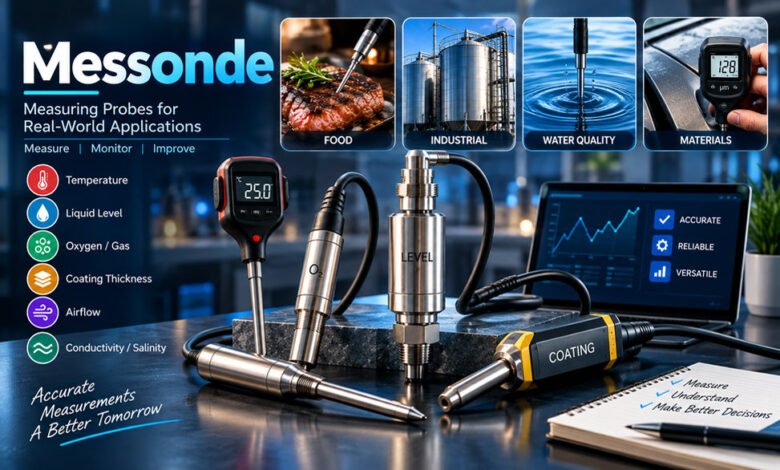

Messonde is a term that can have different meanings online. In technical use, it is often connected with the German word Messsonde, which means a measuring probe or sensing probe. These probes are used to measure things such as temperature, oxygen, airflow, conductivity, liquid level, and material thickness.
People often search for Messonde because the spelling and meaning are not clear. This guide explains what Messonde means, how a measuring probe works, the main types, and where these probes are used.
What Is Messonde?
Messonde is best understood as a term that can have different meanings depending on the context. In technical documents, it is usually connected with Messsonde, the German term for a measuring probe.
A measuring probe is a device or part that detects a physical or chemical value. It may touch a surface, enter a liquid, sit inside a tank, or be placed in moving air.
For example, one probe may measure temperature inside food. Another may check oxygen in water. Industrial probes can measure liquid levels, pressure, gases, or other process conditions.
The probe is often only one part of the measuring system. It collects information and sends a signal to a meter, controller, computer, or other instrument. That equipment then turns the signal into a useful reading.
Messonde does not describe one specific machine. Different measuring probes can have very different designs and purposes.
Messonde vs. Messsonde
The spelling is one of the main reasons this topic causes confusion.
Messsonde is the established modern German technical term. It combines words related to measurement and a probe. In English, it can be translated as measuring probe, measurement probe, test probe, or sensor probe.
Meßsonde is an older German spelling that may still appear in old manuals, patents, and scanned documents.
The shorter spelling Messonde can appear in search results, translated documents, product listings, or copied text. It may also result from a typing or scanning error.
This difference is important when looking for technical information. A search for “Messonde” may show mixed results. Searching for Messsonde can make it easier to find German manuals, manufacturer information, technical specifications, and compatible parts.
Useful English search terms include measuring probe, measurement probe, sensing probe, and measuring sensor.
Why Does Messonde Have Different Meanings?
Messonde is not a standard English technical word with one accepted meaning. This is why search results can look confusing.
In technical material, the strongest meaning comes from its connection with Messsonde, or a measuring probe.
Messonde is also the name of an online publishing website. That website uses the term in a different way and describes Messonde as a modern idea linked with curiosity, exploration, creativity, resilience, and personal growth.
Some other websites describe Messonde as a digital platform, communication system, or advanced technology. However, the information collected for this article does not show strong evidence of one established software product under this name. There is no clearly confirmed developer, official feature list, pricing system, technical documentation, or established user base for such a platform.
For this reason, the meaning should always be decided from the context. A technical manual using the word is very different from a website using Messonde as a brand or modern concept.
How Does a Messonde Work?
The way a Messonde works depends on what the probe is designed to measure.
At the center of a measuring probe is a sensing element. This part reacts when the condition around it changes. The change could involve heat, oxygen, pressure, airflow, liquid, or another physical or chemical property.
The probe creates a signal from this change. Depending on the technology, the signal may involve electrical resistance, voltage, current, light, or a chemical reaction.
A connected instrument reads the signal and converts it into useful information. The result might appear as a temperature in degrees Celsius, an oxygen level, an airflow value, a graph, a warning, or a control signal.
The basic process is:
Property being measured → sensing element → signal → measuring instrument → result
Some probes are simple and have only a sensing tip, cable, and connector. More advanced probes can include electronics, protective housing, transmitters, or digital processing.
A Messonde does not always work by itself. It may need a compatible meter, controller, laboratory instrument, industrial system, or other equipment.
Main Types of Messonde Measuring Probes
There is no single type of Messonde. Measuring probes are designed for different jobs and environments.
Temperature Probes
Temperature probes are among the most common types.
A food temperature probe can be placed inside meat or another dish to measure its internal temperature. Correct placement matters. The sensing tip should normally be placed in the part that needs to be measured and kept away from areas that could give a misleading reading, such as bone.
Temperature probes are also widely used outside kitchens. They can be found in laboratories, HVAC systems, factories, storage facilities, ovens, tanks, pipes, and industrial machines.
Some probes can measure temperature together with another value, such as airflow.
Airflow and Ventilation Probes
Airflow probes are commonly used in heating, ventilation, and air-conditioning systems.
They help technicians check how quickly air is moving through a system. Some can also calculate or help determine volume flow.
A vane probe is one example. It has a small rotating part that moves when air passes through it. The connected measuring instrument uses this movement to calculate airflow.
Some vane probes also contain a temperature sensor. This allows technicians to check airflow and temperature during the same inspection.
Oxygen and Gas Probes
Oxygen probes measure oxygen in liquids or gases. They can be used in laboratories, water systems, environmental work, and industrial processes.
Different probes use different sensing methods. These can include electrochemical and optical technologies.
The correct probe depends on the material being tested. A probe made to measure dissolved oxygen in water may not be suitable for hot industrial gas.
Some oxygen probes also need special care. Depending on the design, this may include calibration, cleaning, membrane care, correct storage, or protection from drying.
Conductivity and Salinity Probes
Conductivity probes are mainly used with liquids. They measure how easily a liquid carries electrical current.
Water containing more dissolved ions usually has higher conductivity. This information is useful in laboratories, water treatment, industrial systems, and marine aquariums.
Conductivity can also help calculate salinity. Temperature is important because conductivity changes when water temperature changes. Many measuring systems therefore use temperature compensation.
These probes need to stay clean. Salt deposits, minerals, algae, and air bubbles can affect the reading. A reading that looks stable is not always accurate if the sensing area is dirty.
Level Measurement Probes
Level probes are used to check the amount of material inside tanks, silos, vessels, and other containers.
Some probes provide point-level detection. This means they detect when a liquid or solid reaches a certain position.
Other systems provide continuous level measurement, allowing the system to track the level as it rises or falls.
Industrial level probes must be selected carefully. High temperatures, pressure, foam, dust, chemicals, and material buildup can affect their performance.
Coating and Thickness Probes
Special measuring probes can check the thickness of paint, enamel, plastic, insulation, and other coatings.
They are used in areas such as car inspection, manufacturing, construction, steel work, maintenance, and quality control.
Different measuring methods are available. Magnetic-inductive methods can be used for suitable coatings over steel or iron. Eddy-current methods can work with suitable coatings over conductive non-magnetic metals.
The probe and measurement method must match both the coating and the material underneath it.
The condition of the surface also matters. Dirt, rough areas, curved surfaces, thin materials, and edges can affect the result.
Environmental and Scientific Probes
Measuring probes are widely used in environmental monitoring and scientific research.
They can help measure air quality, water conditions, emissions, temperature, conductivity, gases, and other environmental values. Oceanographic systems may combine several measurements, such as conductivity and temperature.
Laboratories also use probes to collect measurements from liquids, gases, samples, surfaces, and experimental systems.
Some probes are used only when a measurement is needed. Others stay installed and continuously send data to a monitoring system.
Messonde, Sensor, and Measuring Instrument
A Messonde, sensor, and measuring instrument are related, but they are not always the same thing.
A sensor is the part that detects a change. For example, it may react to heat, oxygen, pressure, or another condition.
A probe is often the physical part placed in or near the material being tested. It may contain the sensor along with a shaft, protective housing, cable, connector, or small electronic parts.
The measuring instrument receives and processes the signal. It may show the result on a screen, save the data, create a graph, or send the information to another system.
Some modern digital probes can process part of the measurement inside the probe itself. Even so, many probes still need a compatible meter or controller.
This is important when buying a measuring probe. A probe may fit physically but still not work with a certain meter. The connector, signal type, electronics, and calibration system must also be compatible.
Common Uses of Messonde
Messonde measuring probes can be used in many areas because different probes measure different conditions.
In kitchens and food production, temperature probes help check the internal temperature of food. In HVAC systems, airflow and temperature probes help technicians test ventilation and heating systems.
Factories use measuring probes to monitor machines, tanks, pipes, liquids, gases, and production processes. These readings can support quality control, maintenance, and process monitoring.
Laboratories use probes to measure samples and record conditions during tests. Water treatment systems and aquariums may use conductivity, salinity, oxygen, and temperature probes.
Environmental monitoring is another important use. Measuring probes can collect information about air, water, emissions, and other environmental conditions.
Special thickness probes are used in car inspections, manufacturing, construction, and quality control. They can measure paint and other coatings without removing the layer.
The exact use always depends on the type of probe and its sensing method.
Calibration and Accuracy
Calibration helps check whether a measuring probe is giving reliable results.
During calibration, the reading is compared with a known reference. If the probe gives a different value, the instrument may need adjustment, servicing, or another action recommended by the manufacturer.
The calibration method depends on the probe. A temperature probe can be checked against a known temperature reference. Conductivity probes may use special calibration solutions. Oxygen measurement systems can have their own zero, span, or other calibration procedures.
Some devices need one reference point, while others use two or more.
Calibration cannot repair physical damage. A worn, dirty, damaged, or faulty sensing element may still give poor results after calibration.
How often calibration is needed also depends on the equipment and its use. Equipment used for important laboratory, safety, industrial, or quality measurements may have stricter requirements than a probe used for simple checks.
When accurate records matter, it can be useful to record the calibration date, reference used, and result.
Cleaning and Maintenance
Good maintenance helps a Messonde continue to give reliable readings.
Dirt on the sensing area can change a measurement. Depending on the probe, this may include dust, grease, chemicals, minerals, algae, dried salt, or other material.
Food probes should be cleaned as directed after use. Water and conductivity probes may need deposits removed from their sensing surfaces. Some oxygen probes have sensitive membranes or other parts that need careful handling.
Storage is also important. Certain laboratory probes need special storage conditions. Some sensing parts should not be allowed to dry out, while other probes need to stay clean and dry when not in use.
Cables and connectors should also be checked. A damaged cable or loose connection can cause unstable readings.
Do not scrape or aggressively clean a sensing surface unless the manufacturer says it is safe. A small scratch can damage a membrane, coating, electrode, or sensing face.
There is no single cleaning method for every measuring probe. Always follow the instructions for the exact model.
Common Messonde Problems
Problems with a Messonde do not always mean that the probe needs to be replaced. Some faults have simple causes.
Incorrect Readings
A probe may show a reading that is clearly too high or too low.
First, check its position and make sure it is being used within the correct measurement range. Then check for dirt and perform the recommended calibration if needed.
Using the wrong probe for the material or environment can also cause incorrect results.
Unstable or Jumping Readings
A value that suddenly moves up and down can point to a loose connector, damaged cable, poor contact, electrical problem, or unsuitable probe position.
Check the cable and connections first. If possible, test the probe with compatible equipment known to be working correctly.
Slow Measurement Drift
Drift means the reading slowly moves away from the expected value.
Dirt, ageing, contamination, or changes in the sensing element can cause this. Cleaning and calibration may help. If the problem continues, the probe may need servicing or replacement.
Dirty Sensing Surface
Minerals, salt, food, chemicals, dust, or biological growth can cover the sensing area.
Clean it only with a method approved for that type of probe. Using a hard tool or strong chemical can cause permanent damage.
Damaged Cable or Connector
Cables can become cut, bent, crushed, or loose. Moisture can also enter connectors that are not designed to be waterproof.
Inspect the cable and plug for visible damage. A damaged cable may require professional repair or replacement of the probe.
Wrong Calibration
Using the wrong reference can make a probe appear accurate when it is not.
Use the correct calibration solution, temperature reference, or procedure specified for the equipment. Check that reference materials are still suitable for use.
Incompatible Equipment
Two probes can measure the same thing but use different connectors, signals, or electronics.
Check the probe model and the supported measuring instrument before connecting them. A plug that fits does not always mean the devices are compatible.
How to Choose the Right Messonde
Start by deciding exactly what you need to measure. A temperature probe, oxygen probe, airflow probe, and coating probe are made for different jobs.
Next, consider the material or environment. The probe may need to work in air, water, food, chemicals, gas, metal surfaces, or another medium.
Check the measurement range and required accuracy. Also consider response time if you need readings to change quickly.
Operating conditions are important. Check the maximum and minimum temperature, pressure limits, moisture protection, and resistance to chemicals or corrosion.
Physical details matter too. Look at probe length, diameter, mounting method, cable length, and connector type.
Compatibility with the meter or controller should always be confirmed. The probe may need a specific signal type, connector, software, or calibration system.
For food applications, check whether the probe materials are suitable for food contact. For saltwater or chemical use, choose materials that can handle corrosion and the substances involved.
Do not choose a Messonde only because it measures the correct value. It must also suit the environment and the equipment connected to it.
How to Identify What “Messonde” Means Online
The word Messonde can lead to very different search results. The surrounding words usually help explain what the writer means.
If a page mentions temperature, calibration, conductivity, airflow, sensor, electrode, measurement, or industrial equipment, it is probably discussing a measuring probe or the German term Messsonde.
If the page talks about curiosity, exploration, creativity, resilience, or personal growth, it is probably using Messonde as the newer coined concept.
Some pages describe Messonde as an app, digital platform, or technology. Claims like these should be checked carefully. Look for an official company, developer, product documentation, working service, pricing information, or other direct evidence.
For technical research, manufacturer documentation, scientific institutions, technical dictionaries, manuals, and product specifications are more useful than general blog claims.
It is also important to remember that a website using Messonde as its name does not automatically represent the German measuring term Messsonde. They are separate uses of similar wording.
Bottom Line
Messonde has more than one meaning online. In technical contexts, it is most strongly connected with Messsonde, the German term for a measuring probe.
These probes can measure temperature, oxygen, airflow, conductivity, level, coating thickness, and many other physical or chemical values. There is no single Messonde device that performs every type of measurement.
The right probe depends on what needs to be measured, the working environment, required accuracy, measurement range, and compatibility with the connected instrument.
Correct calibration, cleaning, storage, and handling are also important. A good probe can still produce poor results if it is dirty, damaged, incorrectly calibrated, or used with the wrong equipment.
Frequently Asked Questions
What does Messonde mean?
Messonde is often linked to the German word Messsonde, which means a measuring or sensing probe.
Is Messonde the correct spelling?
The standard German spelling is Messsonde. Messonde is often used as a spelling variation or simplified form.
Is Messonde the same as a sensor?
Not exactly. A sensor detects a change, while a probe may contain the sensor along with a cable, housing, and other parts.
What can a Messonde measure?
Depending on its type, it can measure temperature, oxygen, airflow, conductivity, pressure, liquid level, and thickness.
Does a Messonde work by itself?
Not always. Many probes need a compatible meter, controller, or other measuring device to show the results.
How often should a measuring probe be calibrated?
It depends on the probe and how it is used. Always follow the manufacturer’s calibration instructions.
How do you clean a Messonde?
Use the cleaning method recommended for the specific probe. Avoid harsh cleaning because it may damage sensitive parts.
Is Messonde a digital platform?
Some websites describe it as a digital platform, but there is no strong evidence of one established Messonde software platform.
What Is Innøve? Features, Technology, Benefits, and How It Works