
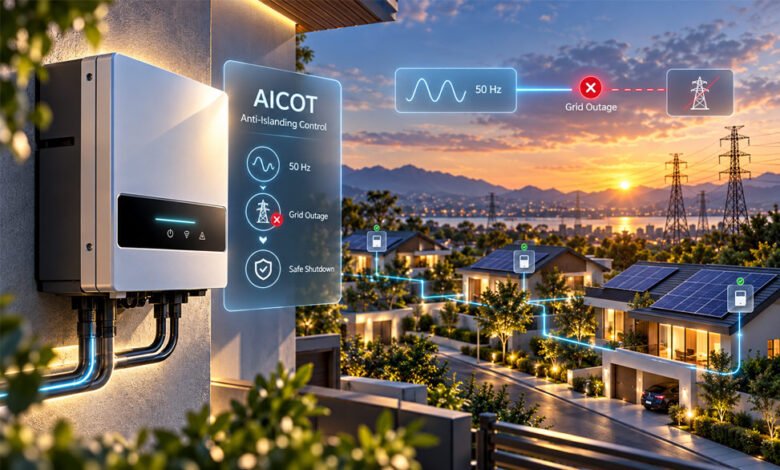

AICOT is a solar safety technology developed by OMRON Corporation. In this context, AICOT stands for Anti-Islanding Control Technology. It is used in photovoltaic power conditioners, also called solar inverters.
The technology was created to help detect a utility power failure, especially in places where many solar systems are connected close together. This article explains what AICOT is, why islanding can be dangerous, how the technology works, and how OMRON developed and tested it.
The name AICOT is also used for an unrelated European cybersecurity project. This article focuses only on OMRON’s solar anti-islanding technology.
What Is AICOT Technology?
AICOT is an anti-islanding control technology developed for grid-connected solar power systems.
A solar inverter normally changes direct current, or DC, from solar panels into alternating current, or AC, that can be used by buildings or supplied to the utility grid.
A grid-connected inverter must also check whether the normal electricity grid is still working. If utility power disappears, the solar system should not continue sending electricity into the disconnected part of the network.
AICOT helps the inverter identify this situation.
Its main advantage is that it was designed for locations where many solar inverters operate close together. In these areas, normal anti-islanding methods may affect each other and make outage detection more difficult.
AICOT is not a type of solar panel. It is also not a separate device that homeowners normally install by itself. It is a control technology built into compatible photovoltaic power conditioners.
What Is Islanding in a Solar Power System?
Islanding happens when one part of an electricity network becomes separated from the main utility grid but continues receiving power from a local energy source.
For example, imagine that utility power goes down in a neighborhood. Solar panels in that area may still be producing electricity because the sun is shining.
If their inverters continue sending electricity into the disconnected network, that part of the grid can remain powered even though the main utility supply has stopped.
This is called unintentional islanding.
It can create serious safety problems. A utility worker may believe that a disconnected power line is no longer live. If a nearby solar system is still supplying electricity, the line may still carry dangerous voltage.
Islanding can also create problems for electrical equipment and make it harder for the utility company to restore normal power.
For these reasons, grid-connected solar inverters normally include anti-islanding protection. The inverter must recognize when the utility supply has disappeared and react correctly.
Why Multiple Solar Inverters Create a Problem
Anti-islanding protection can use different methods to detect a grid failure.
Some systems use passive detection. This means the inverter watches electrical conditions such as voltage and frequency. If these values move outside normal limits, the inverter may identify a problem.
Other systems use active detection. An active method makes a small controlled change in the electrical system and then watches how the grid responds.
This can work well with a small number of inverters.
The problem becomes more difficult when many solar systems are connected to the same local network.
Each inverter may be making its own small changes to detect islanding. The actions of one inverter can interact with the actions of another. In some situations, these signals may weaken or cancel each other.
This can make it harder for a conventional anti-islanding system to recognize that utility power has disappeared.
OMRON studied this issue as solar systems became more common in areas where many homes had rooftop panels. The company developed AICOT to improve anti-islanding control in these high-density solar environments.
How AICOT Works
AICOT uses an active detection method that watches changes in the electrical grid.
One important part of the system is grid frequency. Electricity grids operate around a set frequency. When the main utility grid is connected, it helps keep that frequency stable.
When utility power disappears, electrical behavior can change.
AICOT watches these changes and uses a controlled response to help decide whether the utility grid is still present.
The technology has been described as using frequency feedback with step injection of reactive power.
In simple words, the inverter makes a small controlled electrical adjustment. It then checks how the frequency responds.
If the response suggests that the main utility supply is no longer present, the anti-islanding system can react and stop the solar installation from continuing to power the isolated grid section.
The important point is that this method was designed to work better when many nearby solar inverters are operating at the same time.
Frequency Feedback and Reactive Power
Frequency feedback is one of the main engineering ideas behind AICOT.
The inverter keeps watching grid frequency. It uses changes in that frequency as part of its decision about whether normal utility power is available.
AICOT also uses controlled changes in reactive power.
Reactive power is part of an AC electrical system. It does not work in exactly the same way as the power normally measured as useful electrical output, but it affects voltage, current, and the behavior of the network.
AICOT can introduce a small controlled reactive-power change and then observe the result.
When the utility grid is operating normally, the wider grid has a strong influence on frequency. When the inverter becomes separated from the utility, the response can be different.
AICOT uses this difference to help detect islanding.
The method was developed so that many nearby inverters could carry out anti-islanding detection without creating the same level of interference seen with some older approaches.
Main Features of AICOT
AICOT has several important features that are linked to its use in solar power systems.
Multi-Unit Anti-Islanding Detection
AICOT was developed mainly for locations where many photovoltaic systems operate close together.
Its control method helps deal with the interaction that can happen between the anti-islanding systems of different inverters.
This makes it useful for housing developments, solar communities, and other areas with a high number of rooftop solar systems.
Grid Frequency Monitoring
The system watches grid frequency as part of its detection process.
Changes in frequency can provide useful information about whether the inverter is still connected to the normal utility network.
Frequency Feedback Control
AICOT does more than simply read frequency values.
Its control system uses frequency feedback to guide the active anti-islanding process. This helps the inverter respond to changes in the electrical network.
Reactive-Power Step Injection
The technology uses controlled reactive-power changes as part of its detection method.
By checking how the grid reacts to these small changes, the system can collect more information about whether normal utility power is still available.
Designed for Clustered Solar Systems
A major feature of AICOT is its focus on clustered photovoltaic systems.
It was developed for environments where many power conditioners may be connected to the same distribution network.
The goal was to reduce the interference that could happen between their anti-islanding controls.
Built Into Power Conditioners
AICOT is not normally a separate consumer product.
It is control technology used inside compatible photovoltaic power conditioners. This means users do not operate AICOT like an app or separate solar device.
Development and History of AICOT
OMRON’s work on multi-unit anti-islanding technology was connected to the growth of residential solar power in Japan.
The company reported that research into clustered photovoltaic grid connections began around 2003. OMRON worked with Kandenko and other organizations on projects in Ota, Japan.
The researchers studied an important question: what happens when many independent solar systems are connected within the same local electricity network?
Testing showed that conventional active anti-islanding methods could interfere with one another when many photovoltaic systems operated close together.
OMRON continued developing a method that could reduce this problem.
The company reported successful development of its multi-unit anti-islanding control technology in 2008.
Development did not end at that point. The technology was also tested in larger solar environments to study how it behaved when many systems operated together.
Commercial OMRON photovoltaic power conditioners equipped with the technology reportedly went on sale in July 2011.
This means AICOT moved from research and testing into actual solar power equipment.
Testing at Pal Town Josai-no-Mori
AICOT was tested as part of a large photovoltaic demonstration project at Pal Town Josai-no-Mori in Ota, Gunma Prefecture, Japan.
This type of site was useful because researchers needed more than one or two solar systems to study multi-unit interference properly.
By December 2009, the demonstration reportedly included 554 equipped units.
Their combined solar generation capacity was about 2,129 kW.
The large number of connected photovoltaic systems gave engineers a way to study how anti-islanding controls behaved in a dense solar environment.
It also helped show why multi-unit testing was important. A control method that works with one inverter may behave differently when hundreds of systems are connected in the same area.
The Pal Town project therefore became an important part of the development and testing of OMRON’s anti-islanding technology.
AICOT and Multi-Unit Interference Testing
Before AICOT, large groups of solar power conditioners often needed extra testing to make sure their anti-islanding systems did not interfere with each other.
Engineers had to connect measuring equipment to individual power conditioners and check how the systems behaved together.
According to OMRON, this multi-unit interference testing could take around one to two months.
That added more work to solar projects and could delay installation.
OMRON reported that power conditioners using AICOT removed the need for this type of interference testing in supported multi-unit systems.
This was useful because installers could avoid long testing periods while still using anti-islanding protection designed for areas with many connected PV systems.
Benefits of AICOT
AICOT was developed to make anti-islanding protection work more reliably in areas with many solar systems.
One important benefit is reduced interference between nearby power conditioners. This helps multiple solar inverters operate on the same local network without weakening each other’s islanding detection.
AICOT can also reduce the amount of testing needed before a large group of solar systems is connected.
Other reported benefits include:
- Better support for high-density solar installations.
- Reduced multi-unit interference testing.
- Shorter installation and verification time.
- Improved anti-islanding protection in clustered PV systems.
- Easier connection of many rooftop solar systems in the same area.
- Possible reduction in some extra equipment and testing costs.
OMRON also said the technology could help increase the amount of solar generation that can be installed in one area.
These benefits are mainly based on information reported by OMRON and its development partners.
AICOT vs. Conventional Anti-Islanding Protection
AICOT and conventional anti-islanding systems have the same basic goal.
Both are designed to detect when utility power disappears and stop a grid-connected solar inverter from continuing to supply an isolated part of the network.
The main difference is the type of installation they were designed to handle.
Traditional anti-islanding methods can work well when only a small number of inverters are connected nearby.
Problems can appear when many active anti-islanding systems operate at the same time. Their electrical changes may interact and make detection more difficult.
AICOT was created specifically to deal with this multi-inverter interference problem.
It does not replace the solar inverter. Instead, it is part of the inverter’s control system.
The technology is therefore most useful when many photovoltaic power conditioners are connected within the same local grid area.
Where AICOT Can Be Used
AICOT was mainly developed for places where many solar generation systems operate close together.
This can include residential areas with large numbers of rooftop solar systems.
It can also be useful in:
- Housing developments.
- Solar communities.
- Multi-building solar projects.
- Commercial sites with several photovoltaic systems.
- Local distribution networks with high levels of rooftop solar.
The technology depends on compatible power conditioners.
AICOT should not be assumed to work with every solar inverter. Available information does not show that it is a universal technology that can simply be added to any modern PV system.
Compatibility depends on the specific inverter, electrical design, utility requirements, and local grid rules.
Safety and Limitations
The main safety purpose of AICOT is to help prevent unintended islanding.
When utility power is lost, a solar inverter should stop supplying electricity to the isolated part of the grid.
This helps reduce the risk of an electrical line remaining energized when utility workers expect it to be disconnected.
However, AICOT is only one part of solar electrical safety.
A complete grid-connected solar installation may also need other protection systems, correct wiring, circuit protection, grounding, isolation equipment, and compliance with local electrical and utility rules.
Solar inverter standards have also changed since AICOT was first developed.
Modern smart inverters can include many functions that go beyond basic anti-islanding protection, such as voltage support, frequency control, communication features, and grid-management functions.
For this reason, AICOT should not be treated as the only requirement for a modern solar installation.
There is also limited public information about which current inverter models still use AICOT or whether the original technology is supported in all markets.
Industry Recognition and Standardization
OMRON’s anti-islanding work also received industry attention.
In 2013, a photovoltaic power conditioner using OMRON’s anti-islanding technology received recognition through Japan’s New Energy Grand Prix program.
OMRON later announced in 2015 that its multi-unit anti-islanding technology had been standardized.
Standardization can be important because it gives manufacturers, utilities, and installers a common technical approach to follow.
It can also make it easier to connect equipment from large numbers of solar systems without treating every project as a completely new technical case.
The exact requirements used in a modern solar installation still depend on the country, utility company, inverter model, and current electrical standards.
Why AICOT Still Matters in Solar Engineering
The main engineering problem behind AICOT is still important today.
More homes and businesses now use distributed energy systems such as rooftop solar and battery storage.
This means electricity no longer moves only from large power stations to customers. Many smaller systems can also send electricity into local networks.
As the number of these systems grows, utilities need reliable ways to manage how they interact.
AICOT is an example of how control software and power electronics can solve problems created by large numbers of connected energy systems.
It also shows why simulation is useful in electrical engineering.
Instead of testing every condition only with physical equipment, engineers can model outages, frequency changes, inverter behavior, and system interactions before large-scale field testing.
Modern solar technology has continued to develop, so today’s smart inverters may use newer control methods and follow newer grid codes.
Still, the basic challenge remains the same: many distributed systems must work together without creating new safety or grid-stability problems.
Bottom Line
AICOT is OMRON’s Anti-Islanding Control Technology for photovoltaic power conditioners.
It was developed mainly for areas where many solar inverters operate close together.
Its key idea is to use frequency feedback and controlled reactive-power changes to help detect when utility power disappears.
The technology was also designed to reduce interference between the anti-islanding systems of nearby inverters.
OMRON reported that AICOT helped remove the need for lengthy multi-unit interference testing in supported installations.
AICOT is not a solar panel or a separate inverter. It is a control technology built into compatible power conditioners.
Its main importance is its role in making high-density solar installations easier and safer to connect to the power grid.
Frequently Asked Questions
What does AICOT stand for?
AICOT stands for Anti-Islanding Control Technology in OMRON’s solar systems.
Who developed AICOT?
AICOT was developed by OMRON Corporation for clustered photovoltaic systems.
What is AICOT used for?
It helps solar inverters detect a power outage and stop supplying electricity to an isolated grid section.
How does AICOT detect an outage?
It uses grid-frequency feedback and controlled reactive-power changes to detect loss of utility power.
Is AICOT a solar inverter?
No. AICOT is a control technology built into compatible solar inverters or power conditioners.
Why is AICOT useful with many solar systems?
It helps reduce interference between anti-islanding systems when many inverters operate close together.
When was AICOT developed?
OMRON reported successful development in 2008, with commercial products introduced in July 2011.
Is AICOT still relevant today?
Yes. Its core safety purpose remains relevant, although modern systems must follow current grid and inverter standards.
What Is Giniä? Meaning, Possible Uses, Benefits, and Key Facts
IP2 Network Guide: Features, Setup, Benefits, Safety, and Alternatives





One Comment