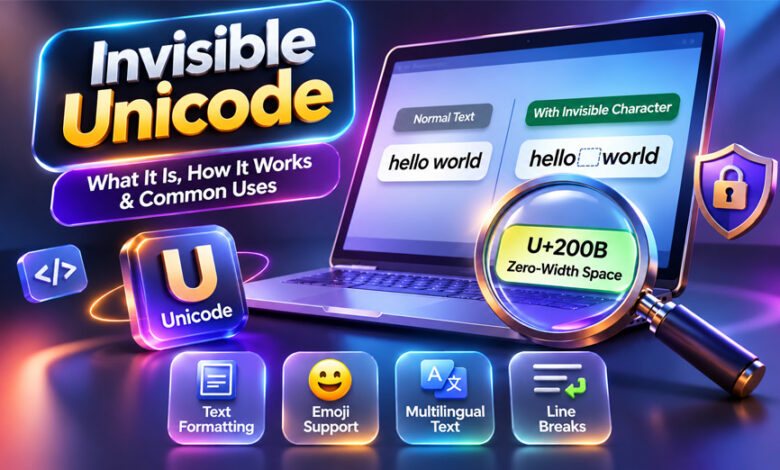

Invisible Unicode characters are real characters in digital text, but you may not see them on your screen. Some take up no visible space. Others look like blank spaces or change how other characters appear.
People often search for invisible Unicode when they have problems with copied text, usernames, passwords, files, code, or formatting. These characters are also useful for languages, emoji, spacing, and text formatting.
This guide explains what invisible Unicode is, how it works, its main types, common uses, problems, and security risks.
What Is Invisible Unicode?
Invisible Unicode means Unicode characters that exist inside text but may not show a visible symbol.
These characters have their own Unicode code points. They are stored in text just like normal letters, numbers, and symbols.
For example, the Zero-Width Space has the code point U+200B. You cannot normally see it, but software can find and count it.
Invisible text is also different from empty text. Empty text has no characters. Invisible text can contain real characters even though it looks blank.
Different invisible characters have different jobs. Some control spaces or line breaks. Others control text direction, character joining, or emoji.
Most of these characters were created for useful reasons. They help computers correctly display languages, symbols, and formatted text.
How Do Invisible Unicode Characters Work?
Unicode gives each character its own code point. Software reads this code point to understand what the character is and what it should do.
For example, the letter A has a Unicode value. A Zero-Width Space also has its own value. The main difference is that you can see the letter A, but you normally cannot see the Zero-Width Space.
Imagine two words that both look like this:
helloworld
The first may contain only the visible letters. The second could have a hidden Zero-Width Space between “hello” and “world.”
They look the same, but software may treat them as different text.
Invisible Unicode can affect searches, character counts, text comparisons, line breaks, filenames, emoji, and text direction.
A zero-width character still uses data. For example, U+200B uses three bytes when stored in UTF-8. It is invisible, but it is still part of the text.
Main Types of Invisible Unicode Characters
There is not just one invisible Unicode character. Unicode has many hidden and blank-looking characters. Each one has a different purpose.
Zero-Width Space (U+200B)
The Zero-Width Space, also called ZWS, is one of the best-known invisible characters.
It takes up no visible space. It can tell software where a line is allowed to break without adding a normal space.
It can be useful for text wrapping. However, it can also cause problems when it appears where it is not needed.
For example, a hidden Zero-Width Space may affect searches, usernames, filenames, code, and text comparisons.
Zero-Width Joiner (U+200D)
The Zero-Width Joiner, or ZWJ, helps join characters together.
It is often used with emoji. Some emoji that look like one symbol are actually made from several characters joined together by ZWJ.
It is also important in some writing systems.
Removing a ZWJ can change how text or emoji appear. A combined emoji may turn into several separate emoji.
Zero-Width Non-Joiner (U+200C)
The Zero-Width Non-Joiner, or ZWNJ, does the opposite. It stops certain characters from joining together.
It is useful in languages where letters have special joining rules, including Persian and some other writing systems.
It does not create a normal visible space. Instead, it changes how nearby characters are shown.
Because it has a real language purpose, it should not always be removed.
Word Joiner (U+2060)
The Word Joiner (U+2060) is another invisible character.
It helps stop a line from breaking at a certain point. It does this without adding a visible space.
Today, U+2060 is normally preferred over U+FEFF when this type of line-break control is needed.
Hangul Fillers
Unicode includes Hangul filler characters such as U+3164, U+115F, and U+1160.
They were created for Korean text. Some of them are treated as letters rather than normal spaces.
Because they can look blank, people sometimes use them for blank-looking usernames, profile names, bios, or messages.
However, they do not work everywhere. Websites, games, and apps can block these characters.
Directional Marks
Some invisible Unicode characters control the direction of text.
The Left-to-Right Mark (U+200E) helps with left-to-right text. The Right-to-Left Mark (U+200F) helps with right-to-left text.
These characters are useful when languages such as English, Arabic, or Hebrew appear together.
They can help keep words, numbers, and punctuation in the correct order.
Removing them from multilingual text may cause the text to appear incorrectly.
Unicode Space Characters
Unicode also has several types of spaces.
An En Space (U+2002) is about half an em wide. An Em Space (U+2003) is wider. The Thin Space (U+2009) and Hair Space (U+200A) create smaller gaps.
A Figure Space (U+2007) can help align numbers. A Punctuation Space (U+2008) is useful around punctuation. The Ideographic Space (U+3000) is commonly used in Chinese, Japanese, and Korean text.
Another example is the Non-Breaking Space (U+00A0). It looks like a normal space but stops the text from breaking onto a new line at that point.
These spaces are not always zero-width. They are often discussed with invisible Unicode because they look blank instead of showing a symbol.
Other Invisible and Format Characters
The Soft Hyphen (U+00AD) marks a place where a word can be divided if a line break is needed. It normally stays hidden unless the word breaks at that point.
U+FEFF is mainly used as a Byte Order Mark (BOM) in text files. It can sometimes cause problems when software does not expect it.
The Combining Grapheme Joiner (U+034F) is used for special text-processing tasks. It does not normally display its own symbol.
Unicode also has Variation Selectors, including U+FE00 to U+FE0F. They can change how another character is displayed. For example, they may help choose between text-style and emoji-style display.
The Braille Pattern Blank (U+2800) is another blank-looking character. Unlike a Zero-Width Space, it normally takes up some width.
All these characters may look invisible or blank, but they do not all work in the same way.
Common Uses of Invisible Unicode
Invisible Unicode has many useful purposes.
Zero-Width Space can help software decide where a line should break. It does this without showing a normal space.
Zero-Width Joiner and Zero-Width Non-Joiner control how characters connect. They are important for some languages and emoji.
Directional marks help when left-to-right and right-to-left languages are used together. They can keep words, numbers, and punctuation in the right order.
Special Unicode spaces are useful in typography. They give writers and designers more control over the space between words, numbers, and symbols.
Some invisible characters also have technical uses. For example, U+FEFF can appear as a Byte Order Mark at the start of a text file.
People may also use blank-looking Unicode for usernames, gaming names, social media bios, captions, or messages. However, support depends on the platform.
Invisible characters can also be used as hidden markers or text watermarks. This allows information to be placed inside text without changing how the text normally looks.
How Invisible Characters Get Into Text
Invisible Unicode can enter text in many ways.
One common way is copying and pasting. Text copied from websites, word processors, or formatted documents may contain hidden characters.
PDF files can also add unexpected characters when text is copied from them. A PDF is mainly made to keep the visual design of a document, so copied text is not always clean.
Multilingual text may contain invisible characters for a good reason. Direction marks, joiners, and non-joiners can help languages display correctly.
Emoji can also contain invisible characters. One emoji shown on your screen may be made from several Unicode characters joined together.
Invisible text generators add these characters on purpose. People may then paste them into usernames, messages, profiles, or other fields.
Hidden characters can also appear in CMS content, databases, imported files, and web pages.
You may only notice them when text that looks correct suddenly does not work as expected.
Problems Caused by Invisible Unicode
Invisible Unicode can cause problems when hidden characters appear where they are not needed.
For example, two usernames or passwords may look exactly the same but fail to match because one contains an extra invisible character.
Character counts may also look wrong. A word that appears to have ten characters could contain an extra hidden character that software also counts.
Invisible Unicode can affect searches, forms, URLs, filenames, spreadsheets, imported data, databases, and code.
A hidden character at the start of a file may also cause problems for software trying to read that file.
However, not every invisible character is a problem. Some are needed for languages, emoji, and correct text formatting.
How to Find Invisible Unicode Characters
You normally cannot find hidden Unicode just by looking at the screen.
One simple option is an online invisible character checker. Paste your text into the tool, and it may show the hidden characters, their positions, and their Unicode values.
Text and code editors can also help. Tools such as VS Code and Notepad++ have options for showing or highlighting unusual characters.
Developers can use regular expressions to search for specific Unicode characters. JavaScript, Python, and other programming languages can also inspect text character by character.
Character count can also provide a clue. If software reports more characters than you can see, there may be a hidden character inside the text.
How to Remove Invisible Unicode Characters
How you remove invisible Unicode depends on the character and where it appears.
For a short piece of text, you can use a Unicode checker or text-cleaning tool. First find the unwanted character, then remove it.
Find and replace can also help when you know which hidden character is causing the problem.
Developers can use regular expressions, JavaScript, Python, or other programming languages to remove selected characters from larger amounts of text.
In spreadsheets, functions such as SUBSTITUTE can remove specific Unicode characters. Similar methods can be used in databases.
However, do not automatically remove every invisible character. Some are needed for correct languages, emoji, spacing, or text direction.
It is better to find the character first and understand why it is there.
When You Should Not Remove Invisible Characters
Some invisible characters should stay in the text.
For example, a Zero-Width Joiner may be needed to display an emoji correctly. Removing it could separate one combined emoji into several symbols.
Zero-Width Non-Joiners may be needed in some languages. Removing them could change how words appear.
Directional marks can be important when English is mixed with Arabic, Hebrew, or another right-to-left language.
Non-breaking spaces may also be added on purpose to stop related text from separating across two lines.
The safest approach is simple: understand what the hidden character does before deleting it.
Invisible Unicode and Security Risks
Invisible Unicode characters are not harmful by themselves. Most were created for useful text and language purposes.
However, they can be misused.
Someone can add hidden characters to make two pieces of text look the same even though their underlying data is different. This may be used for fake-looking usernames, hidden markers, or attempts to get around simple text filters.
Invisible characters can also be used for hidden watermarks. A person may place hidden characters inside normal text to mark a particular copy.
Developers and website owners should therefore check unexpected hidden characters in important user-submitted data.
Invisible Unicode in Phishing Emails
Invisible Unicode has also been reported in phishing emails.
A reported 2026 phishing campaign used hidden Unicode tag characters inside finance-related words. The words looked normal to people reading the emails, but their underlying text contained extra characters.
This could cause problems for basic security systems that search for exact suspicious words.
For example, if an invisible character is placed inside a word, the reader may still see the normal word. A simple security filter may see two separate parts instead.
The reported campaign used characters from the Unicode Tags block, U+E0000 to U+E007F. U+E0020 TAG SPACE was one character reported in the emails.
The source described this method as a form of ASCII smuggling.
According to the source, Microsoft detected around 21,000 hits on February 8, 2026 and more than 1.3 million on February 9. The activity reportedly later passed 2.3 million messages in one day and stayed high for around three months.
These numbers are reported figures for that specific campaign. They do not represent every phishing email that uses hidden Unicode.
Hidden characters may also affect systems that divide text into smaller pieces before checking it. This can change how some security or machine-learning systems understand a word.
However, unusual hidden characters can also help security teams find suspicious emails. They can be checked together with links, sender information, email authentication, domains, and other warning signs.
How to Handle Invisible Unicode Safely
Invisible Unicode should be handled based on where it appears and what it is doing.
Check unexpected hidden characters in usernames, URLs, filenames, databases, and other text where an exact match is important.
Security systems can also normalize text before checking suspicious words or patterns. This can help them find words that have been split with hidden characters.
However, normalization is not the same as simply deleting every invisible character.
Websites that support many languages need to be especially careful. Removing useful joiners or directional marks can damage valid text.
A hidden character alone also does not prove that an email is dangerous. Other details such as the sender, links, domain, email authentication, and message content should also be checked.
Tips to Prevent Invisible Unicode Problems
You can reduce unwanted hidden characters with a few simple steps:
- Paste as plain text when you do not need formatting.
- Check copied text before using it in code, URLs, or important records.
- Check character counts when text looks correct but does not match.
- Validate user input for important fields such as usernames.
- Check for a BOM when a text file has a problem at the beginning.
- Turn on Unicode highlighting in your code editor when possible.
- Be careful with multilingual text before removing hidden characters.
- Keep Zero-Width Joiners when they are needed for emoji.
- Use Unicode-aware tools when checking or cleaning text.
The goal is not to remove every invisible character. The goal is to find unwanted ones and handle them correctly.
Bottom Line
Invisible Unicode characters are real parts of digital text, even when you cannot see them. They can control spaces, line breaks, character joining, text direction, emoji, and other text behavior.
Most invisible characters have useful purposes. Problems happen when they appear by mistake or are used to hide changes in text.
If an invisible character causes a problem, find out which character it is first. Then remove it only if it is not needed.
Frequently Asked Questions
What is an invisible Unicode character?
It is a real Unicode character that may not show on the screen. Software can still store, copy, count, and read it.
What is the most common invisible Unicode character?
The Zero-Width Space (U+200B) is one of the most common examples. It takes up no visible width.
Is an invisible Unicode character the same as a normal space?
No. Some invisible characters have zero width, while others are special spaces or formatting characters.
Why are invisible Unicode characters used?
They help with text formatting, line breaks, languages, character joining, emoji, and typography.
How can I find invisible characters in text?
You can use a Unicode checker, text editor, regular expression, or programming tool to find them.
Can I remove invisible Unicode characters?
Yes, but check what the character does first. Some hidden characters are needed for languages, emoji, and formatting.
Are invisible Unicode characters dangerous?
Usually, no. However, they can be misused for phishing, spoofing, hidden text, or bypassing simple text filters.
Can invisible Unicode characters affect copied text?
Yes. They can stay inside copied text and cause problems with searches, forms, filenames, code, or text matching.