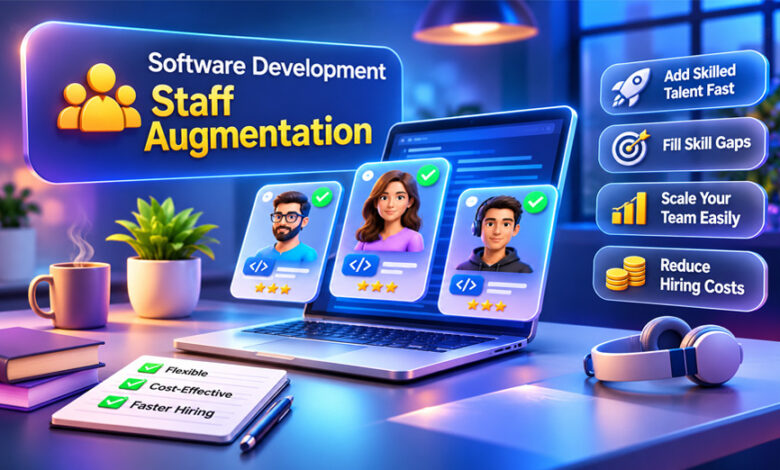

Software development staff augmentation is a way for companies to add outside tech experts to their existing team. A business can hire developers or other specialists when it needs more people or specific skills.
Companies often use this model when they need help quickly or do not want to hire permanent employees. This guide explains how staff augmentation works, its benefits, costs, common roles, risks, and other important details.
What Is Software Development Staff Augmentation?
Software development staff augmentation is a hiring model where a company adds outside software professionals to its current team.
These professionals can work for a few weeks, several months, or even longer. It depends on what the company needs.
The outside developers usually work like part of the company’s own team. They may use the same tools, join meetings, follow the same work process, and report to company managers.
A business can hire one person or several people. They may work part-time or full-time. They can also work locally or remotely from another country.
The main goal is to fill a skill or staff gap without hiring a permanent employee. For example, a company may need a DevOps engineer for one cloud project. It can hire an outside DevOps expert only for that project.
Staff augmentation is a type of outsourcing, but the company normally keeps control of the work.
How Does Software Development Staff Augmentation Work?
The process starts by finding out what the current team needs.
For example, a company may need someone with machine learning skills. Another company may already have the right skills but need more developers to meet a deadline.
The business then decides what kind of professional it needs. It may consider the role, skills, experience, project length, working hours, and time zone.
Next, the company looks for suitable workers. It may use a staff augmentation provider that already has access to developers and other tech professionals.
The company can review and interview candidates before choosing someone.
After hiring, the new professional joins the existing team. They may get access to the codebase, project tools, documents, development systems, and communication platforms.
The company manages their daily work, gives them tasks, checks progress, and provides feedback.
The team can also be changed when needed. More people can be added when work increases, while external workers can be reduced when less help is needed.
Types of Staff Augmentation
There are different ways to use software staff augmentation. The right choice depends on the project and how long help is needed.
Short-Term Staff Augmentation
Short-term staff augmentation is useful when a company needs extra help for a limited time.
It may be used for a product launch, short development project, busy season, or when an employee is temporarily unavailable.
Some short-term contracts may last a few months. However, there is no fixed length.
It can also help when a deadline is close and the current team does not have enough time or people to finish the work.
Long-Term Staff Augmentation
Companies can also use staff augmentation for longer periods.
An outside developer may work with the company for six months, a year, or even longer.
This can be useful for ongoing software development, large projects, system updates, and digital transformation work.
Long-term external developers can learn a lot about the company’s software and work process. Companies should still keep good documents so important knowledge is not lost when the developer leaves.
Skill-Based Staff Augmentation
Skill-based augmentation means hiring someone for a specific skill.
For example, a company may need an AI engineer, cloud expert, cybersecurity specialist, mobile developer, or DevOps engineer.
Hiring a permanent employee may not make sense if that skill is only needed for one part of a project. Staff augmentation gives the company access to the skill only when it needs it.
Common Roles in Software Staff Augmentation
Many different tech professionals can be hired through staff augmentation.
Front-end developers work on the parts of websites and apps that users see and use. They may work on layouts, buttons, menus, responsive design, and other user-facing features.
Back-end developers work behind the scenes. They may manage databases, APIs, servers, security, and application logic.
Full-stack developers can work on both the front end and back end of software.
Mobile app developers create apps for iOS and Android. Some also use tools such as Flutter and React Native to build apps for different platforms.
QA engineers test software and find bugs or other problems. Some QA engineers also create automated tests.
DevOps and cloud engineers help with cloud systems, software deployment, automation, monitoring, and development processes.
Companies can also hire UI/UX designers, data engineers, machine learning experts, cybersecurity specialists, project managers, Scrum Masters, business analysts, and product specialists.
The company should first understand which skill is missing before adding new people.
When Should a Company Use Staff Augmentation?
Staff augmentation can be useful when a company has a development team but needs more workers or special skills.
A common reason is a skill gap. For example, a business may start an AI project but have no AI expert on its team.
It can also help when the current team already has too much work. Adding outside developers can give the internal team extra support.
Another reason is a tight deadline. Hiring a permanent employee can take time. Staff augmentation may provide a faster way to add an experienced professional.
Businesses may also use it for new products, MVPs, busy periods, employee leave, or unexpected staff departures.
Staff augmentation may not be right when a company wants another business to manage the whole project. In that case, project outsourcing may be a better choice.
Benefits of Software Development Staff Augmentation
One major benefit is flexibility. Companies can add more developers when work increases and reduce the team when less help is needed.
Another benefit is access to more talent. Remote hiring allows companies to find skilled professionals from different cities or countries.
It can also make hiring faster. A staff augmentation provider may already have experienced developers available.
The company also keeps control over the project. Outside professionals normally follow the company’s work process and project plans.
There may also be cost savings. A company may avoid some costs linked to permanent employees, such as benefits, office space, and long hiring processes.
However, staff augmentation is not always cheaper. Senior developers and experts in AI, cloud technology, cybersecurity, and DevOps can be expensive.
The model works best when the extra skills and flexibility are worth the cost.
Software Development Staff Augmentation Costs
There is no fixed price for software development staff augmentation.
The cost depends on the developer’s location, experience, skills, role, project length, and provider.
Many companies pay by the hour or based on the amount of time the professional works.
Location can have a big effect on price. Rates can be different in North America, Europe, Asia, and other regions.
Experience also matters. Junior developers normally cost less than senior developers. Experts in areas such as AI, cybersecurity, DevOps, and software architecture may charge more.
One source we reviewed gives a broad range of about $15 to $150 or more per hour. This is only a general estimate. Real prices can be lower or higher.
Companies should also think about other costs. These may include provider fees, onboarding, software tools, security setup, and internal management time.
Choosing the cheapest developer does not always save money. A skilled developer may finish better work in less time.
Staff Augmentation vs. Other Hiring and Outsourcing Models
There are several ways to get extra software development help. These include staff augmentation, project outsourcing, dedicated teams, freelancers, managed services, and permanent hiring.
The main differences are who manages the workers, how closely they work with the internal team, and how long they are needed.
Staff Augmentation vs. Project Outsourcing
With staff augmentation, outside developers join the company’s existing team. The company usually manages their daily work.
With project outsourcing, a company gives a complete project or part of a project to another business. The outside provider usually manages its own team and project work.
Staff augmentation is useful when a company wants to keep control. Project outsourcing may be better when the company wants another provider to manage the whole project.
Staff Augmentation vs. Dedicated Teams
A dedicated team is usually a complete outside team working for one client.
Staff augmentation normally means adding selected professionals to an existing internal team.
A dedicated team can work well for long-term projects. Staff augmentation can be better when a company already has a team but needs extra help.
Staff Augmentation vs. Freelancers
Freelancers are independent workers hired directly or through freelance websites.
They can be useful for small jobs or short projects.
Staff augmentation is usually more organized. A provider may help find and check professionals before they join the client’s team.
Staff Augmentation vs. Managed Services
With staff augmentation, the client normally manages the outside workers.
With managed services, an outside company takes responsibility for managing an agreed service or technology function.
The best option depends on how much control the business wants to keep.
Staff Augmentation vs. In-House Hiring
In-house hiring means adding a permanent employee to the company.
Permanent workers can be a better choice for important roles that the company will need for many years.
Staff augmentation is more flexible. The company can use outside professionals only for the time they are needed.
Challenges and Drawbacks
Staff augmentation also has some challenges.
Finding the right person can still take time, especially when a company needs rare technical skills.
Communication can be difficult when people work remotely or in different countries. Different time zones and working styles can sometimes cause delays.
Outside developers also need time to learn the company’s software, tools, rules, and work process. Poor documentation can make this harder.
The company must also manage the external workers. Staff augmentation does not remove the need to give tasks, answer questions, review work, and check progress.
Long-term staff augmentation can also become expensive. Companies should regularly check whether it still gives good value.
Security, Privacy, and Intellectual Property
Outside developers may need access to source code, databases, company documents, cloud services, and other private systems.
Companies should only give them the access they need to do their work.
Strong passwords, secure login methods, approved communication tools, and clear security rules can help protect company systems.
An NDA or confidentiality agreement can also help protect private business information.
Contracts should clearly explain who owns the source code, designs, documents, and other work created during the project.
Businesses should not simply assume they own everything an outside developer creates. Ownership can depend on the contract and local law.
When a developer leaves, the company should quickly remove access to code, cloud accounts, project tools, and other internal systems.
Legal and Contract Considerations
A clear contract is important when using staff augmentation.
It should explain the work, payment, contract length, responsibilities, privacy rules, and how the agreement can end.
The contract should also clearly explain who owns the code and other work.
Data protection laws may apply if outside developers can access customer or employee information.
Employment and contractor rules can also be different from one country to another.
Businesses working with developers in other countries may need legal advice to make sure their contracts and working arrangements follow the right laws.
How to Choose a Staff Augmentation Provider
Choose a provider that understands the skills your project needs.
Check how it finds and checks developers. Technical skills are important, but communication and teamwork also matter.
Look at the provider’s experience, past projects, client feedback, and available developers.
Pricing should be clear. Ask about hourly or monthly rates, extra fees, minimum contract periods, and payment terms.
Also check how the provider protects company data and intellectual property.
Time zones and language skills are important for remote teams. A developer should be able to communicate and work well with the existing team.
Do not choose a provider only because it offers the lowest price. Skills, reliability, communication, and security also matter.
How to Onboard and Manage Augmented Developers
Outside developers should receive proper onboarding.
Introduce them to the internal team and explain who is responsible for each part of the project.
Give them access to the tools and information they need. This may include code repositories, development systems, project management tools, documents, and communication platforms.
Good documentation makes it easier for a new developer to understand the project.
Clearly explain tasks, deadlines, coding rules, security requirements, and how work will be reviewed.
Remote teams should also have simple communication rules. Everyone should know where to ask questions, report progress, and discuss problems.
Regular feedback can help fix problems early.
How to Measure Staff Augmentation Success
Companies should decide how they will measure success before the work begins.
They can check whether projects and tasks are completed on time.
Quality is also important. Work should not create unnecessary bugs or problems.
Other useful measures include productivity, development speed, project cost, teamwork, deadlines, and return on investment.
Most importantly, the company should check whether staff augmentation solved the original problem.
For example, if the business needed an AI expert, it should ask whether the outside professional successfully provided that missing skill.
Best Practices for Successful Staff Augmentation
Start by clearly deciding what skills and help the company needs.
Do not choose developers only because they are cheap. Check their skills, experience, communication, and quality of work.
Interview candidates when possible.
Keep project documents updated so new developers can understand the software and work process.
Keep communication clear and regular without adding unnecessary meetings.
Protect private systems and only give workers the access they need.
Before an outside developer leaves, make sure important project knowledge is written down and shared with the internal team.
Future of Software Development Staff Augmentation
Remote work has made it easier for companies to hire software professionals from different countries.
AI is also becoming part of the hiring process. Some providers use automated tools to match developers with suitable projects.
Demand for AI, machine learning, cloud, DevOps, data, and cybersecurity skills may continue to grow.
Remote teams are also using more written updates and shared documents instead of depending only on meetings.
Some staff augmentation companies are focusing on specific industries or technical skills.
These are current industry trends. They do not mean every staff augmentation provider will work in the same way.
Bottom Line
Software development staff augmentation helps companies add outside tech professionals to their existing teams.
It can be useful when a business needs special skills, extra developers, faster hiring, or temporary support.
However, companies should also think about costs, communication, security, contracts, management, and knowledge sharing.
The right choice depends on the company’s project, budget, team, required skills, and how long the extra help is needed.
Frequently Asked Questions
What is software development staff augmentation?
It is a hiring model where outside developers or tech professionals join a company’s existing team for a certain project or period.
How does software staff augmentation work?
A company finds a missing skill or staff need, chooses suitable outside professionals, and adds them to its existing team.
How much does software development staff augmentation cost?
There is no fixed price. The cost depends on location, skills, experience, role, provider, and contract length.
What is the difference between staff augmentation and outsourcing?
With staff augmentation, the client usually manages the outside workers. With project outsourcing, the outside provider normally manages the project.
Is staff augmentation only for short-term projects?
No. Companies can use it for both short-term and long-term software projects.
What are the main benefits of staff augmentation?
It offers flexible hiring, access to skilled workers, faster team growth, and more control over project work.
What are the risks of software staff augmentation?
Common risks include communication problems, security concerns, high costs, team integration issues, and loss of project knowledge.
How do you choose a software staff augmentation company?
Check its experience, developer skills, pricing, security, contracts, communication, and previous client work.
EO Pis: Business Performance, KPIs, Dashboards, and Reporting
GrowthScribe Marketing Agency Review: Services, Benefits, and Limitations