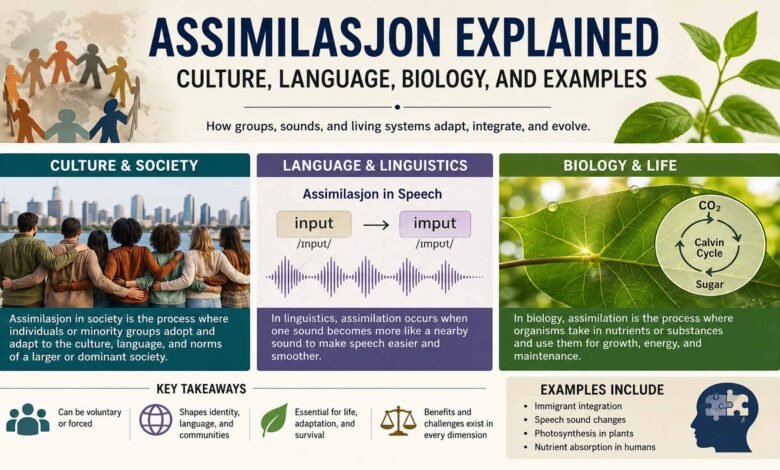

Assimilasjon is the Norwegian word for assimilation. The term can describe different processes depending on the subject. It is commonly used in discussions about culture and society, but it also has specific meanings in linguistics and biology.
People often search for assimilasjon to understand cultural change, immigration, identity, language loss, and historical policies. This article explains what assimilasjon means, how cultural assimilation happens, the difference between voluntary and forced assimilation, and how it affects people and communities.
What Is Assimilasjon?
Assimilasjon means assimilation in English. In simple terms, it describes a process in which something becomes more similar to, joins with, or is incorporated into something else.
The exact meaning depends on the field.
AreaMeaning of AssimilasjonSociety and culturePeople or groups adopt parts of another cultureLinguisticsOne speech sound becomes more like a nearby soundBiologyNutrients or substances are incorporated and used by living organisms
In sociology, assimilasjon usually refers to people adopting the language, customs, values, or social habits of a larger or dominant group. This may happen slowly over many years.
In linguistics, the term describes a change in pronunciation. A sound can become more similar to a nearby sound because it is easier to pronounce that way.
In biology, assimilation refers to the way organisms incorporate and use substances needed for growth, repair, and normal body functions.
These meanings are different, but they share a general idea of adaptation or incorporation.
Assimilasjon in Society and Culture
Cultural assimilation happens when individuals or groups adopt parts of another culture. This is especially common when people move to a new country or live for a long time among people with different cultural traditions.
The process may involve language, food, clothing, social habits, education, work, values, or everyday behavior. Some changes happen naturally because people interact with the wider society.
Assimilation does not always mean that a person completely gives up their original culture. Someone may speak the main language of a country at work while continuing to speak a heritage language at home.
A person may also follow local customs while keeping family traditions, religious practices, or cultural celebrations. For this reason, assimilation often happens in different degrees.
Sociologists have also treated assimilation as a process with several dimensions. Milton Gordon’s 1964 work, for example, described cultural, structural, marital, identificational, civic, and other forms of assimilation. His model helped show that becoming culturally similar to a majority group does not automatically mean full participation in every part of society.
How Cultural Assimilation Happens
Cultural assimilation usually develops through regular contact with other people and institutions. It rarely happens all at once.
Language is one of the most common factors. People who move to another country often learn the main language so they can study, work, use public services, and communicate with others.
Education also plays an important role. Children who attend local schools are often exposed to the majority language and social customs for many hours each day. This can make cultural change happen faster among younger generations.
Work can have a similar effect. Adults may adopt new communication styles, professional habits, and social expectations through daily contact with colleagues.
Friendships, neighborhoods, clubs, universities, and other social spaces can also influence cultural adaptation. The more regular contact people have with the wider society, the more likely they are to become familiar with its customs.
Marriage between people from different cultural backgrounds can lead to further blending. Families may combine languages, traditions, foods, and celebrations from both sides.
Assimilation can also become stronger across generations. Children and grandchildren of immigrants may use the majority language more often than the original family language. At the same time, they may still keep important parts of their heritage.
Voluntary vs. Forced Assimilasjon
Assimilation can be voluntary or forced. This difference is important because the two processes can have very different effects.
Voluntary assimilation happens when people choose to adopt parts of another culture. They may learn a new language, change some social habits, or take part in local institutions because they see practical or personal benefits.
For example, learning the main language of a country may make it easier to study, find work, communicate with neighbors, or take part in public life. These changes can happen without a person giving up their original identity.
Forced assimilation is different. It happens when a government, institution, or dominant group pressures people to abandon their language, customs, religion, or other parts of their culture.
Historically, forced assimilation has included policies that restricted minority languages, removed children from their communities, imposed new forms of education, or treated Indigenous and minority cultures as inferior.
The main issue is choice. Voluntary cultural change develops through interaction and personal decisions. Forced assimilation uses pressure, unequal power, or official rules to make people conform.
Historical Examples of Assimilasjon
Assimilation has appeared in many societies throughout history. The methods used have ranged from gradual cultural influence to direct government control.
The Roman Empire is often discussed as an early example. Rome encouraged many conquered populations to adopt Roman language, law, customs, and political institutions.
Local elites often had strong reasons to adopt Roman ways because Roman citizenship and participation in imperial institutions could provide social and political advantages. However, local cultures did not always disappear completely.
European colonial expansion created more coercive forms of assimilation. Colonial governments often tried to spread European languages, religions, school systems, and cultural standards among Indigenous populations.
In many places, Indigenous languages and traditions were treated as obstacles to colonial rule or modernization. This led to pressure on communities to abandon cultural practices that had existed for generations.
Assimilation policies were also used against Indigenous peoples in North America. Schools became one of the main tools. Children were sometimes separated from their families and discouraged or prevented from speaking their own languages and following traditional customs.
These examples show that assimilation cannot be understood without considering power. Cultural change through normal contact is very different from policies designed to erase a group’s identity.
Assimilation of the Sámi in Norway
The history of the Sámi is especially important when discussing assimilasjon in a Norwegian context.
For many years, Norwegian authorities followed policies commonly described as Norwegianization. These policies were aimed at making Sámi and Kven communities adopt Norwegian language and culture.
The strongest period of Norwegianization developed during the 19th and early 20th centuries, although its effects continued much longer. Schools were an important part of the policy.
Sámi children were often expected to use Norwegian in school, and the use of Sámi languages was restricted or discouraged in different periods and places. Education therefore became a major tool for cultural assimilation.
Government policies also affected access to land and participation in public life. Knowing and using Norwegian could become important for dealing with authorities and gaining social opportunities.
These policies contributed to language decline and cultural loss in some Sámi communities. In some families, parents stopped teaching Sámi languages to their children because speaking Norwegian was seen as safer or more useful.
Norway’s Truth and Reconciliation Commission has examined the consequences of Norwegianization policies toward the Sámi, Kven, Norwegian Finns, and Forest Finns. Its work has highlighted long-term effects on language, identity, trust, and cultural continuity.
This history is an example of forced assimilation rather than normal cultural integration. It shows why modern discussions often place strong importance on language rights, cultural protection, and voluntary participation.
Assimilasjon, Integration, and Multiculturalism
Assimilation, integration, and multiculturalism are related ideas, but they do not mean the same thing.
Assimilation generally means that a minority group becomes increasingly similar to the majority culture. This may include language, behavior, values, and social practices.
Integration means that people take part in the wider society while still keeping important parts of their original culture. A person can work, study, vote, and participate in community life without giving up their heritage.
Multiculturalism goes further by recognizing that different cultural groups can continue to exist within the same society. It often supports the idea that cultural diversity can be maintained rather than gradually disappearing.
Interculturalism is another related idea. It focuses on interaction between groups rather than simply allowing different communities to live separately. The goal is usually communication, cooperation, and two-way cultural exchange.
In real life, people may experience elements of all these models. Someone may become highly integrated into society, adopt some cultural habits, and still keep a strong connection to their family’s language and traditions.
Benefits and Drawbacks of Cultural Assimilation
Voluntary cultural assimilation can have practical benefits. Learning the dominant language can improve communication and make education, work, and public services easier to access.
People may also build larger social networks and become more comfortable in different cultural settings. Exposure to different ideas and traditions can encourage new ways of thinking and create cultural exchange.
Assimilation can also help people participate more fully in public and civic life. However, these benefits are not automatic. Speaking the majority language or adopting local customs does not guarantee equal treatment or equal opportunities.
There are also possible drawbacks. A heritage language may become less common in a family over time. Traditional customs may be practiced less often, especially among younger generations.
Some people may feel pressure to choose between their original identity and the expectations of the wider society. This can create tension within families or communities.
Forced assimilation can cause much more serious harm. When people are pressured to give up their language or culture, the result may include trauma, resentment, cultural loss, and distrust of institutions.
Assimilation can therefore have very different effects depending on whether it happens by choice or through pressure.
Assimilasjon, Identity, and Future Generations
Assimilation often affects identity over several generations.
First-generation immigrants may keep strong ties to their original language and traditions because they spent much of their early life in another country. Their children may grow up using two languages and learning both family traditions and the culture of the wider society.
Later generations may use the majority language more often and know less about their family’s original language. However, they may still identify strongly with their heritage.
This means cultural identity is not always replaced. Many people develop mixed or bicultural identities.
They may celebrate traditions from both cultures, eat foods from both backgrounds, and switch between different languages or social habits depending on the setting.
Intermarriage can increase this cultural blending. Children in multicultural families may grow up with several cultural influences rather than one clear cultural identity.
Assimilation is therefore better understood as a spectrum. People can adopt some parts of another culture while keeping others.
Language Loss and Cultural Preservation
Language is one of the parts of culture most affected by assimilation.
When a dominant language becomes necessary for school, work, government services, and public life, minority-language speakers may begin using their own language less often.
Over time, parents may stop teaching the language to their children. Once this happens across several generations, the number of fluent speakers can decline quickly.
Language loss matters because languages carry more than everyday words. They can preserve oral history, traditional stories, family knowledge, place names, environmental knowledge, and unique ways of describing relationships and the world.
This is why many Indigenous and minority communities work to protect and revive their languages. Efforts may include language classes, bilingual schools, media programs, dictionaries, digital tools, and support for using the language in public life.
Cultural preservation does not necessarily prevent participation in a wider society. People can learn and use a majority language while also maintaining a heritage language.
This balance is one reason modern discussions often focus more on integration, language rights, and cultural choice rather than expecting complete assimilation.
Assimilasjon in Linguistics
In linguistics, assimilasjon has a technical meaning that is different from cultural assimilation. It describes a sound change in which one speech sound becomes more like another nearby sound.
This usually happens because similar sounds can be easier and faster to pronounce. Speakers often make these changes naturally without thinking about them.
Assimilation is common in everyday speech. It can happen within a word or across word boundaries. The exact pattern depends on the language, dialect, and sounds involved.
For example, a nasal sound may change depending on the consonant that follows it. This allows the mouth and tongue to move more smoothly between sounds.
Linguistic assimilation is therefore mainly about pronunciation. It does not involve culture, identity, or social behavior.
Types and Examples of Sound Assimilation
Sound assimilation can happen in several ways. One common difference is based on the direction of influence.
Regressive assimilation happens when a later sound affects an earlier sound. For example, a consonant may change because of the sound that comes after it.
Progressive assimilation happens when an earlier sound influences a later sound.
Assimilation can also affect different parts of pronunciation. A sound may change its place of articulation, voicing, or another feature so that it becomes more similar to a nearby sound.
Nasal assimilation is a common example. A nasal consonant may shift depending on whether the following sound is made with the lips, tongue, or another part of the mouth.
English speakers can hear this type of change in natural connected speech. Similar processes also occur in Norwegian and many other languages.
These changes are not usually mistakes. They are normal features of spoken language and often make speech more efficient.
How Assimilation Changes Languages Over Time
Small pronunciation changes can become important over long periods.
If a certain sound pattern is used regularly by many speakers, children may learn it as the normal pronunciation. Over generations, this can contribute to lasting sound changes in a language.
Assimilation can also help create differences between dialects. One region may keep an older pronunciation while another develops a newer form.
This is one reason languages change over time. Speakers naturally balance ease of pronunciation with the need to keep words clear enough to understand.
Linguists study these changes to learn how modern languages developed from older forms and why related dialects sometimes sound different.
Assimilasjon in Biology
In biology, assimilation refers to the way living organisms incorporate and use substances needed for life.
It is closely connected with digestion, absorption, and metabolism, but these terms are not identical.
Digestion breaks food into smaller parts. Absorption moves nutrients from the digestive system into the blood or other tissues. Assimilation describes how those nutrients are then used or incorporated by cells and tissues.
These substances may support growth, tissue repair, energy production, and the creation of important biological compounds.
Assimilation happens in plants, animals, microorganisms, and humans, although the exact processes differ between organisms.
Assimilation in Plants
Plants depend on several forms of assimilation to grow and survive.
One important process is carbon assimilation. Plants take in carbon dioxide from the air and use photosynthesis to convert carbon into organic compounds.
The Calvin cycle plays a major role in this process. It helps turn carbon dioxide into molecules that can later contribute to sugars and other substances needed by the plant.
Plants also carry out nitrogen assimilation. Nitrogen is essential because plants need it to make amino acids, proteins, nucleic acids, and many other compounds.
Plants usually absorb nitrogen from the soil in forms such as nitrate or ammonium. They then convert it into organic nitrogen compounds that can be used for growth.
Both carbon and nitrogen assimilation are important not only for plants but also for wider ecosystems because plants form the base of many food chains.
Assimilation in Humans and Animals
Humans and animals obtain nutrients through food.
Proteins are digested into amino acids. After absorption, these amino acids can be used to build new proteins, enzymes, hormones, and body tissues.
Carbohydrates are broken down into simpler sugars such as glucose. Cells can use glucose in metabolic pathways that help produce energy.
Fats are also broken down and absorbed. Their components can be used for energy storage, cell membranes, and other biological functions.
The important point is that assimilation happens after nutrients become available to the body. It is part of the wider process through which food is turned into usable biological material.
When the Body Cannot Properly Use Nutrients
Problems with digestion or absorption can prevent the body from getting the full benefit of nutrients.
Medical sources usually describe this as malabsorption rather than simply calling it a failure of assimilation.
Celiac disease is one example. It can damage the lining of the small intestine and interfere with the absorption of nutrients.
Crohn’s disease can also affect nutrient absorption, especially when inflammation involves parts of the digestive system that normally absorb vitamins, minerals, fats, or other nutrients.
Some intestinal infections may cause temporary malabsorption as well.
However, not every nutritional deficiency is caused by poor absorption. Diet, illness, medication, and many other factors can also affect nutritional status.
Assimilasjon in the Modern World
Assimilation remains an important topic in modern societies because migration, global travel, international education, and digital communication bring people from different cultures into regular contact.
Modern debates often focus on how people can participate in a shared society without being expected to give up their cultural background.
Language remains a major issue. Governments may encourage immigrants to learn the national language because it can improve access to education, work, healthcare, and public services.
At the same time, many societies also recognize the value of protecting minority languages and cultural traditions.
Modern discussions therefore often focus less on complete assimilation and more on integration, equal participation, and cultural choice.
Globalization has also made assimilation less one-sided. Cultural influence can move in many directions. Minority communities can influence the wider society just as the majority culture can influence newcomers.
Social Media and Digital Cultural Assimilation
Social media has made cultural exchange much faster.
Platforms such as TikTok, Instagram, YouTube, and other online services can spread slang, music, fashion, humor, food trends, memes, and social habits across countries in a short time.
Young people may follow international trends while still keeping local traditions and languages.
This can create hybrid identities, where people combine different cultural influences instead of fully adopting one culture.
The term glocal is sometimes used to describe this mix of global and local culture.
For example, a person may enjoy global music and fashion while continuing to follow local family customs and speak a regional language at home.
Digital culture therefore shows that modern assimilation is often more fluid and interactive than older models suggested.
Comparing Cultural, Linguistic, and Biological Assimilasjon
The three main meanings of assimilasjon are very different, even though they share a broad idea of adaptation or incorporation.
| Area | What Changes | Simple Example |
|---|---|---|
| Culture and society | People adopt parts of another culture | Learning and using the majority language |
| Linguistics | One sound becomes more like another | A nasal sound changing before another consonant |
| Biology | Organisms incorporate and use substances | Plants using carbon dioxide during photosynthesis |
Cultural assimilation deals with people, identity, and society.
Linguistic assimilation deals with pronunciation.
Biological assimilation deals with nutrients and substances used by living organisms.
Understanding the context is therefore essential when someone uses the word assimilasjon.
Bottom Line
Assimilasjon can mean several different things depending on the subject.
In society, it describes the process of adopting parts of another culture. This can happen voluntarily through everyday contact or be forced through government or institutional pressure.
In linguistics, assimilation describes sounds becoming more similar to nearby sounds. In biology, it refers to the incorporation and use of substances by living organisms.
The social meaning is the most debated because it involves identity, language, culture, equality, and power. The key difference is whether cultural change happens through choice or pressure.
(FAQs)
What does assimilasjon mean?
Assimilasjon is the Norwegian word for assimilation. It can describe cultural adaptation, sound changes in language, or the biological use and incorporation of substances.
Is assimilasjon the same as integration?
No. Assimilation usually means becoming more similar to a dominant culture. Integration means taking part in society while still keeping important parts of one’s original culture.
Is assimilation always voluntary?
No. Assimilation can happen voluntarily through everyday interaction, education, work, and social life. It can also be forced through laws, institutions, or other forms of pressure.
What is an example of forced assimilation?
The historical Norwegianization policies directed toward Sámi and other minority communities are one example. These policies placed pressure on people to use Norwegian language and culture.
Can people assimilate without losing their original culture?
Yes. People can adopt some parts of another culture while keeping their language, traditions, religion, or family customs. Many people develop bicultural or mixed identities.
What does assimilation mean in linguistics?
In linguistics, assimilation is a sound change where one speech sound becomes more similar to a nearby sound. It often happens because the new pronunciation is easier or faster.
What does assimilation mean in biology?
In biology, assimilation describes the incorporation and use of substances by living organisms. It is related to processes such as nutrient use, carbon assimilation, and nitrogen assimilation.
What is the main difference between cultural, linguistic, and biological assimilation?
Cultural assimilation concerns people and society. Linguistic assimilation concerns speech sounds. Biological assimilation concerns how organisms incorporate and use substances.
What Is Nerwey? Meaning, Uses, and Everything You Need to Know
Fascisterne Explained: Meaning, History, and Political Origins