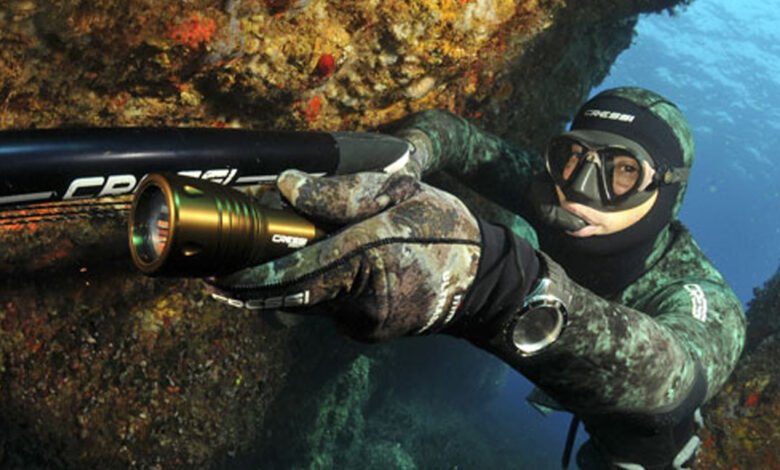

Most people, regardless of their degree of fitness and fish sense, reach a plateau in their diving in terms of the efficiency of their gear. In other words, the equipment that they are using is fine so they continue to use it but as they continue to use it they notice that there are a number of minute inefficiencies in the gear and these become major bottom time and shot losing inefficiencies as the diver uses the gear throughout the day.
This is a listing of dive gear in order of priority for the diver who cannot afford to purchase all of the gear at once. In addition, the diver will know how to best spend their money for the greatest return in improvements.
Fins and the propulsion budget
First consider the propulsion, the fins. Once you have an efficient propulsion system, all the other gear issues become more obvious. Most fishermen start with a pair of plastic fins. They are cheap and very forgiving. But they do load and unload energy poorly in the water.
Fibreglass blades cover the 8m-20m range very well, their progressive flex helps to absorb reef contact and diver error, making them a great intermediary between plastic fins and carbon. However, they do need to be selected based on the diver’s kicking style and their typical dive profile, and only provide a real efficiency gain when the diver is able to keep a clean kicking style, and then only for deep dives and long Open Water dives.
Matching stiffness to your body and your dive
First, you must decide how to choose a blade stiffness. If you are light and dive shallow in soft blades you will feel very efficient. However, in strong current you will feel underpowered. If you are heavy and dive in stiff blades you will feel inefficient because you are loading the blades up with each stroke and they will be producing a lot of useless flutter. So, in reality, you must choose a stiffness for the hardest type of diving you do and then be prepared to adapt to the rest.
Mask, snorkel and the small comfort failures
Note that the benefit of low volume masks is narrower than generally accepted, and therefore below 15m equalising for mask entry only of a small amount of air is of value, whereas above 15m the major considerations are for good fit and good field of view.
Try the mask on to the face without securing the strap. Inhale gently through the nose and if the mask holds together when pressure is applied (i.e. Seals), then it should fit the face of the diver. All the other gimmicks for low volume masks such as black skirts to reduce glare, mirrored lenses and even curled up nose pieces, are secondary to this simple test and therefore basically of little value.
Floats, lines and rigging that stops losing fish
The least glamorous but most important upgrade to your spearing gear is to your fishing rigging. A shot fish that reaches structure and breaks off is not bad luck, it’s gear failure.
- Match float buoyancy to your target species, allowing enough lift to stop a fish reaching a hole without making the float unmanageable in swell.
- Use bungee in the float line system to absorb the initial surge, which reduces tearing at the flopper.
- Choose a float line diameter thick enough to grip and thin enough to avoid drag while swimming.
- Inspect crimps, swivels and shock cord monthly, and replace on schedule rather than on failure.
Reel or float line
Reels are better suited to structures such as reefs, caves and areas with boat traffic where a trailing line could pose problems. Float lines are better for open water, deep water and larger species where surface pressure does all the work for you. Divers who run both systems are far better divers than those who run with only one type of line.
When a speargun upgrade makes sense
Guns, like other diving equipment, are often replaced too soon. Most would be much better off serving as a catalyst for a full range of guns to be tested against their own diving logs, and then only replacing them for a radical change in environment or a marked increase in the size of the species they are after.
| Environment | Typical gun length | Rigging priority | Upgrade signal |
| Estuary and low visibility | Short, 60 to 75 cm | Reel, single band | Struggling to track in tight cover |
| Reef and headlands | Medium, 90 to 110 cm | Reel or short float line | Fish holing up before you land them |
| Open water and pelagics | Long, 120 cm and up | Float line, twin bands | Shots falling short of range |
| Deep drop offs | Rollergun or long railgun | Breakaway system | Insufficient penetration on large fish |
Band and shaft choices before buying a new gun
Before spending money on new guns, get the propulsion system on your current speargun operating properly. New rubber will give back most of the lost power to your current gun. A bigger shaft diameter will allow bigger and heavier fish to be penetrated. However, keep in mind that a bigger shaft will slow down your shot. On the other hand, a thinner shaft will allow for a faster shot and is suited for smaller, speedier fish.
Sequencing your spend
Complete upgrades in this order and each upgrade will expose the limitations of the others.
- Weighting and wetsuit fit, because incorrect buoyancy undermines every other improvement.
- Fins, for the propulsion gain.
- Mask, for comfort and equalising efficiency.
- Rigging and float systems, to secure the fish you already shoot.
- Gun and propulsion, once the environment demands it.
By keeping a simple log of your missed shots and lost fish, you can note down the reason for each one. By reviewing the log at the end of the season, it’s clear where your biggest returns on investment are going to be.