The 7 Types of Material Handling Automation Every Distribution Center Should Know

Distribution centers are under consistent pressure to move more product, with fewer errors, across longer operating hours. Labor availability has tightened in most markets, customer expectations around delivery speed have compressed timelines, and the cost of a fulfillment mistake — a mis-pick, a delayed shipment, a damaged pallet — has real downstream consequences. In this environment, decisions about how goods are moved, sorted, stored, and retrieved carry more operational weight than they once did.
Automation in this context is not a trend or an upgrade. It is increasingly a structural decision that affects how a facility can scale, how consistently it performs during peak periods, and how well it manages risk when staffing or demand shifts unexpectedly. Understanding the different categories of automation — what they do, how they function within a workflow, and where they introduce the most value — is essential before any operational or capital decision is made.
Why the Type of Automation Matters Before the Brand Does
Facilities that approach automation by evaluating specific vendors or products before clarifying their operational need often end up with systems that solve the wrong problem. Each category of material handling automation addresses a distinct part of the fulfillment workflow, and choosing the wrong type creates inefficiencies that compound over time rather than resolve. Understanding what each type of system is designed to do — and where it fits within a broader operational flow — is the starting point for any sound decision. Facilities looking for a structured overview of how these systems connect across the supply chain can find useful context through this resource on material handling automation.
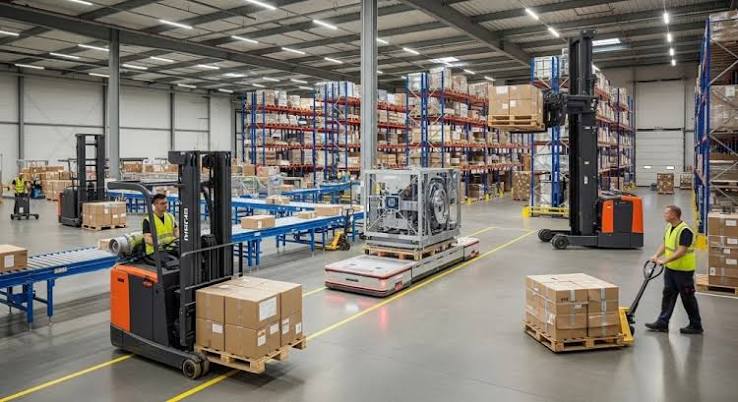
The seven types covered here are not presented in order of importance or complexity. They are organized to reflect how goods typically move through a distribution environment — from receipt and storage, through picking and sorting, to dispatch.
1. Automated Storage and Retrieval Systems
Automated storage and retrieval systems, commonly referred to as AS/RS, manage the storage and retrieval of goods within a defined physical structure. These systems use mechanical carriers — shuttles, cranes, or robotic units — to place items into designated storage locations and retrieve them on demand without direct human involvement in the movement itself.
Where They Create Operational Value
AS/RS systems are particularly effective in facilities where storage density is a constraint. By building vertically and reducing the aisle space required for human-operated equipment, these systems allow a facility to hold significantly more inventory within the same footprint. They also reduce the time between a pick request and the availability of the item at a workstation, which matters when throughput targets are tight. The reliability of AS/RS is high when they are properly maintained, but they are also systems with real single-point failure risks — a mechanical fault in a crane or shuttle can take an aisle or zone offline, which is why redundancy planning is part of any serious implementation.
2. Conveyor Systems
Conveyor systems are one of the oldest forms of automated movement in warehousing, but their role in modern distribution is more integrated than it was historically. They form the connective layer between stations — moving totes, cartons, or pallets from one point in the facility to another without manual transport between steps.
The Role of Flow Design in Conveyor Performance
A conveyor system is only as effective as the process design around it. Poor flow design — bottlenecks at merge points, inadequate accumulation zones, mismatched line speeds — creates backup and increases the rate of product damage or jam events. Conveyors require ongoing attention to maintenance schedules because wear in belts, rollers, and diverters can cause inconsistency at high volume. When they are designed correctly and maintained consistently, they reduce the physical labor associated with moving product between stations and create a more predictable cadence across the operation.
3. Autonomous Mobile Robots
Autonomous mobile robots, or AMRs, navigate warehouse floors independently using onboard sensors, cameras, and mapping software. Unlike fixed conveyor systems or guided vehicles that follow set paths, AMRs determine their own routes in real time based on current conditions in the facility.
Flexibility as a Defining Characteristic
The primary operational advantage of AMRs is their adaptability. Because they do not require physical infrastructure changes — no tracks, no floor markings, no fixed guides — they can be redeployed to different zones or workflows without significant downtime or cost. This makes them well suited to facilities with variable product mixes or seasonal shifts in demand patterns. Their limitation is that they operate at a pace appropriate for their sensing environment, which means they are not the right solution where very high-speed movement is required. They work best as a flexible complement to a fixed automation backbone rather than as a standalone solution for high-velocity operations.
4. Automated Guided Vehicles
Automated guided vehicles, or AGVs, move along predetermined paths using physical guides, magnetic strips, or laser navigation. They are typically used for heavier loads — moving pallets between receiving docks, storage areas, and staging zones — where the consistency of the route is more important than flexibility.
Predictability Over Adaptability
AGVs are built for repetitive, high-volume movement along established routes. Their value comes from consistency and load capacity, not from the ability to reroute around obstacles. In facilities with stable, high-volume pallet flows — such as those moving full pallet quantities between a receiving dock and a bulk storage zone — AGVs reduce the need for forklift operators on routine routes and lower the associated safety risk. They require route planning discipline and do not perform well when their operating environment changes frequently, which limits their applicability in more dynamic picking environments.
5. Sortation Systems
Sortation systems identify individual items or cartons and redirect them to designated lanes, chutes, or destinations based on information read at a scan point. They are the core technology behind high-volume outbound operations where orders need to be separated by route, carrier, or delivery zone.
Throughput and Accuracy at Scale
The primary reason sortation systems exist is that manual sorting at high volume is both slow and error-prone. As order volumes increase, the probability of a mis-sort in a manual process rises in proportion. Sortation systems, when integrated with a warehouse management system, read and route product based on real-time order data, which reduces mis-sorts and speeds the time from pick to dispatch. The MHI industry standards body provides detailed classification of sortation technologies by speed, product type, and application context, which is useful when evaluating system fit for a specific volume profile.
6. Robotic Picking Systems
Robotic picking systems use articulated arms or end-of-arm tools to select individual items from storage locations or totes and place them into order containers. They address one of the most labor-intensive tasks in a distribution center — the act of physically retrieving a specific unit from a storage location and placing it accurately into an outbound tote or carton.
Where Robotic Picking Is and Is Not Ready
Robotic picking has advanced considerably, but it remains most reliable when applied to defined product sets — items with consistent dimensions, packaging, and surface characteristics. Mixed-SKU environments with wide variation in product shape, weight, and packaging material remain challenging for current robotic picking platforms. The technology is improving, but facilities should evaluate robotic picking based on the characteristics of their actual product set, not on general capability claims. For facilities with a manageable product range and high pick volume per SKU, robotic picking can significantly reduce labor dependency and improve pick consistency across shifts.
7. Warehouse Management System Integration
A warehouse management system, or WMS, is not a physical automation system, but it is the operational layer that makes all other automation function cohesively. Without software that directs, monitors, and adjusts the behavior of automated systems in real time, individual automation components operate in isolation rather than as part of a coordinated workflow.
Automation Without Integration Produces Partial Results
A common failure in distribution center automation is implementing physical systems — conveyors, AMRs, sortation — without the software layer required to connect them. When systems cannot communicate, operators lose visibility into where inventory is, what state orders are in, and whether individual components are performing within expected parameters. A well-integrated WMS tracks inventory location and status, directs labor and automated systems toward the same priorities, provides data to identify where bottlenecks are forming, and creates the audit trail that supports both accuracy and accountability. Material handling automation that operates without strong WMS integration rarely delivers the consistency and throughput gains that justified the initial investment.
Bringing It Together: Making Sense of the Automation Map
Distribution centers rarely implement all seven types of automation at once, and most do not need to. The appropriate combination depends on volume, product characteristics, facility layout, and the specific points in the workflow where inconsistency or cost is creating the most operational pressure.
What matters most before any investment is made is having a clear picture of what problem is actually being solved. Automation that addresses a real operational constraint — a genuine bottleneck, a labor dependency that creates risk, a volume ceiling that cannot be cleared manually — tends to deliver durable value. Automation implemented to modernize in the abstract often underperforms because the workflow design around it was not built to take advantage of what the system can do.
The seven categories described here are not competing options. They are distinct tools, each suited to a specific part of the material flow. Understanding what each one does, where it fits, and what it requires to function properly is the foundation for any distribution center that is serious about building an operation that can scale reliably and perform consistently under real operational conditions.