
Piçada and picada look almost the same, but they do not always mean the same thing. This causes confusion because online searches can lead to Brazilian food claims, Spanish-speaking food traditions, meat dishes, or even dictionary meanings that have nothing to do with cooking.
This article explains what Piçada means, how it differs from picada, and how the word picada is used in Argentina, Uruguay, Catalonia, Mexico, and Colombia. It also explains related terms such as carne picada and Brazilian picadinho.
What Does Piçada Mean?
Piçada is a Portuguese word written with the letter ç. Standard Portuguese dictionaries recognize the word, but the documented meanings are mainly informal or slang uses. These dictionary definitions do not clearly describe Piçada as a traditional Brazilian food.
This matters because some websites use Piçada as the name of a Brazilian dish. Readers may therefore assume that it is an established culinary term. Based on the reliable information available, that interpretation is not well documented.
The similar spelling may be part of the confusion. Someone searching for Piçada could actually be looking for picada, carne picada, or the Brazilian dish picadinho. These terms are related to different languages and food traditions and should not automatically be treated as the same thing.
Is Piçada a Brazilian Dish?
Some online articles describe Piçada as a traditional Brazilian preparation with regional versions. They claim that it has Indigenous roots and originally used ingredients such as cassava flour and fresh herbs.
These sources also say that Piçada developed as Brazil changed culturally. According to those accounts, local ingredients and later European influence created different versions across the country.
However, strong culinary documentation for a nationally recognized Brazilian dish under the exact name Piçada is difficult to find. Major Portuguese dictionaries do not support this food meaning.
For that reason, claims about the history, origin, and cultural importance of Brazilian Piçada should be treated as reported information rather than confirmed fact.
This does not prove that no local preparation has ever been called Piçada. Food names can vary between families, towns, and regions. It simply means there is not enough reliable evidence to present the broad online story as established Brazilian culinary history.
Claimed Regional Variations of Piçada
One supplied source describes several supposed regional forms of Piçada across Brazil. These variations are useful to understand because they appear in online searches, but they are not well supported by independent culinary sources.
In Northern Brazil, the claimed version uses tapioca or cassava starch as a base. It is described as light and chewy and may include seafood, vegetables, and coconut milk.
The Northeastern version is said to rely more heavily on coconut milk. Some descriptions add ginger, lime, herbs, spices, shrimp, fish, or seasonal fruits.
In Southeastern Brazil, the source claims that cachaça may be added. Cachaça is a Brazilian spirit made from fermented sugarcane juice and is widely used in Brazilian drinks and some recipes. Its supposed use in Piçada, however, remains unconfirmed.
Southern versions are described as containing fruit juices such as orange, mango, guava, or passion fruit.
There is also a noticeable inconsistency in these descriptions. Some passages clearly present Piçada as a food, while others describe it almost like a chilled fruit drink. This difference makes the exact identity of the claimed dish even less clear.
Until better sources confirm these variations, they should not be presented as established regional traditions.
What Is Picada?
Picada, without the letter ç, is a much better documented culinary term. Its meaning changes depending on the country, language, and cooking tradition.
The word is related to the idea of something being chopped, cut, crushed, or pricked. In food, however, there is no single universal dish called picada.
In Argentina and Uruguay, picada usually means a shared platter of small foods. In Catalan cooking, it describes a crushed mixture used to flavor or thicken another dish. Mexico and Colombia use the term in still other ways.
This is why the country or region matters whenever someone talks about picada. The same word can refer to very different foods.
Picada in Argentina and Uruguay
In Argentina and Uruguay, a picada is commonly a platter of small foods placed in the center of the table and shared.
Typical ingredients can include cured meats, cheeses, sausages, olives, nuts, bread, pickled vegetables, pâtés, and other small snacks. The exact selection depends on the occasion and personal preference.
A picada may be served before a main meal, but it can also be large enough to serve as the meal itself. It is often connected with informal social gatherings where people eat slowly while talking.
The tradition reflects the strong European influence on food culture in Argentina and Uruguay. Spanish tapas and Italian antipasto are often compared with the Rioplatense picada, especially because of their shared use of cured meats, cheeses, bread, and small portions.
The important point is that this type of picada is a shared assortment of foods, not the Brazilian preparation claimed under the spelling Piçada.
Picada in Catalan Cuisine
Catalan picada is completely different from the Argentine and Uruguayan version.
In Catalan cooking, picada is a crushed mixture added to another dish, often near the end of cooking. Common ingredients can include nuts, bread, garlic, herbs, and a small amount of cooking liquid.
The ingredients are traditionally crushed together until they form a paste or coarse mixture. The picada is then stirred into stews, sauces, seafood dishes, or other cooked foods.
Its purpose is not simply to add flavor. Nuts and bread can also give a sauce more body and help it become thicker.
Catalan picada therefore works more like a cooking technique or finishing mixture than a separate meal. This shows how strongly the meaning of the word changes between food cultures.
Picada in Mexico and Colombia
Mexico has its own uses of the word picada. In parts of Veracruz, a picada can refer to a thick corn tortilla with edges that are pinched while the tortilla is still warm.
It is commonly topped with ingredients such as salsa, onion, and cheese. Additional toppings can vary by recipe and location.
Colombian picada has another meaning. It is generally a large shared platter containing pieces of meat and other foods. Depending on the recipe, it can include beef, pork, sausage, chicken, potatoes, plantain, or other fried and cooked items.
The Mexican and Colombian examples make one point especially clear: picada cannot be defined correctly without knowing the regional context.
What Is Carne Picada?
Carne picada literally refers to meat that has been chopped, cut, or minced. The exact meaning depends on the country and how the term is being used.
In some contexts, carne picada simply describes the physical form of the meat. In recipes, it can also refer to a prepared dish made with small pieces of beef cooked with vegetables, seasonings, and sauce.
The collected Mexican-style recipe describes carne picada as tender braised beef that can be served with rice or used as a filling for tacos, burritos, quesadillas, and other dishes.
Carne picada should not be confused with Piçada simply because the words look similar.
Common Ingredients in Carne Picada
The collected recipe uses chuck roast cut into small cubes. Chuck works well because long, gentle cooking helps break down tougher connective tissue and makes the meat tender.
The beef is lightly coated with flour, salt, and black pepper before browning. Flour helps create a browned surface and also contributes to thickening the sauce later.
The sauce includes tomato paste, garlic, red bell pepper, onion, cilantro, cumin, Mexican oregano, and beef broth.
More sliced onion and red and green bell peppers are added during the braising process. Other vegetables such as diced tomatoes, potatoes, or carrots can also be included.
The recipe notes that chicken thighs may be substituted for beef when a different meat is preferred.
How Carne Picada Is Prepared
The beef is first cut into small cubes and coated lightly with seasoned flour. It is then browned in oil in batches.
Cooking the beef in smaller batches helps it develop color instead of steaming. The browned surface adds deeper flavor to the final dish.
While the meat cooks, the sauce ingredients are blended until smooth.
After the beef is removed from the pot, sliced peppers and onions are sautéed until they begin to soften. The sauce is then added to the same pot, which helps loosen the browned pieces left on the bottom.
The beef is returned to the sauce and cooked gently until tender. In the supplied recipe, the pot is covered for about one hour and then left uncovered for around 15 minutes so the sauce can thicken.
Other Ways to Cook Carne Picada
Carne picada can also be prepared in a pressure cooker or slow cooker.
For the pressure-cooker version described in the collected recipe, the beef and vegetables are prepared first and then cooked under high pressure for about 40 minutes. The pressure is allowed to release naturally. The sauce can then be simmered uncovered for another 15 to 20 minutes if it needs to become thicker.
For a slow cooker, the recipe suggests about two hours on high or four hours on low.
Actual cooking time can vary depending on the cut of meat, the size of the pieces, and the appliance being used. The most useful sign is tenderness. Properly braised beef should be easy to cut and should not feel tough.
How Carne Picada Is Served
Carne picada is useful because the same cooked beef can be served in several ways.
It can be placed over Mexican-style rice and served with beans. Another option is cilantro-lime rice with pico de gallo for a simple burrito bowl.
The meat can also be used as a filling for tacos, burritos, quesadillas, or sopes. For tacos, it can be served on corn tortillas with salsa, chopped onion, and cilantro.
These serving styles show why carne picada is better understood as a versatile chopped-meat preparation rather than as another name for Piçada.
What Is Brazilian Picadinho?
Brazilian picadinho is a chopped-meat dish, usually made with small pieces of beef cooked in a sauce. It is a real and well-known part of Brazilian home cooking and is much better documented than the claimed Brazilian dish called Piçada.
The name comes from the idea of meat being cut into small pieces. Recipes vary by family and region, so there is no single fixed version.
Picadinho may include beef, onion, garlic, tomato, herbs, and seasonings. Some versions are served with rice, beans, vegetables, or other common Brazilian side dishes.
Because the words look similar, someone searching for Piçada may sometimes be looking for picadinho instead.
Even so, the names should not be treated as interchangeable. Picadinho has its own identity, preparation style, and place in Brazilian cooking.
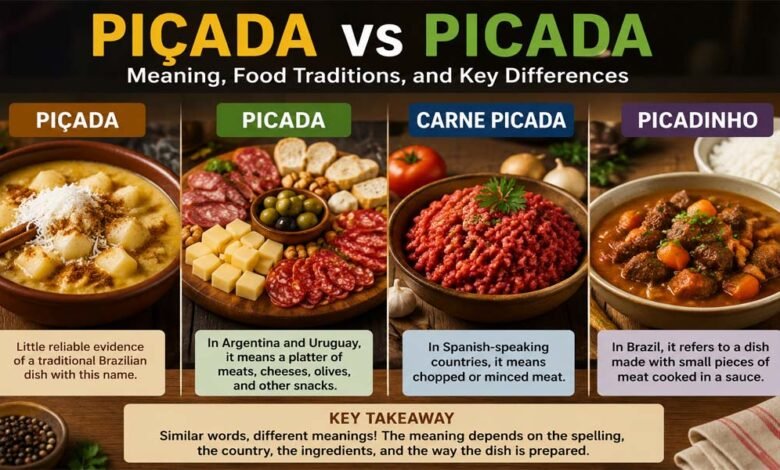
Piçada vs Picada vs Carne Picada vs Picadinho
These four terms look related, but they describe different things.
| Term | Main Meaning | Common Region or Language | Typical Form |
|---|---|---|---|
| Piçada | Portuguese word with non-food dictionary meanings; Brazilian food claims are poorly documented | Portuguese | Meaning depends on context |
| Picada | Culinary term with several regional meanings | Spain and Latin America | Platter, mixture, tortilla, or other preparation |
| Carne picada | Chopped, minced, or cut meat; also used for prepared meat dishes | Spanish-speaking regions | Small pieces of meat |
| Picadinho | Brazilian chopped-meat dish | Brazil | Saucy diced meat dish |
The biggest difference is that picada has several established culinary meanings, while the food meaning attached to Piçada is much less certain.
Carne picada is more specific because it refers to meat. Depending on the country, it may describe chopped meat as an ingredient or a finished dish.
Picadinho is Brazilian and usually refers to small pieces of meat cooked together with seasonings and sauce.
This is why spelling and regional context are important.
Why These Food Terms Are Easy to Confuse
The first reason is spelling. Piçada and picada differ by only one letter, and many people who do not speak Portuguese or Spanish may not notice the difference.
Language also plays a role. Portuguese and Spanish share many similar words, but the same-looking word does not always have the same meaning.
Regional food traditions make the issue more complicated. A picada in Argentina may be a platter of meats and cheeses, while Catalan picada is a crushed cooking mixture. In Mexico, the word may describe a tortilla-based food in some areas. In Colombia, it can refer to a shared meat platter.
Search engines can also mix these terms together because users often search with incomplete or incorrect spelling.
Another problem is online repetition. Once one article gives a term a certain meaning, other sites may repeat the same claim without checking whether it is supported by reliable culinary sources.
For readers, the safest approach is to look at the country, spelling, ingredients, and cooking method before deciding what a word means.
How to Identify Which Picada Someone Means
The easiest way to identify the meaning is to check the regional context.
If the recipe or menu is from Argentina or Uruguay, picada will often mean a shared platter with foods such as meats, cheeses, bread, olives, and snacks.
If the context is Catalan cooking, picada usually means a crushed mixture used to add flavor and body to another dish.
If the food is from Veracruz in Mexico, a picada may refer to a thick corn tortilla with pinched edges and toppings.
In Colombia, the word can describe a large platter with chopped or fried meats and other foods.
If the phrase is carne picada, look at how the meat is being used. It may simply mean chopped or minced meat, or it may describe a prepared beef dish.
If the context is Brazil and the food is chopped beef cooked in sauce, picadinho may be the more accurate term.
Checking the ingredients usually makes the meaning clear.
Bottom Line
Piçada and picada may look almost identical, but they should not be treated as the same culinary term.
The strongest evidence shows that picada has several real food meanings depending on the country. It may describe a shared platter in Argentina and Uruguay, a crushed cooking mixture in Catalonia, a tortilla-based food in parts of Mexico, or a meat platter in Colombia.
Carne picada refers more directly to chopped or minced meat, while Brazilian picadinho is a separate chopped-meat dish.
Claims that Piçada is a traditional Brazilian food with fixed regional versions remain poorly supported. When you see any of these terms, check the spelling, country, ingredients, and preparation method before deciding what it means.
(FAQs)
Is Piçada a traditional Brazilian food?
There is limited reliable evidence supporting Piçada, with this exact spelling, as a widely recognized traditional Brazilian dish.
Some websites describe it as a regional Brazilian food with tapioca, coconut milk, cachaça, or fruit variations. These claims are not well supported by stronger culinary references.
Are Piçada and picada the same thing?
No. They should not automatically be treated as the same word.
Piçada uses the Portuguese letter ç, while picada uses a normal c. Picada also has several documented culinary meanings in different countries.
What does picada mean in food?
It depends on the region.
In Argentina and Uruguay, it commonly means a shared platter of small foods. In Catalonia, it is a crushed mixture used in cooking. Mexico and Colombia have other local meanings.
What is an Argentine picada?
An Argentine picada is a shared platter that may include cheeses, cured meats, sausages, olives, nuts, breads, pickled foods, and other snacks.
It is often served informally among friends or family.
What is Catalan picada?
Catalan picada is a mixture made by crushing ingredients such as nuts, bread, garlic, herbs, and cooking liquid.
It is added to dishes to improve flavor, texture, and thickness.
Is carne picada the same as picada?
Not exactly.
Carne picada specifically refers to chopped, minced, or cut meat. Picada is a broader word that can describe several different foods depending on the country.
What is the difference between carne picada and picadinho?
Carne picada is a Spanish term connected with chopped or minced meat and can also refer to certain prepared meat dishes.
Picadinho is a Brazilian Portuguese term for a dish made with small pieces of meat, usually cooked in a sauce.
They can look similar on the plate, but they come from different language and culinary contexts.
Why are there so many meanings of picada?
Food words often develop different meanings in different regions.
Migration, local ingredients, language changes, and cooking traditions can all influence how one word is used. Picada is a good example because its meaning changes significantly across Spain and Latin America.
Onnilaina Guide: Meaning, Online Uses, Travel Claims, and Facts
What Does Konversky Mean? AI Platform Claims, Features, and Alternatives