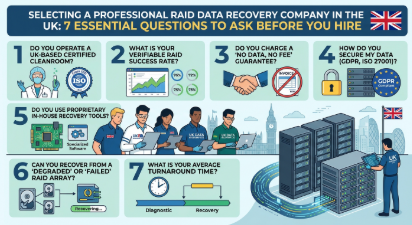
Professional RAID Data Recovery Company in the UK: 7 Questions to Ask Before You Hire

If an RAID array fails, the pressure will be instantaneous. The servers are shut down and staff is offline. The data on these disks can be worth far more than the machines themselves. Since RAID systems distribute information on various disks, recovery is much more complex than repairing a single broken drive. In permanent loss, a single wrong move can make a recoverable situation change.
That is why it is important to select the right provider. Not every lab has tools, abilities, or processes to safely rebuild a damaged array.
To get the information protected, make use of the following seven questions before undertaking an obligation to determine if a professional RAID data recovery company in the UK can really protect your data.
1. How Much RAID Experience Do You Have?
RAID Recovery is a particular skill. Arrays are on a number of levels including RAID, 0, 1, 5, 6 and 10, each of them storing data differently. Ask if the company works with your exact RAID level and configuration regularly. The lab, which deals with complicated arrays every week, will diagnose problems faster and make less mistakes than a lab that sees RAID as an ad hoc trajectory.
Also ask about hardware. NAS devices, SAN systems and servers of brands such as Dell, HP, Synology, and QNAP have peculiarities. Your platform experience is saving precious time.
2. Do You Work in a Certified Clean Room?
If one or more drives in your array have physical damage, such as failed heads or damaged platters, they must be repaired in a controlled clean-room environment. Opening a drive in an ordinary workspace exposes the platters to dust and can ruin them permanently.
A reliable provider will confirm that physical repairs will occur in a suitable clean room and will gladly explain their process. If your reply is vague, proceed.
3. How Will You Protect the Original Drives?
A failing array is fragile. Good engineers never try your original disks. Instead, they produce sector-by-sector images of each drive and do the reconstruction of these copies. This approach reduces the risk of damage and ensures that your original media is safe.
Ask the question straight away: “Will you clone the drives before attempting recovery?” The correct answer is yes.
4. Is the Evaluation Free and Is the Pricing Clear?
There are a large number of different costs, so transparency is crucial. A reputable professional RAID data recovery company in the UK needs a free or well-priced diagnosis, followed by a standing quote explaining what is included.
Watch out for very low headline prices that will grow later, or vague quotes with hidden extras. Ask what prices can change, like extra drive failures or very large capacities, so there are no surprises.
5. Do You Operate a “No Data, No Fee” Policy?
Well, the recovery is never guaranteed, but you shouldn’t be paying for failure. The “no data, no fee” policy demonstrates that the company is confident about what it can do and shares the risk with you. Make sure that you write down terms and check how “success” is defined. The aim is to recover and utilize your important files, not just a partial list of file names.
6. How Do You Keep My Data Secure and Confidential?
RAID arrays often store sensitive business information including client information, finance files, and databases. Ask about how the company protects your data from the moment it arrives to be returned or removed.
Checking for mature security technologies such as limited access to the laboratory, the signing of confidentiality agreements, media security, and a clear policy on the subsequent disposal of your data. If your organisation processes personal data, ask how the company supports your UK GDPR obligations.
7. How Fast Can You Work, and Do You Offer Emergency Service?
Each hour of rest costs money for a business. Ask about realistic turnaround times and if priority or emergency options are available. A good laboratory will explain the stages of the process, from diagnosis to imaging, reconstruction and verification, and will be able to keep you up to date on the road.
Check as well for returned data. Your files must be delivered to a new, secure device and you should have the possibility to check whether all the important things are present.
What to Do While You Decide
Whatever company you pick, protect your array in the meantime. Turn the system down when drives fail and are not restarting. Avoid rebuilding onto a degraded array, since it may overwrite data and cause further disruptions.
Do not swap or rearrange a drive, or ever run recovery software on a physically damaged drive. Note RAID level, number of disks and symptoms to facilitate a quick evaluation of your case by the lab.
Conclusion
The failed RAID array is stressful, but does not need to mean lost data. A correct specialist can diagnose the problem, repair the damaged drives, reconstruct the array and safely return your files. You can separate the real experts from risky providers by asking for experience, clean room facilities, drive imaging, pricing, guarantees, safety and speed.
Take the time to compare options, but don’t wait too long because the failed array can rapidly deteriorate. Select a professional RAID data recovery company in the UK, which is open, experienced and willing to answer each of these seven questions in a trustful manner. Your business data is worthy of nothing less.