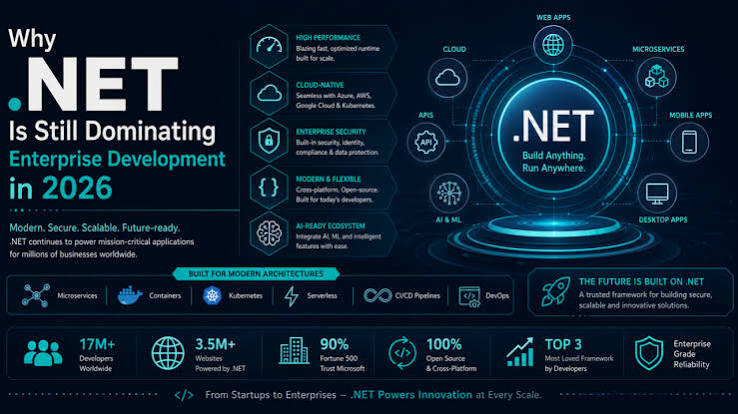

Every few years, a new framework arrives with big promises, and founders start wondering whether their tech stack is already outdated. If you are building a product meant to serve paying business customers, the question is fair: is .NET still worth betting on in 2026? The short answer is yes. Microsoft’s platform has quietly evolved into a fast, cross-platform, cloud-ready ecosystem, and that is exactly why more product companies now choose to hire dot net developers when they need a backend they can trust for years.
For startups, the stack decision is rarely about hype. It is about how quickly you can ship, how safely you can scale, and how easily you can find people who know the technology well. .NET scores strongly on all three. It runs on Windows, Linux, and macOS, deploys cleanly to containers and every major cloud, and benefits from long-term support releases that give your team a predictable upgrade path. A founder planning an enterprise-grade product can hire dot net developers knowing the foundation will not shift under them every eighteen months.
Performance is one reason the platform keeps earning its place. Modern .NET consistently ranks among the faster mainstream web frameworks in independent benchmarks, and each release brings further runtime improvements. For a product company, that translates directly into lower infrastructure bills and snappier user experiences. When you hire dot net developers who understand how to use asynchronous programming, caching, and efficient data access properly, the same hardware can serve far more customers.
Security and compliance are the other big draw. Enterprise buyers ask hard questions about authentication, data protection, and audit trails before they sign a contract. .NET ships with mature tooling for identity management, encryption, and secure configuration, and it integrates tightly with Azure Active Directory, now part of Microsoft Entra. Startups selling into banks, healthcare providers, or large corporations benefit from this maturity, because it shortens security reviews and builds buyer confidence. Founders who hire dot net developers with enterprise experience often find that procurement conversations become noticeably smoother.
What Has Changed in Modern .NET
Many people still picture the old .NET Framework, tied to Windows and heavy to deploy. That picture is out of date. Since the unification of the platform, .NET has become open source, cross-platform, and lightweight. Minimal APIs let teams stand up a service with very little boilerplate. Native support for containers, Kubernetes, and cloud-native patterns makes microservices practical. Regular annual releases, with long-term support versions in between, give teams both innovation and stability.
The language itself keeps improving. C# gets steady updates that reduce repetitive code, improve readability, and add safer handling of null values and data. Developer tooling, including Visual Studio, Visual Studio Code, and JetBrains Rider, is among the best available, which helps small teams stay productive and catch bugs early.
Why It Suits Startups and Product Companies
Startups often assume .NET is only for big corporations, but the reality is more nuanced. A well-structured .NET application can start as a simple modular monolith and evolve into distributed services as the business grows. That flexibility matters when you are not yet sure what your product will look like in two years.
The ecosystem also removes a lot of early decision fatigue. Entity Framework Core handles database access, ASP.NET Core powers web APIs, Blazor supports interactive web interfaces in C#, and .NET MAUI covers cross-platform mobile and desktop apps. Having one language and a coherent toolset across these layers reduces context switching and lets a lean team cover more ground.
Integration is another advantage. Most enterprise customers already run Microsoft technologies such as Microsoft 365, Azure, SQL Server, or Power Platform. A product built on .NET connects to these systems naturally, which makes it easier to sell and easier to deploy inside customer environments. That compatibility can be a real competitive edge when you are courting larger accounts.
AI, Cloud, and the Road Ahead
Skeptics sometimes ask whether .NET can keep up with the AI wave. The answer is increasingly yes. Microsoft has invested heavily in libraries and abstractions for working with large language models, and Azure’s AI services integrate smoothly with .NET applications. Product companies can add intelligent features such as document summarization, semantic search, and smart assistants without abandoning their existing backend.
On the cloud side, .NET is a first-class citizen on Azure, but it is equally at home on AWS and Google Cloud. Tools for observability, health checks, and distributed tracing are built into the platform, helping teams run reliable services in production. For founders, this means less custom plumbing and fewer surprises at scale.
The Talent Advantage
A technology is only as strong as the team behind it. The .NET community is large, mature, and global, with a deep pool of engineers who have built and maintained serious systems. That depth reduces hiring risk. You are far more likely to find experienced people for .NET than for a newer framework with a smaller community.
Look for candidates who go beyond syntax. Strong engineers understand clean architecture, testing, API design, performance tuning, and cloud deployment. Ask about real systems they have shipped, how they handled scale, and how they approached security. Many startups also widen their search by working with vetted remote talent networks, which can speed up hiring and open access to skilled engineers across time zones. When you hire dot net developers who combine technical depth with product thinking, they will help you make smarter trade-offs, not just write code.
A Few Cautions
No technology is right for every situation. If your team is entirely built around another ecosystem, or your product is a very small prototype with no enterprise ambitions, a different stack might feel lighter at first. Licensing and hosting costs also deserve a careful look, although the open-source runtime and generous cloud options make this far less of a barrier than it once was.
The key is to match the tool to your goals. If your roadmap involves serving business customers, integrating with enterprise systems, and scaling reliably, .NET deserves a serious place on your shortlist.
The Bottom Line
.NET in 2026 is modern, fast, secure, and backed by one of the largest developer ecosystems in the world. For startups, founders, and product companies building software that businesses will depend on, it offers a rare mix of speed, stability, and long-term support. Choose it deliberately, staff it with experienced engineers, and it can carry your product comfortably from first release to enterprise scale.