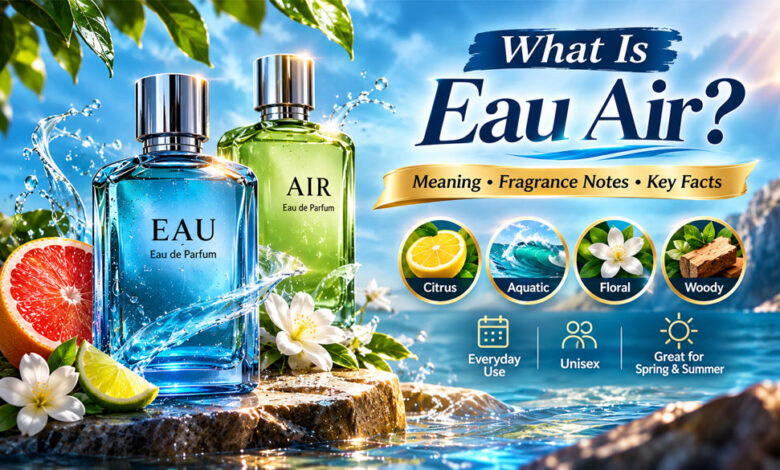

Eau Air is a term linked with fresh, light, and water-inspired perfumes. The words give the idea of water, fresh air, and clean scents.
However, Eau Air is not an official type of perfume. It is also not a standard perfume strength like Eau de Parfum or Eau de Toilette.
People searching for Eau Air may be looking for fresh perfumes, aquatic scents, or perfumes with EAU or AIR in their names. This guide explains what Eau Air means, how these fragrances smell, their common notes, and how to choose one.
What Does Eau Air Mean?
The word eau means “water” in French. Air means the air around us. Together, Eau Air gives the idea of water, freshness, and open space.
In perfume discussions, the term can be used for scents that feel fresh, clean, watery, or light. These perfumes may contain aquatic, citrus, green, floral, or musky notes.
However, Eau Air is not an official perfume category. It also does not describe one specific perfume or one fixed formula.
Its meaning depends on the context. In some cases, people may simply use the term when talking about fresh and airy perfumes. In other cases, they may be searching for perfumes with EAU or AIR in their names.
The words Eau Air also do not tell you how strong a perfume is or how long it will last. You need to check the actual product, brand, concentration, and fragrance notes for that information.
Similar words can also appear outside perfumery. For example, air and water are used together when describing some heating systems and other technologies. These uses are separate from the fragrance meaning.
What Does an Eau Air Fragrance Smell Like?
There is no single smell for Eau Air.
In general, these fragrances have a fresh and open feel. They are often different from very heavy, sweet, or spicy perfumes.
One perfume may smell like cool water or sea air. Another may have strong citrus and green notes. Some combine light flowers with clean musk and soft woods.
This means two perfumes can both feel airy while smelling very different.
Aquatic and Marine Notes
Aquatic and marine perfumes try to create the feeling of water.
They may remind you of rain, sea air, mist, a cool lake, or a coastal breeze.
Perfumers often create these smells using an accord. An accord is a mix of fragrance materials that work together to create a certain smell.
An aquatic perfume does not always contain seawater. Different fragrance materials can be mixed to create a watery or marine smell.
Aquatic perfumes can also be different from each other. Some are floral and soft. Others can smell mineral-like, fruity, salty, or strongly marine.
Ozonic and Airy Notes
Ozonic fragrances usually have a cool and open feel.
They may smell clean, bright, fresh, rain-like, or slightly metallic.
“Airy” is not the name of one perfume ingredient. It describes how the complete fragrance feels.
Perfumers can combine citrus, green notes, light flowers, musk, and other materials to create this effect.
Fresh air itself does not have one exact smell. The smell we notice outdoors may come from rain, trees, plants, soil, or seawater. Perfumes can copy some of these impressions.
Citrus and Green Notes
Citrus notes are common in fresh perfumes.
Lemon, bergamot, grapefruit, mandarin, and orange can give a perfume a bright opening. Grapefruit can smell fresh with a slightly bitter edge. Bergamot often has a softer citrus smell.
Green notes can remind people of leaves, grass, herbs, and plants.
Petitgrain and galbanum are often used for green effects. Vetiver can add a dry, grassy, or woody smell.
These notes can make a perfume feel fresh and crisp. However, not every green perfume is soft. Some can be sharp, bitter, or strongly herbal.
Floral, Musk, and Woody Notes
Flowers can also be part of a fresh perfume.
Common examples include jasmine, orange blossom, freesia, gardenia, and lily-of-the-valley accords.
These floral notes can make a citrus or aquatic perfume softer without making it too sweet.
Musk is often used later in the fragrance. White musk can create a soft and clean smell.
Light woods can add more depth. Cedar and other woody notes may give the perfume a dry or slightly warm finish.
A perfume can therefore start with fresh citrus, become floral in the middle, and finish with musk or woods.
How Fragrance Notes Develop
A perfume can change after you put it on your skin.
Perfume descriptions often divide the scent into top notes, heart notes, and base notes. These help explain how the smell changes over time.
The stages can overlap, so they should not be seen as completely separate.
Top Notes
Top notes are what you usually smell first.
Fresh perfumes often start with citrus or green notes. Lemon, grapefruit, and bergamot are common examples.
These bright smells can be strongest during the first few minutes. Some citrus notes also fade fairly quickly.
This is why you should not judge a perfume only from its first spray.
Heart Notes
Heart notes become clearer after the opening starts to fade.
They make up an important part of the perfume’s main smell. They may include flowers, fruits, herbs, spices, or aquatic notes.
For example, a perfume may smell strongly of grapefruit at first but become more floral or herbal later.
Giving the perfume some time helps you understand its real character.
Base Notes
Base notes become easier to notice later.
Musk, amber, woods, moss, and vetiver are common examples. These notes help shape the final smell of the perfume.
This later stage is often called the dry-down.
The dry-down is important when choosing a perfume. You may love the fresh opening but dislike the musky or woody smell that appears later.
The opposite can happen too. A sharp green opening may become softer and more pleasant after some time.
Fragrance Notes Are Not Always Literal Ingredients
A perfume note is not always an actual ingredient.
For example, a perfume may list “sea breeze” as a note. This does not mean seawater was added to the bottle.
Perfumers can mix different materials to create a smell that reminds people of the sea.
The same is true for terms such as “aquatic notes” and “solar notes.” These words describe a smell or feeling rather than one exact ingredient.
A fragrance note list is useful because it gives you an idea of what the perfume may smell like. However, it is not a complete list of everything inside the bottle.
This is important when shopping online. Reading the notes can help, but testing the perfume is the best way to understand how it actually smells.
Eau Air vs Eau de Parfum and Eau de Toilette
Eau Air is not the same as Eau de Parfum (EDP) or Eau de Toilette (EDT).
Eau Air describes a fresh or airy fragrance idea. Eau de Parfum and Eau de Toilette are terms linked with perfume concentration.
Here are common approximate ranges:
| Fragrance Type | Approximate Concentration |
|---|---|
| Eau de Cologne | 3–8% |
| Eau de Toilette | 5–15% |
| Eau de Parfum | 10–20% |
| Perfume Extract | 15–40% |
These are general ranges. Different perfume companies may use slightly different formulas.
An airy perfume can be an Eau de Toilette or an Eau de Parfum.
A higher concentration also does not always mean the perfume will smell heavier or sweeter. A fresh citrus perfume can still be an Eau de Parfum.
Concentration alone cannot tell you exactly how long a perfume will last either. Ingredients, formula, skin, weather, and the amount you use can all affect its performance.
EAU vs AIR by Free Yourself
Free Yourself offers two separate perfumes called EAU and AIR in its Elements Collection.
They are not one perfume called Eau Air. They are two different fragrances with different notes.
According to the available product information, both are unisex Eau de Parfums with a reported 20% fragrance concentration.
EAU Eau de Parfum
EAU opens with grapefruit, lemon, pink pepper, and bergamot.
Its heart includes petitgrain, blackcurrant, gardenia, orange blossom, and aquatic notes. Its base contains musk, amber, and white woods.
These notes give EAU a more watery and floral style. Blackcurrant adds a fruity touch, while musk and white woods help shape the later smell.
The name EAU does not mean the perfume smells only like water. It combines aquatic notes with citrus, flowers, fruit, musk, and woods.
AIR Eau de Parfum
AIR opens with grapefruit, lemon, green notes, and galbanum.
Its heart contains cardamom, ginger, vetiver, and lavender. The base includes amber, musk, solar notes, and moss.
AIR has a more citrus-green and herbal style. The amber, musk, moss, and solar notes add more depth as the perfume develops.
EAU vs AIR at a Glance
| Detail | EAU | AIR |
|---|---|---|
| Type | Eau de Parfum | Eau de Parfum |
| Reported concentration | 20% | 20% |
| Opening | Grapefruit, lemon, pink pepper, bergamot | Grapefruit, lemon, green notes, galbanum |
| Heart | Petitgrain, blackcurrant, gardenia, orange blossom, aquatic notes | Cardamom, ginger, vetiver, lavender |
| Base | Musk, amber, white woods | Amber, musk, solar notes, moss |
| Main style | Aquatic, floral, slightly fruity | Citrus-green, herbal, aromatic |
| May suit | People who like softer floral and aquatic scents | People who like greener and herbal scents |
This comparison shows why you should not choose a perfume only by its name. EAU and AIR both suggest freshness, but they have different scent profiles.
Why People Like Fresh and Airy Fragrances
Many people like fresh and airy perfumes because they can feel clean and comfortable without being too heavy.
They often use citrus, aquatic, green, floral, and musky notes. These scents can work well for everyday use when they are applied in a suitable amount.
Fresh perfumes are especially popular during spring and summer. Citrus and aquatic notes can feel pleasant in warm weather.
However, you can wear them at any time of year. Green, floral, aquatic, and light woody fragrances can also work during cooler months.
Fresh does not always mean weak. Some marine and green perfumes can be quite strong. The formula and the amount you apply make a big difference.
Who Are Eau Air-Style Fragrances For?
Eau Air-style perfumes may be a good choice for people who like fresh, clean, and lighter scents.
If you enjoy the smell of water, rain, or sea air, you may prefer aquatic fragrances.
If you enjoy bright scents, citrus notes such as lemon, grapefruit, and bergamot may suit you.
People who enjoy leaves, grass, herbs, and plants may prefer green fragrances. Light flowers and clean musk may suit someone who wants a softer smell.
These perfumes can also be useful for people who do not enjoy very sweet, spicy, or heavy fragrances.
Fresh fragrances can be worn by anyone. You do not need to choose a perfume only because it is marketed for men or women. The notes and your personal taste matter more.
How to Choose an Eau Air Fragrance
Start by thinking about what kind of fresh smell you enjoy.
For a watery or coastal smell, look for aquatic and marine notes. For something bright, look for lemon, grapefruit, bergamot, and other citrus notes.
If you prefer a plant-like smell, look for green and herbal notes. Light flowers and musk can give you a softer type of freshness.
Read the full note list before buying. The first few notes do not tell you how the perfume will smell after an hour or two.
Do not choose a perfume only because the bottle is blue or the advertising shows water, clouds, or the ocean. The packaging does not always match the actual smell.
Also think about where you will wear the perfume. A smaller amount may be better for an office, classroom, or another shared indoor space.
Test It on Paper and Skin
You can first test a perfume on a paper strip.
This can help you quickly decide whether you like the general smell.
If you like it, test the perfume on your skin when possible. The scent can change as it develops.
A perfume that smells strongly of citrus at first may later become floral, musky, woody, sweet, or herbal.
Try not to test too many perfumes at the same time. It can become difficult to notice the differences between them.
Buying a sample can also be helpful. You can wear it for a full day before deciding whether to buy a larger bottle.
Check the Full Wear
When testing a perfume, check four simple things:
- Opening: What do you smell first?
- After an hour: Do you still enjoy the scent?
- Projection: Does it stay close to your skin or spread farther?
- Later wear: Do you still like the base notes?
This can help you choose a perfume that you enjoy for more than just the first few minutes.
How Long Do Eau Air Fragrances Last?
There is no fixed lasting time for an Eau Air-style perfume.
Longevity depends on the formula, ingredients, concentration, your skin, weather, clothing, and how much perfume you apply.
A fresh perfume does not always fade quickly. Some fresh fragrances can remain noticeable for several hours.
Citrus notes may become weaker earlier, while musk, woods, amber, and other base notes may stay noticeable for longer.
You may also become used to your own perfume after wearing it for some time. This can make you think it has disappeared even when other people can still smell it.
If lasting power is important to you, test the perfume during a normal day before buying a full bottle.
How to Make a Fresh Fragrance Last Longer
Apply perfume to clean skin. Moisturized skin may help some perfumes stay noticeable for longer.
You can use an unscented lotion before applying the perfume. This avoids mixing it with another strong smell.
The neck and wrists are common places to apply fragrance. Avoid rubbing your wrists together right after spraying.
Store perfume in a cool and dry place. Keep the bottle away from direct sunlight and large temperature changes.
Do not simply use many more sprays if a perfume feels weak. Too much fragrance can become uncomfortable for people around you.
Use a smaller amount in offices, classrooms, public transport, and other shared spaces.
Are Eau Air-Style Fragrances Safe for Sensitive Skin?
A fresh smell does not mean a perfume is automatically safe for sensitive skin.
Perfumes can contain citrus, floral, botanical, synthetic, and other fragrance materials. Some people may be sensitive or allergic to certain ingredients.
Words such as “natural,” “clean,” or “hypoallergenic” do not guarantee that a product will never cause a reaction.
If you have a known fragrance allergy, check the actual ingredient list when available. The fragrance notes shown in advertising are not a full ingredient list.
Stop using a perfume if you notice redness, itching, burning, or another skin reaction.
If reactions happen often or are serious, speak with a qualified healthcare professional.
Some people can also be sensitive to strong smells without having a skin allergy. This is another reason to avoid using too much perfume in shared places.
Does Airy Mean Natural or Sustainable?
No. A fresh or airy perfume is not automatically natural or environmentally friendly.
Perfumers can create an airy smell using plant-based materials, laboratory-made aroma materials, or both.
Words such as “water,” “nature,” “green,” and “pure” may simply describe how the perfume is meant to feel.
If sustainability is important to you, check what the company actually says about its products.
Look for information about ingredient sourcing, packaging materials, recycling, and refill options.
Buying a sample before buying a full bottle can also help reduce waste if you later decide that you do not like the perfume.
Common Mistakes When Choosing an Eau Air Fragrance
One mistake is thinking Eau Air is the name of one universal perfume. It is better understood as a fresh fragrance idea unless a specific product is being discussed.
Another mistake is confusing Eau Air with Eau de Parfum or Eau de Toilette. These terms have different meanings.
Not every fresh perfume smells the same. An aquatic scent can be very different from a citrus-green perfume or a soft floral fragrance.
Do not choose only because the bottle is blue or the advertising shows the sea. Packaging does not tell you exactly what is inside.
You should also avoid judging a perfume only from its first spray. Give the heart and base notes time to appear.
Fresh does not always mean weak or short-lasting. The formula matters.
Aquatic notes also do not mean seawater is inside the perfume.
Do not assume natural-looking packaging means a perfume is sustainable. Check the company’s actual information.
Finally, avoid using too much perfume just because the scent feels light to you. Other people may notice it more strongly than you do.
Bottom Line
Eau Air is a fragrance idea linked with water, air, freshness, and light scents. It is not an official perfume concentration or one standard fragrance family.
Eau Air-style perfumes may use aquatic, ozonic, citrus, green, floral, musky, and woody notes. This means different perfumes can offer very different types of freshness.
Eau Air should also not be confused with Eau de Parfum or Eau de Toilette. These terms describe perfume concentration.
When choosing a fresh perfume, look beyond the name and packaging. Check the notes and test the perfume on your skin when possible. Give it time to develop before deciding if it is right for you.
Frequently Asked Questions
What does Eau Air mean in perfume?
Eau Air suggests water, air, and freshness. It can describe fresh, aquatic, airy, or light scents, but it is not an official perfume category.
Is Eau Air an official perfume category?
No. Eau Air is not a standard perfume family or concentration. Its meaning depends on how the term is being used.
Is Eau Air the same as Eau de Parfum?
No. Eau Air describes a fragrance idea. Eau de Parfum is a term used for perfume concentration.
What is the difference between EAU and AIR perfume?
Free Yourself’s EAU and AIR are two separate perfumes. EAU has more aquatic and floral notes, while AIR has more citrus, green, herbal, and aromatic notes.
What does an airy perfume smell like?
An airy perfume may smell aquatic, citrusy, green, floral, musky, or ozonic. There is no single smell for every airy fragrance.
Are Eau Air fragrances for men or women?
Anyone can wear fresh and airy fragrances. Your personal taste and the fragrance notes are more important than gender labels.
Do fresh and airy perfumes last all day?
It depends on the perfume. Its formula, concentration, ingredients, your skin, weather, and the amount you apply can all affect how long it lasts.
Are Eau Air-style fragrances good for summer?
Yes, citrus, aquatic, and green perfumes are popular during warm weather. However, fresh fragrances can also be worn during other seasons.
Corporate Software Inspector Guide: Features, Benefits, Patching, and Security
Dashboard Anywhere Guide: Login, Features, Benefits, and Security