
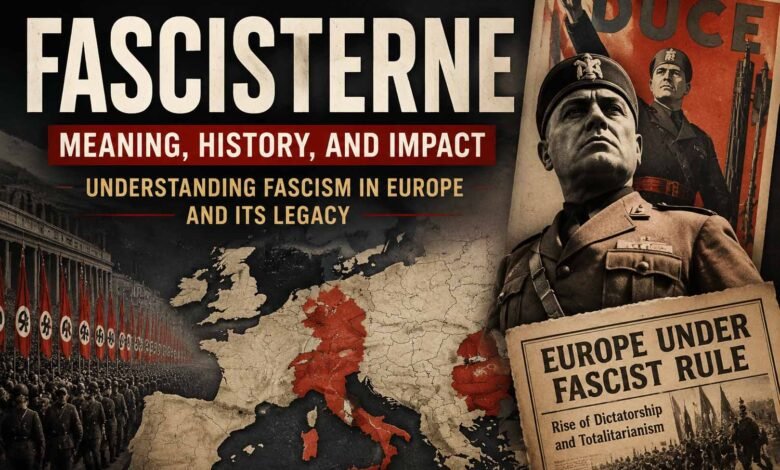
Fascisterne: Meaning, Key Characteristics, and Role in European History

Fascisterne is a Danish word that means “the fascists.” People often search for this term to understand its meaning, its connection to fascism, and its role in European history, especially during World War II. The word is also used in modern political discussions, which can sometimes cause confusion.
This article explains what Fascisterne means, where the term comes from, how fascist ideology developed, its main characteristics, and why the word remains important today. It also looks at Denmark’s historical connection to Fascisterne and the lasting impact of fascism in Europe.
What Does Fascisterne Mean?
Fascisterne is the definite plural form of the Danish word fascist. In English, it translates to “the fascists.” Unlike the general word “fascists,” Fascisterne usually refers to a specific group of people identified by their support for fascist beliefs or movements.
The word comes from the Danish term fascisme, meaning fascism. Fascism is a political ideology that places the nation and the state above individual interests. It supports strong centralized leadership and gives the government broad authority over political and social life.
In historical writing, Fascisterne commonly refers to fascist movements or governments that existed in Europe during the early and mid-20th century. In Denmark, the word often has a more specific historical meaning because it became closely associated with the German occupation during World War II and those who supported it.
Today, the word also appears in political debates and media discussions. Sometimes it is used accurately to describe movements that share important characteristics with historical fascism. In other cases, it is used more loosely as a political insult. Because of this, the meaning often depends on the context in which the word is used.
The Origins of Fascism in Europe
Fascism developed in Italy after the end of World War I. Many European countries were facing economic hardship, political instability, unemployment, and social unrest. Large numbers of people had lost confidence in existing governments and wanted stronger leadership.
Benito Mussolini took advantage of this situation by founding the Fasci di Combattimento in 1919. The movement attracted war veterans, nationalists, and people who believed Italy needed a more powerful government. In 1922, Mussolini became Prime Minister, making Italy the first country governed by an openly fascist regime.
The movement quickly influenced other countries. During the 1920s and 1930s, similar political groups appeared across Europe. Although each movement reflected local political conditions, many shared similar beliefs, including strong nationalism, opposition to liberal democracy, anti-communism, and support for authoritarian leadership.
Germany became the most well-known example after Adolf Hitler and the National Socialist Party came to power. Smaller fascist movements also appeared in countries such as Spain, Hungary, Romania, and Denmark.
The spread of fascism was driven by a combination of economic problems, political uncertainty, national pride, and fear of social change. These conditions helped extremist political movements gain support in several parts of Europe before World War II.
Key Characteristics of Fascist Ideology
Fascist movements differed from country to country, but they generally shared several core beliefs and political goals. Understanding these characteristics helps explain why historians classify certain governments and movements as fascist.
One of the most important features was extreme nationalism. Fascist governments promoted the idea that the nation should always come before the individual. National unity was treated as the highest goal, and citizens were expected to place the interests of the country above their own.
Another defining characteristic was authoritarian leadership. Fascist systems concentrated political power in a single leader or a single ruling party. Elections, when they existed, offered little genuine political competition, and governments faced very few limits on their authority.
Many fascist governments also developed into totalitarian states. They attempted to control not only politics but also education, culture, the media, and many parts of everyday life. Individual freedoms were often restricted in the name of protecting the nation.
Propaganda played a major role in maintaining public support. Governments used newspapers, radio broadcasts, speeches, posters, public events, and national symbols to shape public opinion and encourage loyalty to the state.
Another common feature was the suppression of opposition. Political rivals, journalists, activists, and critics often faced censorship, imprisonment, intimidation, or violence. Independent organizations and political parties were frequently banned.
Many fascist movements also promoted ideas based on racial or ethnic superiority. Minority groups were often blamed for national problems and became targets of discrimination or persecution. This process, sometimes called scapegoating, helped governments justify harsh policies against groups they considered outsiders.
Finally, fascism often emphasized militarism. Military strength, discipline, and national expansion were presented as signs of national greatness. Armed forces and military values became an important part of public life in several fascist states.
Important Figures Who Shaped Fascism
Several political leaders and thinkers played major roles in developing fascist ideology and spreading it across Europe.
Benito Mussolini is widely regarded as the founder of modern fascism. His leadership in Italy established many of the political ideas and governing methods that later influenced other fascist movements. He promoted nationalism, centralized authority, and the belief that a strong state should guide every part of society.
Adolf Hitler adopted many of these ideas after coming to power in Germany. His Nazi government combined fascist principles with racial ideology and antisemitism. Although Nazism is considered a specific form of fascism rather than the same ideology in every respect, Hitler’s regime became one of the most influential and destructive examples of fascist rule.
Italian philosopher Giovanni Gentile also helped shape fascist thought. He argued that the state should stand above individual interests and provided much of the intellectual foundation for Mussolini’s political system.
Together, these figures helped shape fascism into one of the most influential political ideologies of the twentieth century. Their ideas affected not only Italy and Germany but also inspired smaller fascist movements in several other European countries.
Fascisterne in Denmark
The word Fascisterne has a particularly important meaning in Denmark because of the country’s experience during World War II. While Denmark never established a fascist government like Italy or Nazi Germany, it did have its own fascist political movement.
The best-known Danish fascist party was Danmarks Nationalsocialistiske Arbejderparti (DNSAP). The party was led by Frits Clausen and was inspired by Adolf Hitler’s National Socialist movement in Germany. Although DNSAP attracted some supporters, it never gained enough public support to take control of the Danish government through elections.
Germany invaded Denmark on 9 April 1940. The country remained under German occupation until 5 May 1945. During these years, the meaning of Fascisterne became much more personal for many Danes. The word was often used to describe the German occupation forces, Danish collaborators, and others who supported the occupation.
At the same time, many Danes joined resistance groups. These groups carried out sabotage, gathered intelligence, published illegal newspapers, and helped people escape from German control. One of the best-known events took place in October 1943, when Danish resistance members and ordinary citizens helped most of Denmark’s Jewish population escape to neutral Sweden. This rescue remains one of the most significant humanitarian efforts of the Second World War.
After Germany’s defeat in 1945, Denmark prosecuted many collaborators, and the influence of fascist organizations declined rapidly. Today, Fascisterne remains closely connected with this period of Danish history.
Fascism Compared With Other Authoritarian Ideologies
Fascism shares some features with other authoritarian systems, but it also has important differences.
Communism and fascism both allow the government to hold significant power, but they are built on different ideas. Communism focuses on economic equality and collective ownership of property. Fascism focuses on national unity, strong leadership, and loyalty to the nation above individual rights.
Fascism also differs from many religious authoritarian systems. Religious governments often base their authority on religious beliefs or laws, while fascist governments place the state and national identity at the center of political life.
Another point that often causes confusion is the relationship between fascism and Nazism. The two are closely related but are not exactly the same. Nazism refers specifically to the ideology of Adolf Hitler and the National Socialist Party in Germany. It included many fascist principles while placing a stronger emphasis on racial ideology and antisemitism. In simple terms, Nazism is generally considered a specific form of fascism rather than a separate political system.
The Impact and Legacy of Fascist Regimes
Fascist governments had a lasting impact on Europe and the wider world. Their policies changed politics, society, and international relations for many years.
Politically, fascist regimes weakened or eliminated democratic institutions. Political opposition was restricted, independent newspapers were censored, and governments concentrated power in the hands of a single leader or ruling party.
Many fascist governments also increased state control over important industries and public institutions. Their economic policies differed from country to country, but they generally placed national goals above individual interests.
The human cost was far greater than political or economic change. Millions of people suffered because of war, persecution, forced displacement, imprisonment, and violence carried out by fascist and Nazi governments during the Second World War.
After 1945, the defeat of the Axis powers led to major political changes across Europe. Fascist governments collapsed, many collaborators faced legal action, and fascist political organizations were dismantled.
The legacy of this period continues today. Schools, museums, memorials, and historical research help preserve the memory of these events. Many countries also strengthened democratic institutions and human rights protections in response to the lessons learned from fascist rule.
Why Fascisterne Still Matters Today
Although the historical fascist governments ended decades ago, the word Fascisterne is still used in many discussions.
Historians use the term when writing about fascist movements, political parties, governments, and historical events from the early twentieth century. In Denmark, it is especially associated with the German occupation and those who supported fascist ideology during that time.
The word also appears in modern political debate. Some people use it to describe groups or leaders they believe display authoritarian or extremist tendencies. Others use it as a general political insult.
Because of these different uses, context is important. Most historians and political experts recommend using the term carefully and only when a person, movement, or government genuinely shares the defining characteristics of historical fascism. Using the word too loosely can reduce its historical meaning and create confusion.
Understanding Fascisterne also helps people recognize how political extremism developed in the past. Studying history encourages critical thinking and reminds societies why democratic values, human rights, and open political debate remain important.
Bottom Line
Fascisterne is the Danish word for “the fascists.” While the word itself is simple, it represents an important part of European history. It is closely connected with fascism, the rise of authoritarian governments, and the events that shaped Europe during the first half of the twentieth century.
Understanding the meaning of Fascisterne requires more than a direct translation. It also involves learning about the origins of fascism, its main beliefs, its influence across Europe, and Denmark’s experience during the German occupation.
Today, the word continues to appear in historical research and political discussions. Knowing its background helps readers understand both its historical significance and the importance of using it accurately.
(FAQs)
What does Fascisterne mean?
Fascisterne is a Danish word that means “the fascists.” It is the definite plural form of the Danish word fascist and usually refers to a specific group of fascists rather than fascists in general.
Is Fascisterne the same as Nazisterne?
No. Fascisterne is a broader term that refers to fascists in general. Nazisterne refers specifically to the Nazis, or National Socialists, who ruled Germany under Adolf Hitler. Nazism is generally considered one form of fascism.
Was there a fascist government in Denmark?
No. Denmark did not have a fascist government like Italy or Germany. However, it had a fascist political party called Danmarks Nationalsocialistiske Arbejderparti (DNSAP), led by Frits Clausen. The party never gained enough support to govern the country.
Who founded fascism?
Modern fascism was founded by Benito Mussolini in Italy. He established the Fasci di Combattimento in 1919 and became Prime Minister in 1922, leading the first fascist government.
What role did DNSAP play in Denmark?
DNSAP was Denmark’s main fascist political party during the 1930s and World War II. It supported ideas similar to those of Nazi Germany but never achieved enough electoral support to form the Danish government.
Why is it important to understand the history of Fascisterne?
Understanding Fascisterne helps explain how fascist movements developed, why they gained support in some countries, and what consequences followed. It also helps preserve historical knowledge and encourages the protection of democracy, human rights, and political freedom.
sĺ Explained: Is It a Real Word or a Character Encoding Error?
Wifekivers Explained: Meaning, Popularity, and Relationship Slang Guide





One Comment