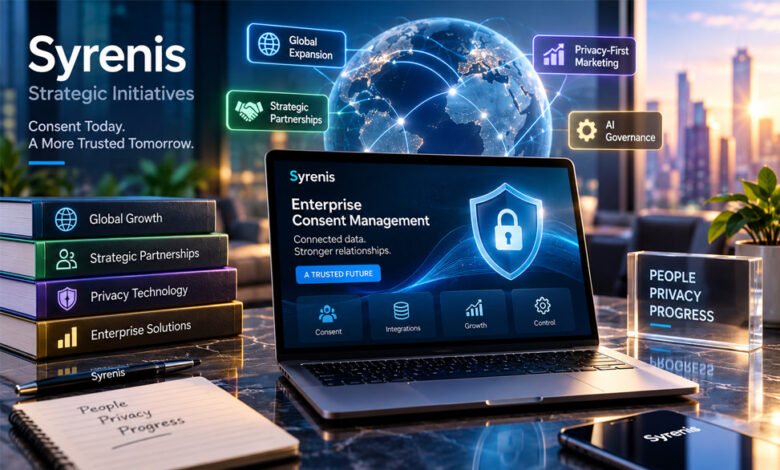

Syrenis strategic initiatives focus on improving how large companies manage customer consent, privacy choices, and preference data. The strategy also includes business growth, new partnerships, technology development, and expansion in the United States.
These initiatives are important because large companies often use many websites, apps, marketing tools, and customer databases. A privacy choice made in one place may need to be applied across all of them.
This article explains Syrenis strategic initiatives, the Cassie platform, its growth plans, enterprise strategy, and important partnerships.
What Are Syrenis Strategic Initiatives?
Syrenis strategic initiatives are the company’s plans for growing its business and developing its consent and preference management technology.
The collected information shows several main areas. These include global expansion, enterprise sales, product development, partnerships, system integrations, and better privacy experiences for customers.
The strategy is built around a simple problem. Large companies often collect customer choices through many different systems. A person may accept certain communications on a website but later change that choice through another channel.
If these systems do not communicate properly, one system may show that the person has opted in while another shows that the person has opted out. Syrenis aims to reduce this problem by keeping consent and preference information connected.
Its approach also goes beyond cookie banners. Consent can become part of a company’s wider customer data system. Legal, privacy, marketing, technology, and data teams can then work from the same information.
The wider purpose is to make privacy choices easier to record, update, follow, and prove.
Syrenis and the Cassie Platform
Cassie is Syrenis’s consent and preference management platform. It is designed for organizations that need to manage customer permissions across different systems, brands, regions, and communication channels.
Cassie can be used to collect and manage consent and preferences. For example, a customer may choose whether they want marketing emails or select the types of information they are interested in.
The important part is what happens after that choice is made. The information needs to reach the systems that use customer data. If a customer later changes or removes permission, the new choice should also be reflected in connected systems.
Cassie is designed to support this type of consent management across a large organization.
It can also keep records showing what a person agreed to and when the choice was made. Time-stamped records are useful when a company needs to check the history of a customer’s permission or show how consent was handled.
Preference management is another part of the platform. Instead of giving customers only a simple yes-or-no option, businesses can allow them to manage more detailed choices, such as preferred communication channels or topics.
This makes Cassie relevant to privacy teams as well as marketing, customer service, data, and technology teams.
Creating a Single Source of Truth
One of the main ideas behind Syrenis strategic initiatives is creating a single trusted record for consent and preferences.
Large companies may store customer information in many places. An email system may hold marketing preferences. A website may store cookie consent. A CRM may contain customer details. Other choices may come from apps, customer service teams, or other channels.
Problems can appear when these records do not match.
For example, a customer might unsubscribe from marketing through one service. If another marketing system does not receive that update, the customer could continue receiving messages.
A centralized consent record is intended to reduce this problem.
When a person makes or changes a choice, connected systems can receive the latest information. This gives different departments a more consistent view of what the customer has allowed.
A central record can also help with privacy reviews and audits. A company may need to know when permission was given, what the customer agreed to, and whether the choice later changed.
This does not remove every privacy or compliance responsibility. Companies still need suitable policies, security controls, and legal processes. However, keeping consent records together can make those responsibilities easier to manage.
Global Growth and U.S. Expansion
Global expansion is another important part of Syrenis strategic initiatives.
Syrenis works with enterprise organizations that may operate across different countries and privacy rules. These companies can have customers in many regions, so they need consent systems that can work across complex business environments.
The collected information reports Syrenis locations in Daresbury in the United Kingdom and in Austin and Atlanta in the United States.
The U.S. market is particularly important because privacy requirements can differ between states. California, for example, has major privacy laws including the California Consumer Privacy Act (CCPA) and the California Privacy Rights Act (CPRA). Other states have introduced their own privacy requirements.
This can make privacy management difficult for companies operating across the country. The same organization may need to manage millions of customers while respecting different privacy requirements.
A stronger U.S. presence can put Syrenis closer to enterprise customers and partners dealing with these issues.
The collected material also connects its U.S. activity with industries such as finance, healthcare, retail, media, and technology. These industries can manage large amounts of customer information and may have complex privacy needs.
Enterprise Sales and Growth Strategy
Enterprise privacy software is different from a simple consumer app. A large company may need many teams to review a platform before it is introduced.
Privacy and legal teams may examine compliance needs. Security and IT teams may check how the technology connects with existing systems. Marketing and data teams may consider how customer preferences will be used.
This can make enterprise software sales and implementation take time.
The collected information says Syrenis has added commercial leaders with experience in software-as-a-service (SaaS) and business growth. Its commercial focus reportedly includes international expansion, U.S. growth, stronger sales opportunities, and shorter sales cycles.
This supports the wider Syrenis strategy. Winning a large customer is only one part of the process. The platform must also work with the customer’s existing technology and privacy processes.
For this reason, enterprise growth is closely connected with Syrenis’s product, integration, and partnership plans.
Strategic Partnerships
Syrenis strategic initiatives also include partnerships with privacy and consulting organizations.
Software can manage consent records, but enterprise privacy programs often involve much more. Companies may need help with privacy policies, legal requirements, system mapping, implementation, employee training, and the design of customer privacy experiences.
Syrenis can provide the technology, while consulting partners can help businesses plan and implement wider privacy programs.
This approach is especially useful for large organizations where privacy changes may affect many departments and systems.
The Data Privacy Group
Syrenis announced an alliance with The Data Privacy Group (DPG) in August 2025.
The relationship combines Syrenis technology with DPG’s privacy consulting experience. The reported initial focus included organizations in the UK, Europe, and North America.
The two companies can play different roles in a privacy project. DPG can help organizations understand, design, and improve their privacy programs. Syrenis technology can then help put consent and preference rules into use across business systems.
This type of relationship can be useful when a company needs both technical tools and professional privacy support.
KPMG Collaboration
The collected information also describes work involving Syrenis and KPMG.
It reports that Syrenis created a dedicated KPMG resource hub following a workshop and product demonstration. The material discusses how implementation partners can help organizations get more value from consent management.
Topics connected with this work include progressive profiling and ways businesses can measure the value of their consent programs.
However, the available information should not automatically be taken to mean that every KPMG organization or service has a broad formal partnership with Syrenis. The confirmed scope should be described according to the specific collaboration and resources available.
Myna
The supplied research also reports a relationship between Syrenis and Myna, described as a U.S.-based privacy consulting firm.
The relationship is presented as another way to connect privacy strategy with practical enterprise implementation.
This fits the wider partnership approach used in Syrenis strategic initiatives: combining consent technology with specialist privacy knowledge.
Detailed information about the exact scope and terms of the Myna relationship is limited in the material collected so far. It is therefore better not to make broader claims about the partnership without stronger supporting information.
Integrations and Connected Privacy Data
Consent data is most useful when it connects with the systems a company already uses.
Large businesses may have CRM software, email platforms, analytics tools, customer service systems, and other marketing technology. These systems need access to current customer choices.
Syrenis reports that its platform supports more than 350 integrations. These can help connect consent and preference information with other business tools.
For example, a customer may change an email preference. The marketing platform needs to receive that change before sending another campaign.
Pre-built connectors can make some integrations easier. Flexible data mapping can also help companies match consent information with the way their existing systems store customer data.
Real-time syncing is important because customer choices can change at any time. The aim is to keep connected systems working from the latest available preference.
This approach can also help companies keep their existing technology. Instead of replacing every system, they can add a consent management layer that connects those systems.
The exact integrations available can change, so companies should check current compatibility with Syrenis before planning an implementation.
Cross-Domain Consent
Large organizations often run several websites. They may also own different brands, stores, portals, or online services.
This can create a poor experience if the same visitor is repeatedly asked to make the same privacy choice.
Syrenis offers Cross Domain Consent to help with this problem. Based on the information collected, the feature is designed to allow consent choices to work across approved connected domains.
For example, a company may operate several related websites. Where the setup and applicable privacy requirements allow it, a user’s existing choice may be recognized on another connected site.
This can reduce repeated consent requests and what is sometimes called consent fatigue.
However, companies still need to configure cross-domain consent correctly. Different websites, purposes, technologies, and regions may have different privacy requirements. Sharing a consent choice between domains does not remove those responsibilities.
Enterprise Scale and Performance
Enterprise consent systems may need to process very large amounts of information.
A global business can have millions of customers. Each person may have several consent records and preferences. Those choices can also change over time.
The supplied information reports that Syrenis technology has supported clients with as many as 350 million data subjects. It also reports capacity of up to 50,000 record requests per second.
These figures should be treated as reported platform claims unless confirmed through current technical documentation or other primary evidence.
Performance matters because consent changes may need to reach several systems quickly. If someone withdraws permission, delays between connected systems can create problems.
Large companies therefore need more than a visible consent form. They also need the infrastructure behind it to store, process, and share preference information reliably.
Preference Centers and Progressive Profiling
Syrenis strategic initiatives also focus on giving customers more control over their preferences.
A preference center is a place where users can manage their choices. Instead of simply subscribing or unsubscribing from everything, a person may be able to choose which types of communication they want.
Depending on how a company sets up its preference center, choices may include communication topics, channels, or other customer preferences.
Syrenis also supports progressive profiling.
Progressive profiling means collecting useful customer information gradually. A company does not need to ask a person many questions during their first interaction.
Instead, it can request relevant information over time when there is a suitable reason to ask.
This can make forms shorter and may help businesses build more useful first-party customer profiles. Customers can also have clearer control over what information they choose to provide.
Privacy-Led Marketing and First-Party Data
Marketing is another area connected with Syrenis strategic initiatives.
Companies want to understand their customers, but they also need to respect privacy choices and applicable data rules. Accurate consent and preference information can help marketing teams know how customers want to be contacted.
First-party data is information a business collects directly through its own relationship with customers. Preference centers and progressive profiling can help collect this information in a more controlled way.
For example, a customer might choose the topics they want to hear about or the communication channels they prefer. Marketing teams can use those preferences when planning messages.
This can reduce unwanted communication and make customer data more useful.
However, having a consent management platform does not automatically make every type of data processing lawful. Businesses still need to understand which legal basis and privacy requirements apply to each activity.
AI Governance and Consent Data
Artificial intelligence creates another possible use for well-managed consent information.
Organizations using data with AI need to understand where that data came from and what they are allowed to do with it. Reliable records can help answer some of these questions.
The collected information presents Syrenis consent records as a possible part of AI governance. Records can include the purpose linked to a choice, the person’s identity, timestamps, and changes to consent.
For example, an organization may need to check whether particular customer data can be used for a certain purpose. A clear history of permission can provide useful evidence when reviewing that use.
It is important to understand the limit of this role.
Consent management is only one part of AI governance. Organizations may also need data security, access controls, model testing, risk assessments, internal policies, legal reviews, and human oversight.
Syrenis can therefore provide a consent and preference layer, but it does not replace a complete AI governance program.
Benefits for Enterprise Organizations
The main possible benefits of Syrenis strategic initiatives come from keeping privacy information organized and connected.
For enterprise organizations, these benefits may include:
- One central place for consent and preference records.
- More consistent customer choices across connected systems.
- Clearer records for privacy reviews and audits.
- Better coordination between privacy, legal, marketing, technology, and data teams.
- Support for preference centers and first-party data.
- Fewer unwanted communications when preferences are correctly applied.
- Connections with existing enterprise software.
- Support for large volumes of consent information.
- Better records for some AI governance and data-use checks.
The actual benefit will depend on how the platform is configured and connected to the company’s systems. Software alone cannot fix poor data practices or an incomplete privacy program.
Challenges and Limitations
Enterprise consent management can also be difficult to implement.
One challenge is integration. Large organizations may have older software alongside newer cloud platforms. Customer information can be stored in different formats and under different identifiers.
Connecting all these systems may require planning, mapping, testing, and technical work.
Privacy rules are another challenge. An international company may operate under different requirements depending on the country, state, customer, and type of data involved. A consent platform can help manage choices, but the organization still needs to determine which rules apply.
Partnerships also require clear responsibilities. When software providers and outside consultants work on the same project, each party needs to understand its role.
Data synchronization must also be monitored. An integration is only useful if changes continue to reach the correct systems accurately.
AI creates further limits. A consent record may help show whether a person agreed to a certain use, but it cannot answer every question about AI safety, fairness, security, or governance.
Some performance and scale figures in the available material are also company or platform claims. Enterprise buyers should check current technical documentation and requirements when evaluating the service.
Future of Syrenis Strategic Initiatives
The collected information suggests that Syrenis wants consent management to become a wider part of enterprise data infrastructure.
International expansion can bring the company closer to large customers. Consulting relationships can provide additional help with privacy planning and implementation. More integrations can make consent information available across a wider technology stack.
AI governance may also create new uses for detailed consent records as companies look more closely at where their data comes from and what they are permitted to do with it.
The success of these initiatives will depend on practical factors. Syrenis needs to keep its technology scalable, easy to connect, and clear to audit. Its integrations also need to keep customer choices accurate as information moves between systems.
Privacy laws and technology will continue to change. This means consent and preference management systems will also need regular updates.
Bottom Line
Syrenis strategic initiatives combine business growth with consent and preference management technology.
The strategy includes U.S. and international expansion, enterprise sales, consulting relationships, system integrations, preference management, first-party data, and possible AI governance uses.
At the center of these initiatives is the idea of keeping customer choices in one trusted system and making those choices available to the business tools that need them.
For large organizations, this can make privacy information easier to manage across websites, marketing platforms, customer systems, and other technology. However, the platform still needs proper setup, integrations, policies, security, and legal review to work effectively.
Frequently Asked Questions
What are Syrenis strategic initiatives?
They are Syrenis’s plans for business growth, privacy technology, partnerships, integrations, and consent management.
What is Syrenis?
Syrenis is a company that helps businesses manage customer consent, privacy choices, and preferences.
What is Cassie?
Cassie is Syrenis’s platform for managing customer consent and preferences across different business systems.
What is a single source of truth for consent?
It means keeping customer consent and preferences in one trusted place so connected systems use the same information.
Does Syrenis integrate with other business systems?
Yes. Syrenis connects with CRM, marketing, analytics, and other business tools. It reportedly supports more than 350 integrations.
What is Cross Domain Consent?
It helps businesses use a customer’s consent choices across approved connected websites, reducing repeated consent requests.
How does Syrenis support first-party data?
It uses consent records, preference centers, and progressive profiling to help businesses collect information directly from customers.
Can Syrenis be used for AI governance?
Consent records can help companies understand how customer data may be used. However, other security, legal, and AI controls are also needed.
Uvlack Review: Features, Benefits, Security, and What to Know
Valplekar Explained: Meaning, History, Traditions, and Cultural Practices